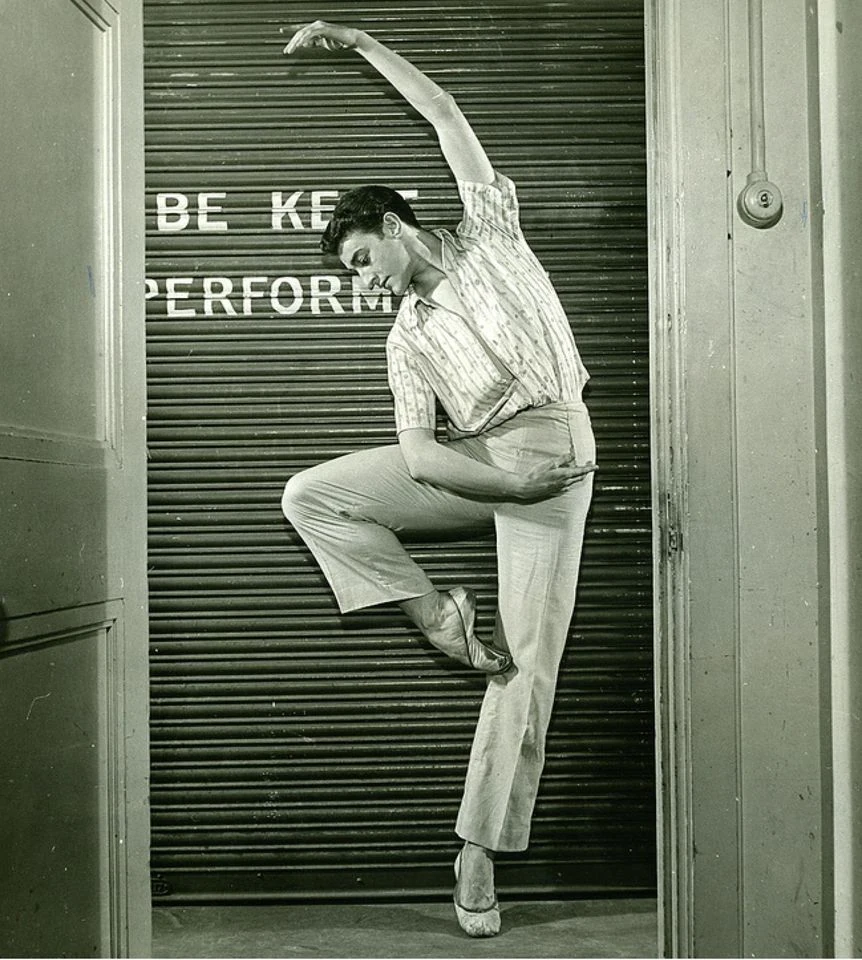
Kenneth MacMillan made ballet a place for difficult stories. His choreography brought fear, desire, violence and social constraint into the classical repertoire, asking dancers to convey inner lives as well as formal beauty. He created ten full-length ballets and more than fifty shorter works, while moving between the Royal Ballet and companies in Europe and the United States. His best-known works include Romeo and Juliet, Manon and Mayerling.
A dancer who found his direction
MacMillan was born in Dunfermline, Scotland, on 11 December 1929, the youngest of four surviving children. His father, William, worked as a labourer and sometimes as a cook; his mother was Edith, née Shreeve. The family moved to Great Yarmouth in search of work. After his mother died in 1942, MacMillan remained close to an elder sister. His childhood experience of being an outsider has been linked by his biographer to a feeling that would recur in his ballets, though it should not be treated as a simple explanation for his art.
He encountered ballet in Retford, where his school had been evacuated during the Second World War, and took lessons with Jean Thomas. He had already studied Scottish and tap dancing. With help from another teacher, Phyllis Adams, he secured a place at the Sadler’s Wells Ballet School at fifteen. His first view of the Sadler’s Wells company came at the New Theatre in London.
In 1946, while still a student, he appeared in the production of The Sleeping Beauty that reopened the Royal Opera House. Initially a non-dancing extra, he joined the newly formed Sadler’s Wells Theatre Ballet, a smaller company that also served as a training ground. He advanced quickly, taking a leading role in Frederick Ashton’s Valses nobles et sentimentales and, after other dancers were injured, stepping into a principal role in Ashton’s Les Rendezvous.
MacMillan became a member of the senior Covent Garden company and toured in Europe and the United States. But success as a performer did not settle his future. He suffered severe stage fright and disliked performing. He later described choreography as a release from dancing. His first ballet, Somnambulism, was made for the company’s Choreographers Group and performed in 1953. A year later, Laiderette introduced an outsider figure, a masked clown at a ball whose host falls in love with her before she loses the mask.
Finding a choreographic voice
With the success of Danses concertantes, set to Stravinsky and first performed in 1955, MacMillan committed himself to choreography. The work established a long collaboration with designer Nicholas Georgiadis. MacMillan drew on classical ballet while absorbing the movement and dramatic possibilities of his own generation. He worked across television, opera and musical theatre as well as ballet, and his subjects soon ranged beyond the conventional courtly or romantic tale.
The Burrow (1958), with its atmosphere of war, oppression and concealment, showed his interest in menace and psychological pressure. The Invitation, first performed at the Royal Opera House in 1960, centred on rape and provoked mixed reactions. In The Rite of Spring (1962), he cast the young Monica Mason as the chosen maiden who dances herself to death in a ritual. These works helped extend what ballet could address, though their subjects and intensity made them challenging for audiences as well as performers.
His first full-length ballet, Romeo and Juliet, premiered in 1965 to Prokofiev’s score. MacMillan made it for Lynn Seymour and Christopher Gable, but the opening-night performance was given by Margot Fonteyn and Rudolf Nureyev. The change was made for commercial reasons: their international fame was expected to draw a full house and publicity. MacMillan and his chosen dancers felt betrayed. The episode sharpened his dissatisfaction with the Royal Opera House management, even as the ballet became one of his most recognised works.
MacMillan took Song of the Earth, his setting of Mahler’s Das Lied von der Erde, to the Stuttgart Ballet after the Royal Opera House board rejected the proposal. He accepted a post leading the Deutsche Oper ballet in Berlin in 1966. The experience proved isolating: ballet had low priority, he did not speak German, and the pressure of managing a company alongside creating work affected his health. He made seven ballets for the company, including Concerto, Anastasia and Cain and Abel. Some of his most frequently revived work was created for Stuttgart and Berlin, not only for the Royal Ballet.
Leading the Royal Ballet, then returning to creation
In 1970 MacMillan returned to London as co-director of the Royal Ballet with John Field, after Frederick Ashton’s retirement. Field left within months, and MacMillan faced a company unsettled by the proposed merger of its two companies and the prospect of job losses. The managerial demands were not a comfortable fit. During his seven years as artistic director, his work divided opinion: the expanded Anastasia and Manon received both fierce criticism and praise.
Manon (1974), based on Abbé Prévost’s novel, places its heroine in a world shaped by money and desire. MacMillan’s choreography makes relationships and power visible through movement, rather than relying on spectacle alone. In the same period he created the more buoyant Elite Syncopations (1974), set to ragtime by Scott Joplin and other composers, and Requiem (1976), dedicated to the memory of his friend John Cranko. The Royal Opera House rejected the music choice for Requiem, so the ballet premiered in Stuttgart before reaching Covent Garden in 1983.
MacMillan resigned as artistic director in 1977 to concentrate on choreography, becoming the Royal Ballet’s principal choreographer. His next full-length work, Mayerling (1978), dramatised the deaths of Crown Prince Rudolf of Austria and his young mistress. Its dark subject and demanding roles typified his willingness to take ballet into unsettling territory. Later works included Different Drummer (1984), based on Büchner’s Woyzeck, and Winter Dreams (1991), inspired by Chekhov’s Three Sisters.
His work beyond the Royal Ballet remained substantial. He was associate director of American Ballet Theatre from 1984 to 1989, creating and staging works for the company, and became artistic associate of Houston Ballet in 1989. He also directed plays in Manchester and London. A serious heart attack in 1988 did not end his working life. He created The Judas Tree for the Royal Ballet in 1992 and was preparing a production of Carousel for the National Theatre when he died.
A life in dance, cut short backstage
MacMillan married Australian painter Deborah Williams in 1972; they had one daughter. He was knighted in 1983 and received honorary degrees from the University of Edinburgh and the Royal College of Art. In his later career he continued to make work for dancers from different traditions, including Darcey Bussell and Irek Mukhamedov, for whom he created Winter Dreams.
On 29 October 1992, MacMillan died of a heart attack backstage at the Royal Opera House during a performance of Mayerling. The company’s general director announced his death to the audience after the performance. The Royal Ballet’s junior company was performing Romeo and Juliet in Birmingham that same evening. Six weeks later, the National Theatre production of Carousel, on which MacMillan had nearly finished work, opened with his family and friends in the audience.
His work continued to receive recognition after his death. The Judas Tree won the Laurence Olivier Award for Best New Dance Production in 1993, and he received a posthumous Society of London Theatre Special Award that year. In 1994, he was awarded the Tony Award for Best Choreography for Carousel.
Why Kenneth MacMillan deserves a place in British Legacy
MacMillan’s place in British cultural history rests on more than his leadership of the Royal Ballet. He changed the subjects and emotional register available to British ballet, giving choreographic form to outsiders, fear, sexual violence, oppression and the pressures of social life. Works such as The Invitation, Manon and Mayerling made psychological conflict central to the stage action. Their impact depended on dancers being asked to communicate character and motive through movement, not simply to execute steps with precision. That approach widened the expressive possibilities of classical ballet and helped make it a form capable of addressing difficult human experience.
His career also reveals a British artistic institution in conversation with the wider world. MacMillan created work for companies in Stuttgart, Berlin, Houston and New York as well as for the Royal Ballet, and his ballets continue to form part of international company repertoires. He did not confine his creativity to one institution or one medium: his work extended into television, opera, musicals and spoken drama. The Royal Ballet’s history is inseparable from his years as artistic director and principal choreographer, but his importance is not limited to that position. His enduring contribution is a body of work that expanded what ballet could say, demanded a deeper dramatic engagement from performers and gave British dance a distinctive, emotionally candid voice.
Sources
Kenneth MacMillan · Kenneth MacMillan
Adapted in part from Kenneth MacMillan by Wikipedia contributors, under CC BY-SA 4.0. Text has been edited and combined with the existing article; this adapted text is shared under the same licence. Contributor history.