At Kew, botanical science and public gardens occupy the same landscape. The Royal Botanic Gardens in south-west London are known for their extensive plant collections, but the place is also a working centre for research and conservation, with historic glasshouses, royal buildings and a gallery devoted to botanical art. Kew’s story connects a garden founded in the eighteenth century with present-day efforts to conserve plant diversity.
From royal garden to botanic collection
Kew Gardens traces its origins to 1759, when Princess Augusta, the mother of King George III, established a garden described in the original account as nine acres. It grew over the centuries, shaped by royal patrons and horticulturalists. The site now covers 330 acres. Its growth has made room for collections and buildings that reflect different aspects of Kew’s history: the cultivation of plants, the study of botanical life and the public display of both.
The scale of the plant collection is one part of Kew’s identity. The account describes more than 50,000 plant species, making the gardens a place to encounter a wide range of the world’s flora. Among its glasshouses, the Temperate House is identified as the world’s largest Victorian glasshouse. It holds plants from temperate regions, including some described as threatened or extinct in their natural habitats.
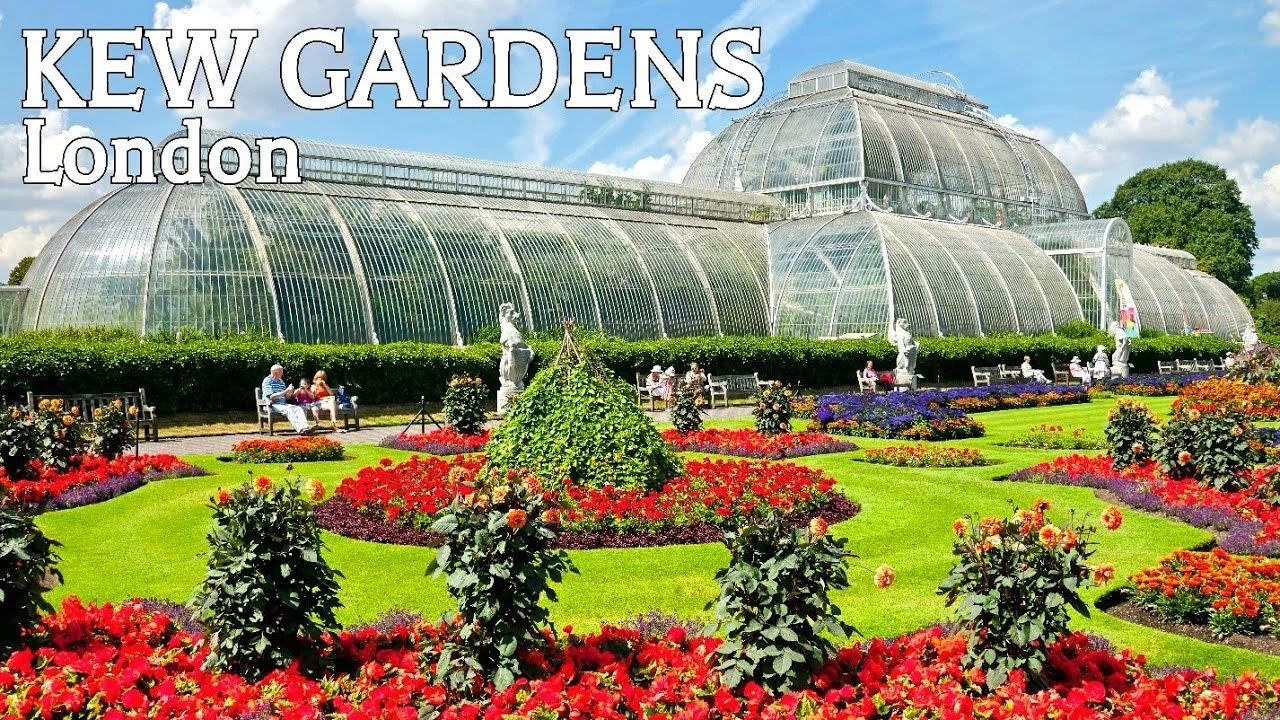
The Palm House offers a distinct example of Victorian glasshouse design. Designed by Decimus Burton and Richard Turner and completed in 1848, it is home to tropical plants. Glass and wrought iron give the building its characteristic form, while its collection makes the structure a setting for the plants it was built to house.
Research and conservation
Kew’s collections support work beyond the display of plants. The Jodrell Laboratory is described as a centre for research into plant and fungal science. That work gives the gardens a scientific role alongside their horticultural one, connecting the study of living collections and preserved specimens with questions of biodiversity, ecology and conservation.
The Millennium Seed Bank is another part of this work. The account describes it as the largest and most diverse wild plant seed bank in the world, with the aim of conserving seeds for the future and helping to restore plant populations if needed. Kew’s herbarium, meanwhile, holds seven million preserved plant specimens. Such a collection provides a resource for researchers studying plants and their distribution, and complements the living collections elsewhere in the gardens.
Kew’s conservation activity also reaches beyond London. The original account says the gardens work with more than 80 countries on global plant conservation initiatives. It also identifies educational programmes and the “State of the World’s Plants” report as ways Kew shares botanical knowledge and brings attention to environmental issues. Together, these activities give the gardens a role that extends from collecting and research to public understanding and international collaboration.
Buildings, art and public life
Kew’s historic buildings add other layers to the site. Kew Palace, described in the original account as the smallest of the British royal palaces, offers a connection with Georgian royal life. The Pagoda, a 50-metre tower built in 1762, reflects the eighteenth-century European interest in Chinese design. These landmarks sit within a botanic garden whose character is shaped as much by its architecture and history as by its plants.
The Marianne North Gallery brings art into that story. It is dedicated to the Victorian artist Marianne North, who travelled widely and painted plants. Her botanical pictures connect close observation of flora with artistic record, complementing the scientific work represented by Kew’s laboratories, herbarium and plant collections.
Education and visitors are also part of Kew’s public role. Its programmes aim to share knowledge and encourage interest in botany, while the gardens draw millions of visitors annually, according to the original account. The combination of collections, research, conservation, historic buildings and art means visitors encounter more than a conventional ornamental garden: Kew presents plants as subjects of beauty, study and practical concern.
Why Kew Gardens deserves a place in British Legacy
Kew Gardens deserves a place in British Legacy because its history and work are closely tied to Britain’s scientific, horticultural and cultural life. Founded in 1759 under Princess Augusta, it developed into a major public garden whose glasshouses and historic buildings preserve visible traces of earlier periods. The Temperate House and Palm House are not merely architectural landmarks: they provide spaces for plant collections, joining design and horticulture in a way that defines Kew’s character.
Its contribution is not confined to what visitors can see. The Jodrell Laboratory, Millennium Seed Bank and herbarium make research and conservation central to the gardens’ purpose, while international partnerships and educational programmes extend that work beyond London. The Marianne North Gallery adds an artistic record of plants to the scientific collections. Taken together, these features show how a British institution can connect public access with botanical knowledge and conservation. Kew’s legacy lies in sustaining that connection: between a historic garden and current research, between local visitors and global plant diversity, and between the pleasure of seeing plants and the work of understanding and conserving them.