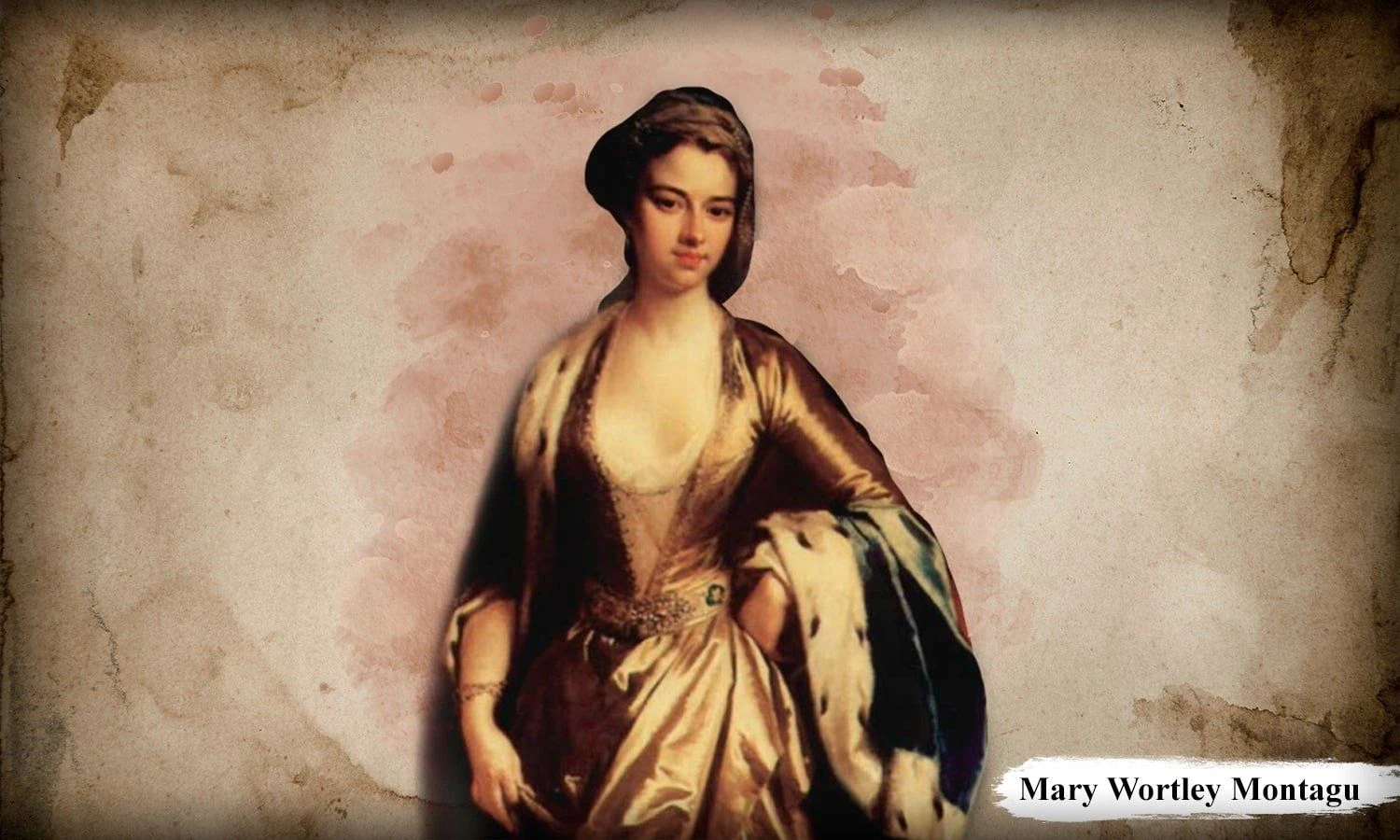
Lady Mary Wortley Montagu made two journeys across cultural boundaries. Her letters described Ottoman life to readers in Britain, challenging accounts written by men who had not entered the women’s spaces she visited. Her advocacy of smallpox inoculation, a risky practice she had seen in the Ottoman Empire, carried another kind of knowledge home. She was neither the inventor of variolation nor the originator of vaccination; her achievement was to promote inoculation in Britain and help make it a subject of public and medical discussion.
A self-made education
Born Mary Pierrepont on 15 May 1689 at Holme Pierrepont Hall in Nottinghamshire, she was the eldest child of Evelyn Pierrepont, later Duke of Kingston-upon-Hull, and his first wife, Mary Feilding. Her mother died in 1697. Mary spent part of her childhood with her paternal grandmother and later lived at her father’s house. She recalled receiving little useful instruction from her governess, so she turned to the family library, reading widely and teaching herself Latin—a language generally reserved for men in her time.
By her mid-teens she had assembled manuscript collections of poems, songs and prose, and had begun corresponding with prominent churchmen. Her education was not a conventional route into literary life: it was built through reading, writing and an evident appetite for intellectual exchange. That habit of observation and argument would shape both her poetry and the travel letters for which she later became best known.
Mary married Edward Wortley Montagu in 1712, after a period of correspondence and disagreement between him and her father over the marriage settlement. Their first child, a son, was born in 1713. In London she entered court and literary circles, meeting figures including Alexander Pope and John Gay. In December 1715 she contracted smallpox and survived, although the illness left her face disfigured. Smallpox had also killed her brother in 1713, giving her later interest in prevention a close personal context.
Letters from the Ottoman Empire
In 1716 Edward was appointed ambassador at Constantinople. Mary travelled with him, passing through Vienna and Adrianople before reaching the Ottoman capital. The couple remained there until 1718, and their daughter was born during their time abroad. Mary’s letters recorded the journey and her encounters with Ottoman society, including visits to women’s quarters and a bathhouse in Sofia. These settings gave her access to aspects of women’s lives that male travellers could not observe directly.
She used that access to question the authority of earlier travel writing. Her descriptions of dress, custom and conversation did not simply present an unfamiliar place to British readers: they tested the assumptions those readers might bring to it. She noted differences between Ottoman and European social practices and criticised travellers who wrote confidently about things they had not seen. The letters also reveal her attention to the limits and freedoms shaping women’s lives on both sides of the journey.
Her Turkish Embassy Letters were not published in her lifetime. On her return to England, she revised her travel writing but kept it from print. A copy passed to the Reverend Benjamin Sowden in Rotterdam in 1761, shortly before she died; the letters were published posthumously in 1763. The first edition sold out, though the text was not a straightforward, authorised publication of a finished book. Later editions and additions further complicated how her writing reached readers.
Montagu wrote beyond travel correspondence. Her poems and essays circulated in manuscript and appeared in print during her lifetime, sometimes anonymously or without her permission. Her poem “Epistle from Mrs Yonge to her Husband”, written in 1724, gave voice to a woman facing the consequences of a social double standard around marriage and divorce. In 1737 and 1738 she also published an anonymous political periodical supporting Robert Walpole’s government. Her literary work ranged across poetry, social observation and political comment.
Variolation: a practice brought into debate
During her Ottoman travels, Montagu encountered variolation, then used to reduce the danger of smallpox. The procedure introduced material from a smallpox blister through scratched skin. It could result in a milder case and subsequent protection, but it was not safe: recipients could develop smallpox, suffer complications or die, and could spread infection to others. This was inoculation with smallpox itself, not the later vaccination method based on cowpox.
Montagu had her son inoculated in Constantinople in March 1718, with the help of the embassy surgeon Charles Maitland. When a smallpox epidemic reached England in 1721, she arranged for her daughter to be inoculated there by Maitland and argued for the procedure despite resistance. She also helped persuade Caroline of Ansbach, Princess of Wales, to have two of her daughters inoculated in 1722. In 1721, seven prisoners awaiting execution at Newgate were offered variolation; all survived and were released. The episode did not end controversy, but it brought the procedure into public view.
Montagu’s promotion helped establish variolation as a subject of British debate, not as a risk-free cure or a method she had invented. The distinction matters. Edward Jenner’s later vaccination used cowpox and was safer; it was a different technique. Montagu died in 1762, before Jenner developed it. Her importance lies in recognising the potential of a practice she had observed abroad, testing it within her own family and using her standing and writing to advocate for it in Britain.
Exile, publication and remembrance
After returning to England, Montagu devoted much of her attention to family life, reading and writing. Her later years included a long period abroad: she left England in 1739 and lived in several European cities. She returned in January 1762 after learning of her husband’s death, and died in London on 21 August that year, aged 73. She was buried at Grosvenor Chapel.
Montagu’s travel letters, poems and essays reached readers in different ways and at different times, sometimes without her consent. The circumstances of their publication, alongside their attention to gender, cultural observation and public argument, form part of their history. Her writing survived not as a single, carefully issued collection but through manuscripts, posthumous editions and the continuing work of readers and editors.
Why Lady Mary Wortley Montagu deserves a place in British Legacy
Montagu’s British legacy rests on a specific act of exchange. She observed variolation in the Ottoman Empire, had her son inoculated there, and advocated for the practice in England when smallpox posed a grave danger. Her actions helped bring a preventive procedure into British public discussion, including through the inoculation of her daughter and the later involvement of the Princess of Wales. Variolation carried real risks, and it was not vaccination; recognising those limits makes her contribution clearer, not smaller. She helped communicate and promote an existing practice, rather than claiming its invention.
Her literary legacy is equally concrete. In letters from her travels she recorded encounters with Ottoman women and challenged the confidence of male travel writers whose accounts lacked access to those spaces. Her poems and political writing show a mind at work across forms, addressing social conventions as well as public affairs. The Turkish Embassy Letters, published after her death, gave later readers a woman’s account of travel and cultural difference at a time when such voices had fewer routes into print. Taken together, her writing and medical advocacy show how observation could become both argument and action. They connect British literary history to a wider world and place women’s knowledge within the histories of travel, medicine and public life.
Sources
Lady Mary Wortley Montagu — Wikipedia revision · Lady Mary Wortley Montagu — Wikipedia
Adapted in part from Lady Mary Wortley Montagu by Wikipedia contributors, under CC BY-SA 4.0. Text has been edited and combined with the existing article; this adapted text is shared under the same licence. Contributor history.