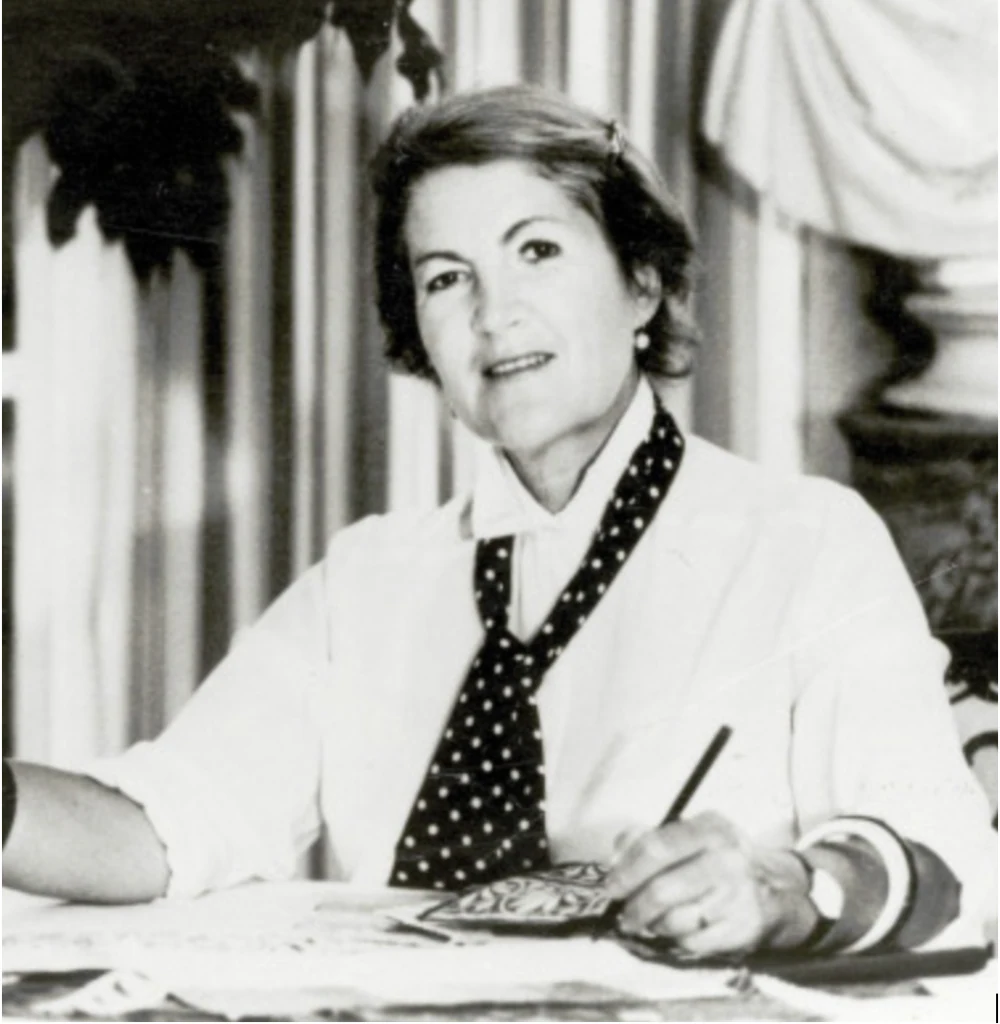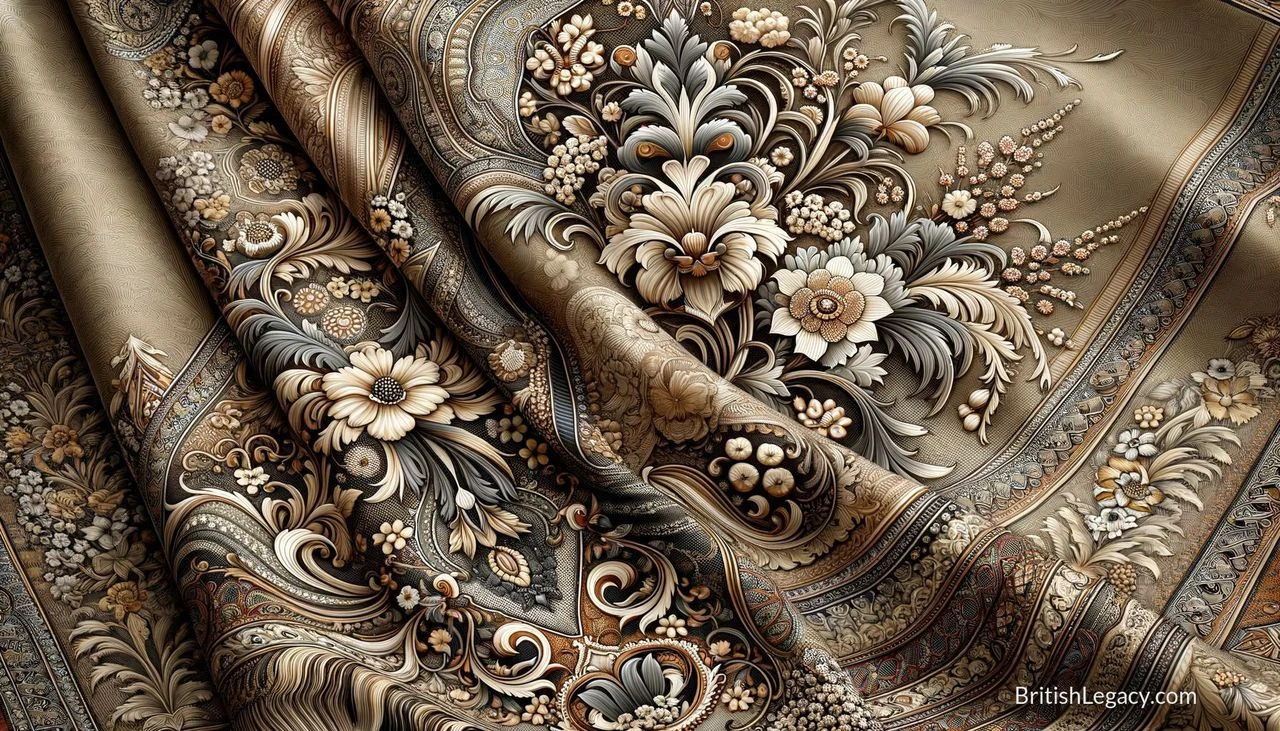
Laura Ashley’s name became synonymous with romantic prints and a particular vision of country-inspired British style. The business behind that name began much more modestly: with headscarves and household textiles designed by Ashley and printed by her husband, Bernard, in the attic of their London flat. Their early work drew on traditional craft and Victorian patterns. Over the next decades, the business expanded into clothing and grew into an international brand, while Ashley remained closely attentive to its fabrics.
From Dowlais to London
Ashley was born Laura Mountney on 7 September 1925 at her grandmother’s home in Dowlais, Merthyr Tydfil, Wales. She attended Marshall’s School in Merthyr Tydfil before moving to Elmwood School in Croydon. At 13, she was evacuated back to Wales; with no school places available, she attended Aberdare Secretarial School. She had learnt handicrafts from her grandmother, an experience that later fed into her work with textiles.
In 1942, aged 16, Ashley joined the Women’s Royal Naval Service. She met engineer Bernard Ashley at a youth club in Wallington. After the war, he was posted to India with the Gurkhas, and they kept in touch by letter. Ashley worked as a secretary for the National Federation of Women’s Institutes in London from 1945 to 1952. She and Bernard married in 1949, and she was raising their first two children as the couple began to develop their business.
Prints made in an attic
A Women’s Institute display of traditional handicrafts at the Victoria and Albert Museum helped prompt Ashley’s move into printed fabric. Looking for small pieces with Victorian designs to use in patchwork, she found that the materials she wanted were not available. She saw an opportunity to make them herself. In 1953, she began producing Victorian-style headscarves, alongside napkins, table mats and tea towels.
The venture was a partnership of complementary skills. Ashley developed the designs; Bernard, an engineer, designed a printing machine and printed the textiles in the attic of their flat at 83 Cambridge Street, Pimlico. They invested £10 in wood for a screen frame, dyes and linen. Their company was first registered as Ashley Mountney, using Laura’s maiden name. Bernard later changed it to Laura Ashley, judging that a woman’s name better suited the products.
The headscarves sold by mail order and through high-street retailers including John Lewis. Bernard left his City job to print fabrics full-time. The company moved to Kent in 1955. When their third child was born, the family moved to Wales in 1960. Ashley’s business was no longer simply an attic enterprise: it was developing the capacity to make and sell textiles at a larger scale.
From textiles to a wider business
The first Laura Ashley shop opened in Machynlleth, Montgomeryshire, in 1961. The business expanded from furnishing materials into clothing design and manufacture during the 1960s. Its style was marked by romantic designs, often with a nineteenth-century rural character, and the use of natural fabrics. Florals became especially recognisable, alongside checks and stripes. The designs connected historical and pastoral references with clothes and home products made for contemporary customers.
The brand’s development extended beyond Wales. A London shop opened in 1968, and the business went on to expand internationally, with boutiques in Europe and the United States. By the 1970s and 1980s, it had become a lifestyle name spanning fashion and home furnishings. Ashley kept a close eye on fabrics, while Bernard chaired the company. Their four children also contributed: David designed shops, Jane worked as the company photographer, and Emma and Nick joined the fashion design team.
The business’s growth did not mean that its identity depended on a single garment or print. Clothing, furnishing materials and homewares brought the same broad design sensibility into different parts of everyday life. The combination of domestic textiles and fashion helped make the label recognisable as a whole, rather than limiting it to a specialist fabric business.
Death and the company’s continuation
Shortly after her sixtieth birthday in 1985, Ashley fell down the stairs at her daughter’s home in the West Midlands. She was taken to hospital in Coventry and died ten days later of a brain haemorrhage. She was buried in the churchyard of St John the Baptist in Carno, Wales.
The company continued after her death. Two months later, Laura Ashley Holdings went public in a flotation that was 34 times oversubscribed. A memorial plaque at the family’s former home in Pimlico was unveiled in 1994. The Laura Ashley Foundation was established in 1987. Its work, initially focused on funding the arts, later broadened to include community and social-welfare projects; in 2011 it changed its name to the Ashley Family Foundation.
Why Laura Ashley deserves a place in British Legacy
Laura Ashley deserves a place in British Legacy because her career joined a particular design vision to the practical work of building a business. Her interest in traditional craft and the absence of the Victorian-patterned fabric she wanted for patchwork led her to create printed textiles. The first products were modest in scale, but the partnership with Bernard Ashley brought design and engineering together: she developed the patterns, while he made the printing equipment and produced the cloth. Their first £10 investment and attic workshop became the starting point for a company that moved into clothing and home furnishings.
Her significance is also rooted in the character of the work. Romantic, rural-inflected prints and natural fabrics gave the brand a consistent identity across different products, linking clothing to the textiles of domestic life. Its growth from Wales and London to international markets shows how a distinctive design language could travel without losing its connection to craft and place. The company’s continuation after Ashley’s death, and the foundation later established in her name and then renamed for her family, extend that story beyond the products themselves. Her legacy is not simply a familiar label: it is an example of how design, manufacturing and enterprise combined to shape a widely recognised strand of British fashion and home style.
Sources
Laura Ashley — Wikipedia revision 1359110962
Adapted in part from Laura Ashley by Wikipedia contributors, under CC BY-SA 4.0. Text has been edited and combined with the existing article; this adapted text is shared under the same licence. Contributor history.