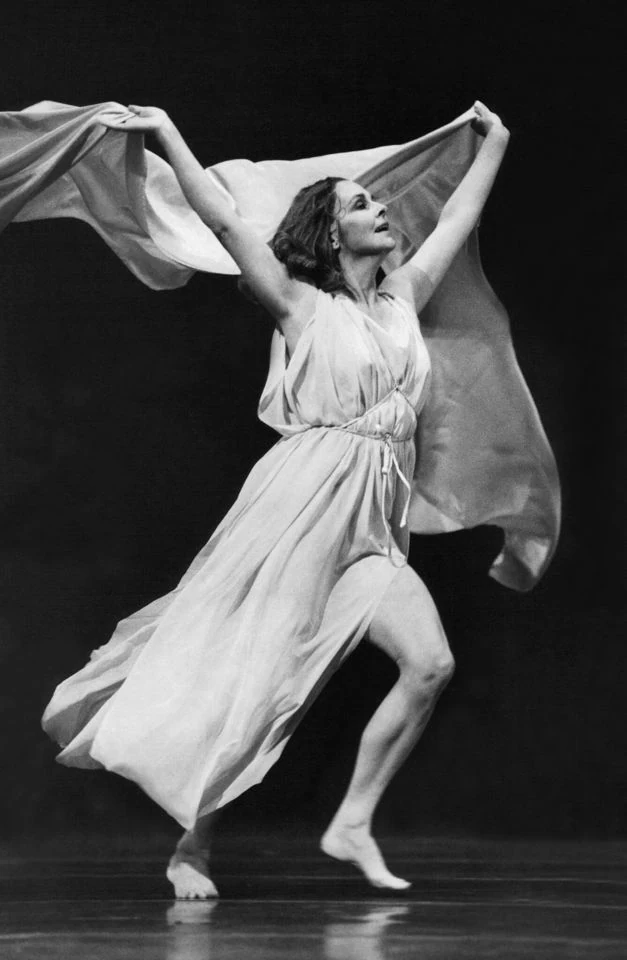
Lynn Seymour brought an unusually searching dramatic presence to ballet. At the Royal Ballet she became closely associated with choreographer Kenneth MacMillan, creating roles in works including Romeo and Juliet, Anastasia and Mayerling. Her career also took her to Berlin and Munich, into choreography and company direction, and back on stage after retirement. Born in Alberta, she made her name in British dance: her work with MacMillan and Frederick Ashton helped shape the repertory and performance culture of the Royal Ballet.
From Alberta to the Royal Ballet
Seymour was born Berta Lynn Springbett in Wainwright, Alberta, on 8 March 1939. She studied ballet in Vancouver before an audition in 1953 brought an opportunity that would take her to London. Frederick Ashton awarded her a scholarship to Sadler’s Wells Ballet School, placing her within the British ballet world while she was still a teenager.
In 1956, she joined Covent Garden Opera Ballet. The following year she moved to the Touring Royal Ballet, and in 1958 joined the company at Covent Garden. She became a principal dancer in 1959. These steps mattered: her career did not begin with an immediate appointment to the main company, but developed through training, touring and successive roles within the organisation.
Her first created role was the Adolescent in MacMillan’s The Burrow (1958), a ballet based on Anne Frank’s diary. The role brought her prominence. MacMillan went on to make parts for her that drew on her lyrical technique, unconventional style and intense dramatic force. She also worked closely with Ashton, creating the Young Girl in The Two Pigeons in 1961. Her artistic identity formed through these different choreographic relationships, not through a single partnership alone.
MacMillan’s Juliet and a changing repertory
The role that established Seymour internationally was Juliet in MacMillan’s Romeo and Juliet. The ballet was created for her in 1965, although Margot Fonteyn danced Juliet at its première. Seymour’s interpretation was rebellious and sensual as well as spontaneous; the account of her work also records her admiration for Franco Zeffirelli’s 1960 Old Vic production, in which Judi Dench played Juliet.
That role showed what made Seymour distinctive as a dance-actress. She could make a character’s emotional life legible through movement, carrying psychological tension into the physical structure of a ballet. MacMillan’s The Invitation and Le baiser de la fée were among her earlier created roles; her work with him continued to develop across different companies and periods.
From 1966 to 1969, Seymour was prima ballerina at the Berlin Opera Ballet, where MacMillan was director. She danced the first performance of his Concerto; its second movement was inspired by her physical expressiveness. In the one-act version of Anastasia in 1967, she created the turbulent role of Anna Anderson, who claimed to be the lost Grand Duchess of Russia. The role gave a contested claim to identity dramatic form without turning it into a simple portrait of certainty.
Seymour was not confined to MacMillan’s work. She guested with companies including London Festival Ballet, London Contemporary Dance Theatre, the National Ballet of Canada, Alvin Ailey American Dance Theater and American Ballet Theatre. She worked with choreographers including John Cranko, Antony Tudor, Jerome Robbins, Glen Tetley, Lar Lubovitch and Roland Petit, and was often partnered by Rudolf Nureyev. To strengthen her classical technique, she attended classes with Danish teacher Stanley Williams at the School of American Ballet.
Returning to London, making ballets
Between 1971 and 1978, Seymour returned to the Royal Ballet as a guest artist. Her roles included the title part in the three-act version of Anastasia (1971) and Mary Vetsera in MacMillan’s Mayerling (1978). Ashton created further opportunities for her: she danced his solo Five Brahms Waltzes in the Manner of Isadora Duncan in 1976 and originated Natalia Petrovna in A Month in the Country, with Anthony Dowell as Beliaev.
She began choreographing while still performing. Her first ballet, Night Ride, set to music by Michael Finnissy, was made for the Royal Ballet Choreographic Group in 1973. Her subsequent works included Gladly, Sadly, Badly, Madly for London Contemporary Dance Theatre; The Court of Love and Intimate Letters for Sadler’s Wells Royal Ballet; and Wolfie for Rambert. Bastet, set to music by Michael Berkeley, was another work for Sadler’s Wells Royal Ballet.
In 1978, she became artistic director of the Bavarian State Ballet in Munich, a post she held until 1980. She invited the young William Forsythe to join the company. Injuries and administrative problems marked her time there, and after illness she briefly returned to the Royal Ballet. She retired in 1981, subsequently coaching there on an occasional basis.
Beyond retirement
Retirement did not end Seymour’s life on stage. In 1989, at the invitation of Peter Schaufuss of English National Ballet, she returned to dance as Tatiana in Cranko’s Onegin in London. She also performed the title role in MacMillan’s Anastasia, receiving an ovation in New York. Later appearances included Gillian Lynne’s A Simple Man with Northern Ballet Theatre, Escape at Sea with Second Stride, and Matthew Bourne’s Swan Lake and Cinderella with Adventures in Motion Pictures.
She also worked in film and television. She appeared in the children’s series The Little Vampire, in Herbert Ross’s film Dancers with Mikhail Baryshnikov, and in Derek Jarman’s Wittgenstein, playing Lydia Lopokova of the Ballets Russes. Her work as a choreographer and director thus sat alongside a career that continued to move between ballet, theatre and screen.
In 2006–07, Seymour was artistic director of the Greek National Ballet in Athens. The Royal Ballet School’s Lynn Seymour Award for Expressive Dance, named in her honour, recognises expressive performance. Seymour was appointed CBE in the 1976 Birthday Honours and received the Evening Standard Drama Award in 1977. She died in London on 7 March 2023, one day before her 84th birthday.
Why Lynn Seymour deserves a place in British Legacy
Seymour’s place in British cultural history rests not simply on the prominence of her name, but on the work she helped make possible within British ballet. After training at Sadler’s Wells Ballet School, she joined the Royal Ballet and became a principal dancer. Her Juliet in MacMillan’s Romeo and Juliet was created for her, while her performances in Anastasia and Mayerling helped establish a repertory in which character and psychological tension mattered as much as classical form. Her collaborations with Ashton, including the creation of roles in The Two Pigeons and A Month in the Country, show that her contribution reached beyond one choreographer.
She also extended that contribution through making and leading work. Seymour choreographed for British companies including the Royal Ballet Choreographic Group, London Contemporary Dance Theatre, Sadler’s Wells Royal Ballet and Rambert. As artistic director in Munich and later in Athens, she took on responsibility for companies as well as individual performances. Her return to the stage after retirement demonstrated a continuing connection to the repertory and to new generations of performers, while the Royal Ballet School’s award in her name gives that connection an ongoing institutional form. Born in Canada, Seymour’s British legacy is grounded in the years of training, performance, creation and artistic leadership she gave to British institutions and audiences.
Sources
Lynn Seymour — Wikipedia revision 1330144118
Adapted in part from Lynn Seymour by Wikipedia contributors, under CC BY-SA 4.0. Text has been edited and combined with the existing article; this adapted text is shared under the same licence. Contributor history.