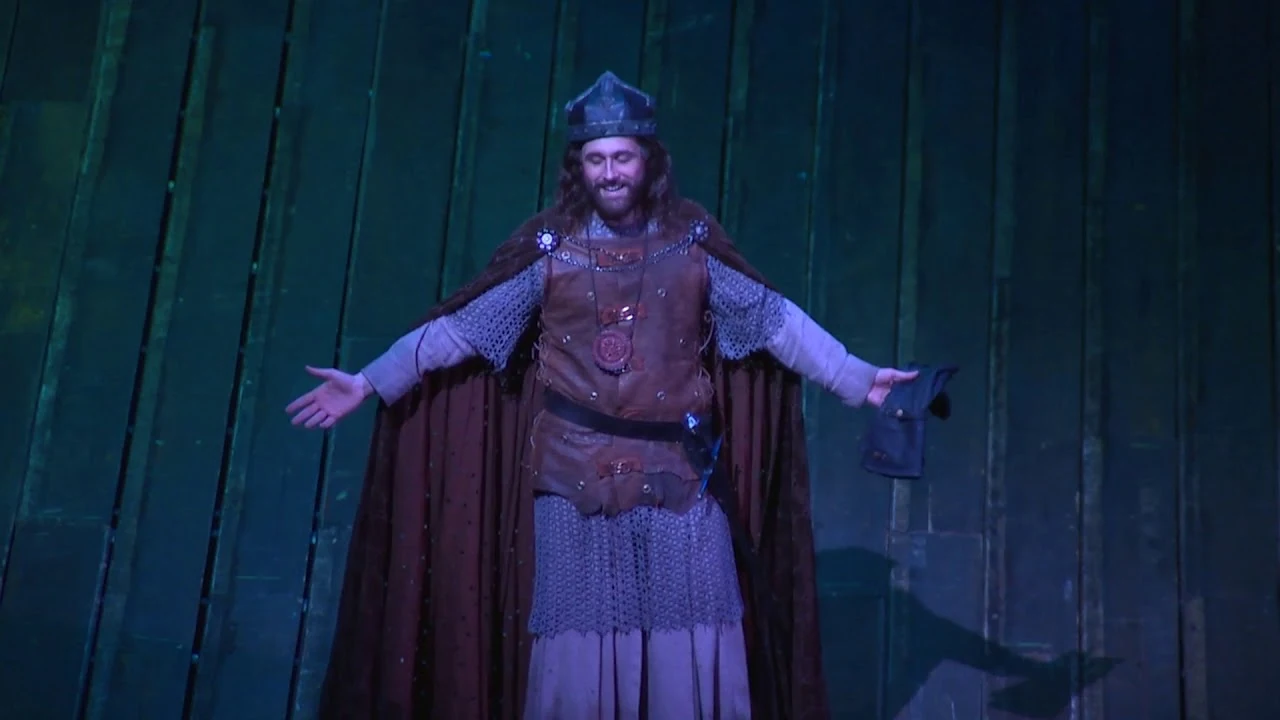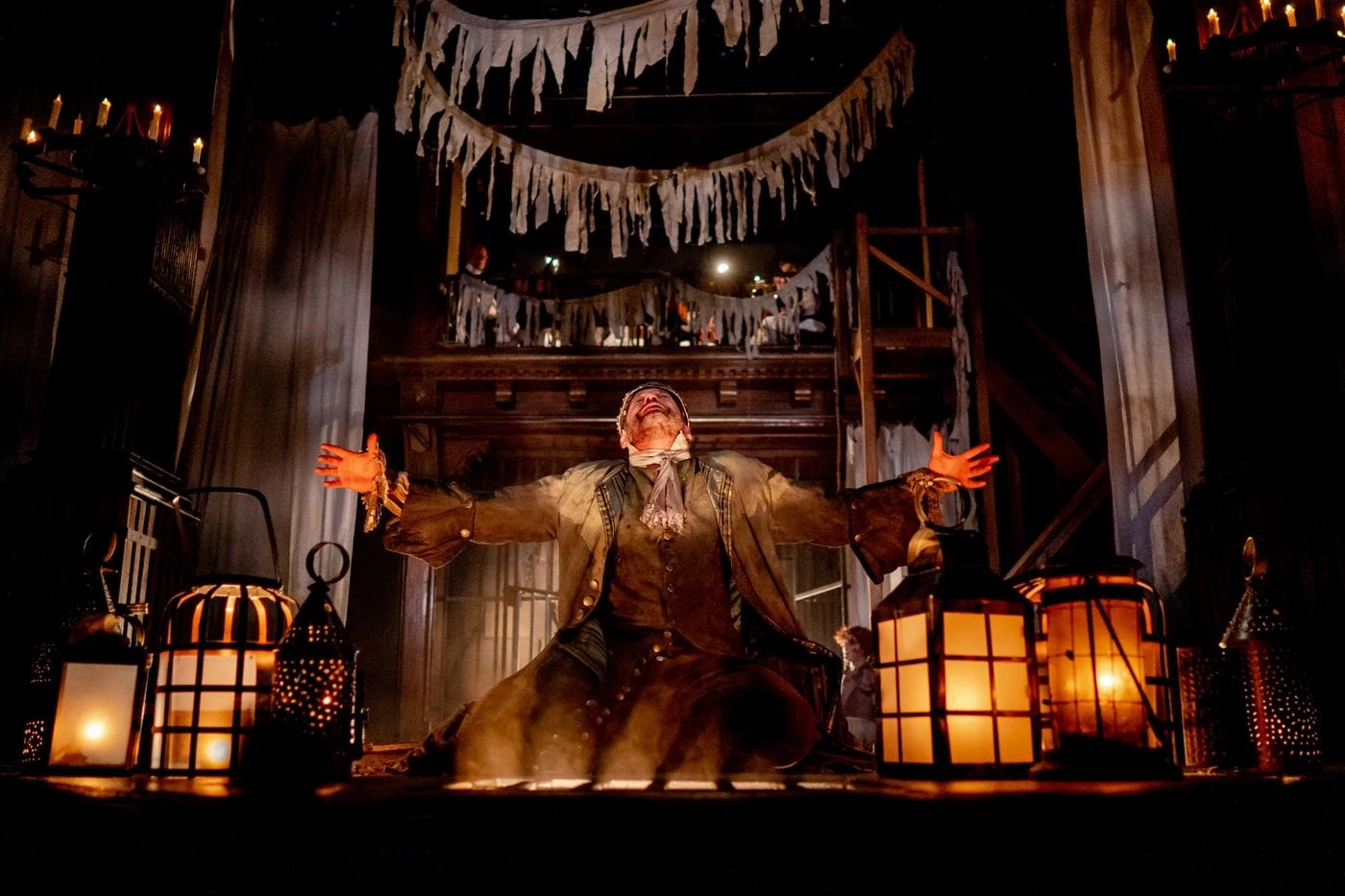
Three witches greet a victorious soldier with a promise of kingship. Macbeth’s decision to make that promise real through murder brings him the crown, but not security: suspicion drives him to further violence, while guilt and fear unsettle both him and Lady Macbeth. Shakespeare’s Macbeth turns political ambition into a private and public catastrophe. First performed, according to scholarly estimates, in 1606, it has remained a testing ground for actors and directors and a central work in the British theatrical tradition.
A play made for a new reign
Shakespeare probably wrote Macbeth in 1606, during the reign of James I. The play dramatises events in Scotland, but its subject also spoke to the political questions facing England after James’s accession in 1603: who has the right to rule, how authority is maintained and what happens when a king becomes a tyrant. The witches’ prophecies, the murder of Duncan and the eventual restoration of Malcolm make succession more than background. It is the mechanism through which the tragedy examines power.
James was the patron of Shakespeare’s acting company, the King’s Men, and scholars have identified allusions to the new monarch in the play. The witches’ vision of a line of kings is one possible compliment to James, who believed himself descended from Banquo. The play’s date and political references are matters of scholarly interpretation, rather than settled proof of a single intention. Its source story came principally from Raphael Holinshed’s Chronicles of 1587, but Shakespeare changed the historical material for the stage. In particular, his Banquo is not an accomplice to Duncan’s murder, as he is in Holinshed’s account.
The exact circumstances of the first performance are not established. The sole eyewitness account from Shakespeare’s lifetime describes a performance at the Globe on 20 April 1610. That record does not prove that the Globe hosted the premiere, or that the play was first staged there for James. The tragedy was first published in the First Folio of 1623, the only early printed source for its text.
From prophecy to tyranny
At the start, Macbeth is a respected Scottish general. After he and Banquo help defeat a rebellion, three witches greet him as Thane of Glamis, Thane of Cawdor and future king. The new title of Cawdor soon confirms part of their prophecy. Macbeth begins to imagine the crown, while Banquo hears that his descendants will rule, though he himself will not.
Lady Macbeth urges her husband to seize the opportunity. When King Duncan visits their castle at Inverness, Macbeth kills him in his sleep and takes the throne. Duncan’s sons, Malcolm and Donalbain, flee, leaving Macbeth to assume power. But the act does not settle his fears. Banquo’s prophecy troubles him, so he arranges Banquo’s murder; Banquo’s son Fleance escapes. At a royal banquet, Macbeth sees Banquo’s ghost, while his guests see only a king in apparent distress.
Seeking certainty, Macbeth returns to the witches. Their riddling assurances make him feel invulnerable, but they also sharpen his fear of Macduff. Macbeth orders the killing of Macduff’s family. In England, Macduff joins Malcolm, who gathers support to reclaim Scotland. Their forces advance on Dunsinane using branches cut from Birnam Wood as camouflage, seeming to fulfil the witches’ warning that the wood must come to Macbeth’s stronghold. Macduff reveals that he was born by Caesarean section, and so is not, in the prophecy’s ordinary sense, “of woman born”. He kills Macbeth; Malcolm is restored as king.
The play’s concentrated pace makes the damage of ambition visible in successive choices. Macbeth is not simply carried along by prophecy: he decides to act, then commits further crimes to protect the power he has taken. Lady Macbeth, initially resolute, later sleepwalks and tries to wash imagined blood from her hands. Scotland’s political disorder mirrors the couple’s unravelling, while the witches’ equivocal language makes apparent certainty dangerous.
Centuries of performance and reinvention
Macbeth has been altered as well as performed. After theatres reopened with the Restoration of the monarchy in 1660, William Davenant’s adaptation expanded the witches’ parts with songs and spectacle. That version remained influential for decades. David Garrick later advertised a return to Shakespeare’s text, though his production retained popular additions and cut substantial passages. The changing treatment of the title roles has repeatedly shifted the play’s emphasis: Sarah Siddons’s Lady Macbeth, for example, was remembered for combining terror with remorse.
In the twentieth century, modern settings and new acting approaches offered further ways to read the story. Barry Jackson’s 1923 production at Birmingham Repertory Theatre dressed the characters in modern clothes. At the Royal Shakespeare Company’s Other Place in 1976, Trevor Nunn directed Ian McKellen and Judi Dench in a spare production with a small cast. Its Macbeth and Lady Macbeth were presented not as remote monsters but as recognisable people whose relationship deteriorates under the pressure of their actions. The RSC’s 1999 production, directed by Gregory Doran and starring Antony Sher and Harriet Walter, used a modern military setting to sharpen the contrast between Duncan’s world and Macbeth’s violence.
The play has travelled well beyond the British stage, with adaptations in film, television, opera and other forms. Akira Kurosawa’s 1957 film Throne of Blood relocated the story to feudal Japan and drew on Noh drama. Giuseppe Verdi’s opera, with a libretto by Francesco Maria Piave, appeared in 1847 and was revised in French in 1865. These versions do not displace the play’s theatrical life; they show how readily its conflict between desire, authority and consequence can be recast.
Its theatrical afterlife also includes a familiar superstition: some performers avoid saying the title inside a theatre, calling it “The Scottish Play” instead. The belief is part of theatrical folklore, not evidence of a curse. On stage, however, the play’s supernatural elements remain central to its dramatic design: the witches’ words tempt Macbeth, confound his judgement and expose the danger of treating equivocal promises as guarantees.
Why Macbeth deserves a place in British Legacy
Macbeth belongs in British Legacy not simply because it is famous, but because its history connects a work of English drama to the political and cultural circumstances of Britain in the early seventeenth century. Shakespeare drew on a Scottish story and reshaped it for a theatre company under James I, whose accession joined the English and Scottish crowns in one monarch. The result is not a straightforward record of history: it is a drama that uses contested succession, kingship and rebellion to explore the costs of power. Its enduring value lies partly in that productive tension between its Jacobean setting and the questions it continues to place before audiences.
The play’s British legacy is also made in performance. From Restoration adaptations and the influential interpretations of actors such as Sarah Siddons to modern productions at Birmingham Repertory Theatre and the Royal Shakespeare Company, each generation has found new ways to stage its violence, supernatural machinery and collapsing marriage. Those productions keep Shakespeare’s text in active public life: not as a fixed monument, but as material for actors, directors and audiences to examine anew. Its influence across international theatre, cinema and opera extends that life further. The continuing conversation around Macbeth is a specific cultural achievement: a British play whose language and theatrical possibilities have travelled widely without losing the capacity to challenge the institutions and ambitions at its heart.
Sources
Adapted in part from Macbeth by Wikipedia contributors, under CC BY-SA 4.0. Text has been edited and combined with the existing article; this adapted text is shared under the same licence. Contributor history.