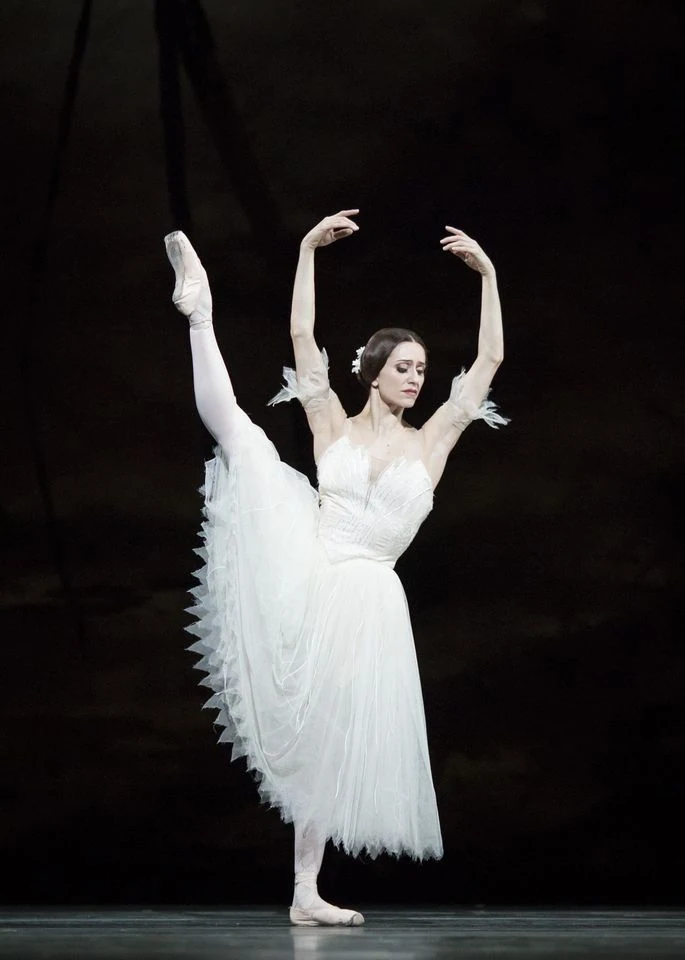
Marianela Núñez’s path to The Royal Ballet began in Buenos Aires, where she entered the Teatro Colón Ballet School at six. By 14 she had been selected to dance with the company; three years later, an audition in Los Angeles brought an offer from The Royal Ballet. She joined in 1998 and became one of its principal dancers, building a repertory that ranges from Giselle and Swan Lake to works by contemporary choreographers.
Training in Buenos Aires, a move to London
Born in Buenos Aires on 23 March 1982, Núñez began ballet classes at three. She first took lessons in her teacher’s garage and decided at five to concentrate on ballet. At six she entered the Teatro Colón Ballet School, beginning a course of training that led early to professional performance.
At 14, while still halfway through her training, Núñez was chosen by the company’s lead, Maximiliano Guerra, to dance with him. The Colón company selected her to join its ranks, and she performed with it in Buenos Aires and on tour. In 1997, aged 15, she auditioned for The Royal Ballet while the company was in Los Angeles. She was offered a contract, but could not work in the UK until she was 16. Instead, she attended The Royal Ballet School, with a contract to follow the next year.
Núñez joined The Royal Ballet in 1998. She became a First Soloist in 2000 and a principal dancer in 2002. In 2001 she stepped into the role of Kitri in Don Quixote, replacing the injured Leanne Benjamin and dancing opposite Carlos Acosta as Basilio. The role marked an important early opportunity in the company’s repertory, before her promotion to principal the following year.
A repertory beyond the familiar classics
Núñez has danced leading roles in classical and contemporary works. Her repertory with The Royal Ballet includes Kitri in Don Quixote, Aurora and the Lilac Fairy in The Sleeping Beauty, Odette and Odile in Swan Lake, and both Giselle and Myrtha in Giselle. Other roles include Juliet in Romeo and Juliet, Nikiya and Gamzatti in La Bayadère, and Manon in Manon.
The breadth of this work is evident in the different demands of its parts. As Odette and Odile, she dances contrasting roles within the same ballet; in Giselle, she has performed both the title character and Myrtha. Alongside the familiar story ballets, her roles include Alice in Alice’s Adventures in Wonderland, Hermione in The Winter’s Tale and Mitzi Caspar in Mayerling.
Her work with choreographers extends from Frederick Ashton, John Cranko and Kenneth MacMillan to Wayne McGregor and Christopher Wheeldon. Núñez has also performed in works created for her, including Infra, Asphodel Meadows, Human Seasons, Tetractys and Carlos Acosta’s Carmen. In 2013 she received the Laurence Olivier Award for Outstanding Achievement in Dance for her performances in Viscera, Aeternum and “Diana and Actaeon” from Metamorphosis: Titian 2012.
Recognition at home and abroad
In 2018, after a performance of Giselle, Núñez marked 20 years with The Royal Ballet. The company’s artistic director, Kevin O’Hare, described her as “one of the greats of her generation”. Her career has also included guest appearances in Austria, the United States, Italy, Argentina and Australia, as well as repeated performances with La Scala Theatre Ballet and a return to the Teatro Colón company where she began.
Her distinctions include the Critics’ Circle National Dance Award for Best Female Dancer in 2005, 2012, 2018 and 2022, and Argentina’s Konex de Platino for Best Dancer of the Decade in 2009. She received the María Ruanova Award in 2011 and was appointed an Officer of the Order of the British Empire for services to dance in the 2025 New Year Honours. Núñez is an Argentine-British dancer and a naturalised British citizen.
Why Marianela Núñez deserves a place in British Legacy
Núñez’s place in British cultural life rests on a long, specific contribution to The Royal Ballet. Since joining the company in 1998, she has progressed from First Soloist to principal dancer and taken on a repertory that spans major classical roles and contemporary work. Her performances connect audiences with ballets such as Giselle, Swan Lake and The Sleeping Beauty, while her work in pieces by choreographers including Wayne McGregor and Christopher Wheeldon shows the company’s life beyond its best-known classics. Her 2013 Olivier Award recognised work across several productions, rather than a single role.
Her story also gives British Legacy a clear example of artistic exchange. Trained in Buenos Aires, Núñez came to Britain as a teenager and built her career within a leading UK ballet company; she has since performed internationally while remaining a principal of The Royal Ballet. That combination makes her British connection more than a matter of birthplace: it is the sustained work she has done in a British institution and the audiences she has reached through it. Her 20-year company milestone in 2018 and appointment to the OBE for services to dance in 2025 mark, in different ways, the continuity and public recognition of that contribution.
Sources
Marianela Núñez — Wikipedia revision 1379768131
Adapted in part from Marianela Núñez by Wikipedia contributors, under CC BY-SA 4.0. Text has been edited and combined with the existing article; this adapted text is shared under the same licence. Contributor history.