
Marie Rambert’s influence on British dance rested not only on her own work as a dancer, but on the opportunities she created for others. She taught, built a company and sought out emerging choreographers, including Frederick Ashton. The organisation that grew from her work has changed its name and direction over time; its roots lie in Rambert’s commitment to making room for new work within British ballet.
From Warsaw to the Ballets Russes
Born Cyvia Rambam in Warsaw on 20 February 1888, Rambert grew up in a Lithuanian Jewish family. She later adopted the name Marie Rambert. As a young woman she was drawn to dance after seeing Isadora Duncan perform in 1904. She studied in Paris, including with Madame Rat at the Paris Opera and Émile Jaques-Dalcroze, whose teaching introduced her to eurhythmics.
In 1912, Sergei Diaghilev invited her to study with the Ballets Russes. She worked with the company from 1912 to 1913, dancing in its corps de ballet and helping Vaslav Nijinsky and others work through the movement of Igor Stravinsky’s The Rite of Spring. Her contract was not renewed after a tour. In 1914 she moved to the United Kingdom and continued her training with Enrico Cecchetti.
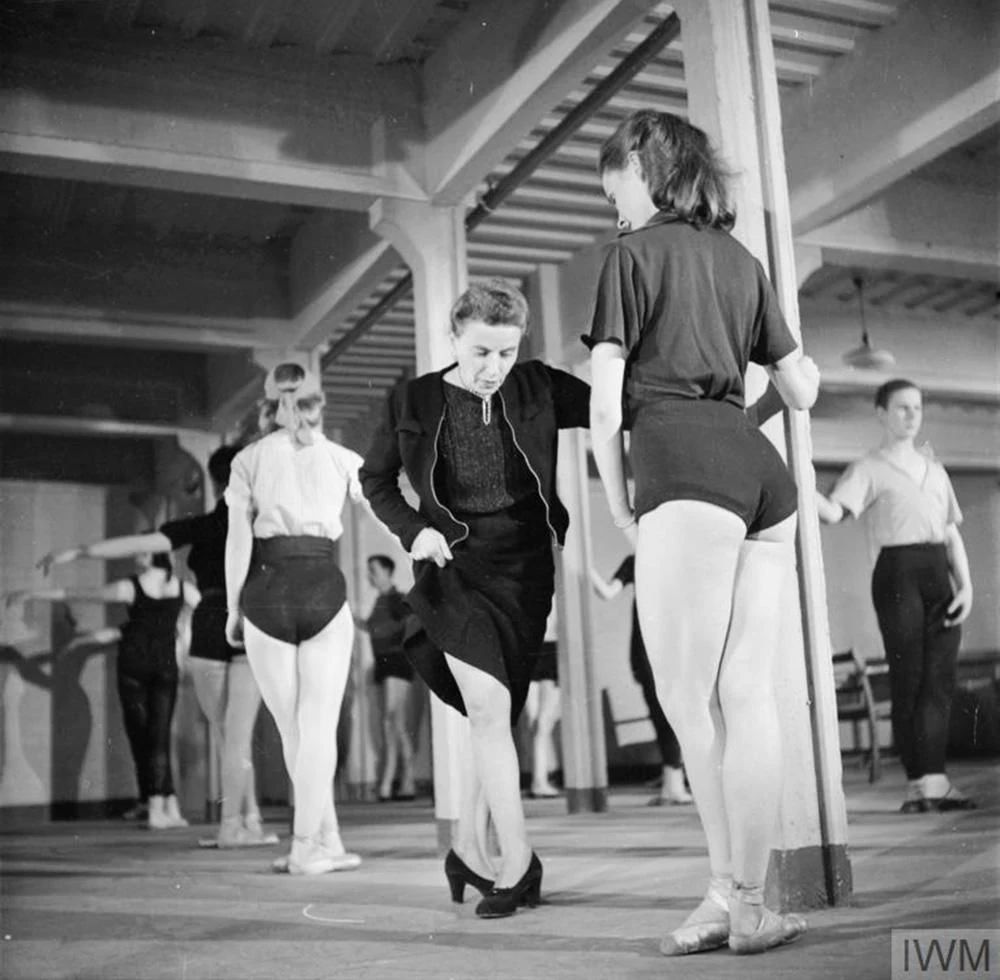
That route brought together different strands of dance education: the classical discipline of ballet and a wider interest in rhythm and movement. Rambert’s later work in Britain drew on her experience of both. She began teaching ballet classes in 1919, before establishing her own school in Bedford Gardens.
A school becomes a company
Rambert’s early work as a teacher developed into an organisation that could support dancers and choreographers as well as instruction. In 1926 she created a company, first known as Ballet Club. Its first informal performance was in Riverside Nights at the Lyric Theatre in London; the company also appeared in nightly revues. It later used the names Marie Rambert Dancers and Ballet Rambert, among others.
The company dates its birth to the 1926 performance of Frederick Ashton’s A Tragedy of Fashion, which it identifies as the first ballet company in Britain. Rambert gave Ashton an early opportunity to choreograph and helped him develop his work. She also brought in other emerging artists, including William Chappell. Her role was not simply to present a fixed repertory: she built a setting in which new choreographers could gain experience and put work before an audience.
Her husband, Ashley Dukes, renovated a building as the Mercury Theatre, where the company performed much of its work. The theatre gave the company a regular base as it developed beyond its early appearances in revues. Rambert continued to seek out new choreographers, among them Antony Tudor and Agnes de Mille, and the group’s repertoire encompassed classical ballet as well as work that moved towards modern dance.
Change without abandoning experiment
In 1965, Rambert and Norman Morrice reorganised the company to place greater emphasis on modern dance. This was a significant change in direction, rather than a simple relabelling: the organisation continued to change its name and repertoire over the years, while retaining a connection to the teaching and choreographic opportunities Rambert had established. Its later name, Rambert Dance Company, and its current name, Rambert, reflect that evolving history.
Rambert’s interest in dance as an art that could be reworked extended to its past as well as its future. In 1979 she worked with Millicent Hodson on a restoration of Nijinsky’s choreography for The Rite of Spring. The restoration was completed in 1987, after Rambert’s death. Her experience with the Ballets Russes had connected her to the original work; her later involvement reflected the value she placed on preserving choreography through careful reconstruction.
Rambert was married to Ashley Dukes from 1918 until his death in 1959. They had two daughters. She died at her home in London on 12 June 1982, aged 94. Her honours included appointment as a Commander of the Order of the British Empire in 1953 and as a Dame Commander in 1962 for services to ballet. She also received the Queen Elizabeth II Coronation Award from the Royal Academy of Dance in 1957 and the Gold Medal of the Order of Merit of the Republic of Poland in 1979.
Why Marie Rambert deserves a place in British Legacy
Marie Rambert deserves a place in British Legacy because her contribution was structural as well as artistic. After moving to Britain in 1914, she taught, established a school and built a company that gave dancers and choreographers a place to develop. Her support for Frederick Ashton helped bring a significant new choreographic voice into the company’s work, while her attention to artists such as William Chappell, Antony Tudor and Agnes de Mille widened the opportunities available to others. The importance of that work lies not in a claim that one person alone created British dance, but in the practical institution she helped build and the artists it enabled.
Her company also had the capacity to change. Rambert and Norman Morrice’s 1965 reorganisation made modern dance a stronger part of its direction, while the later company continued to evolve under different names and with a changing repertoire. Her work on the restoration of The Rite of Spring adds another dimension: she helped connect new artistic development with the preservation of choreography. Together, these achievements show how a teacher and founder could influence both the making and transmission of dance. Rambert’s British legacy is visible in the company that grew from her school, but also in the sustained space she made for choreographers to test ideas and for dance in Britain to develop beyond a single style.
Sources
Marie Rambert — Wikipedia revision
Adapted in part from Marie Rambert by Wikipedia contributors, under CC BY-SA 4.0. Text has been edited and combined with the existing article; this adapted text is shared under the same licence. Contributor history.
.jpg)