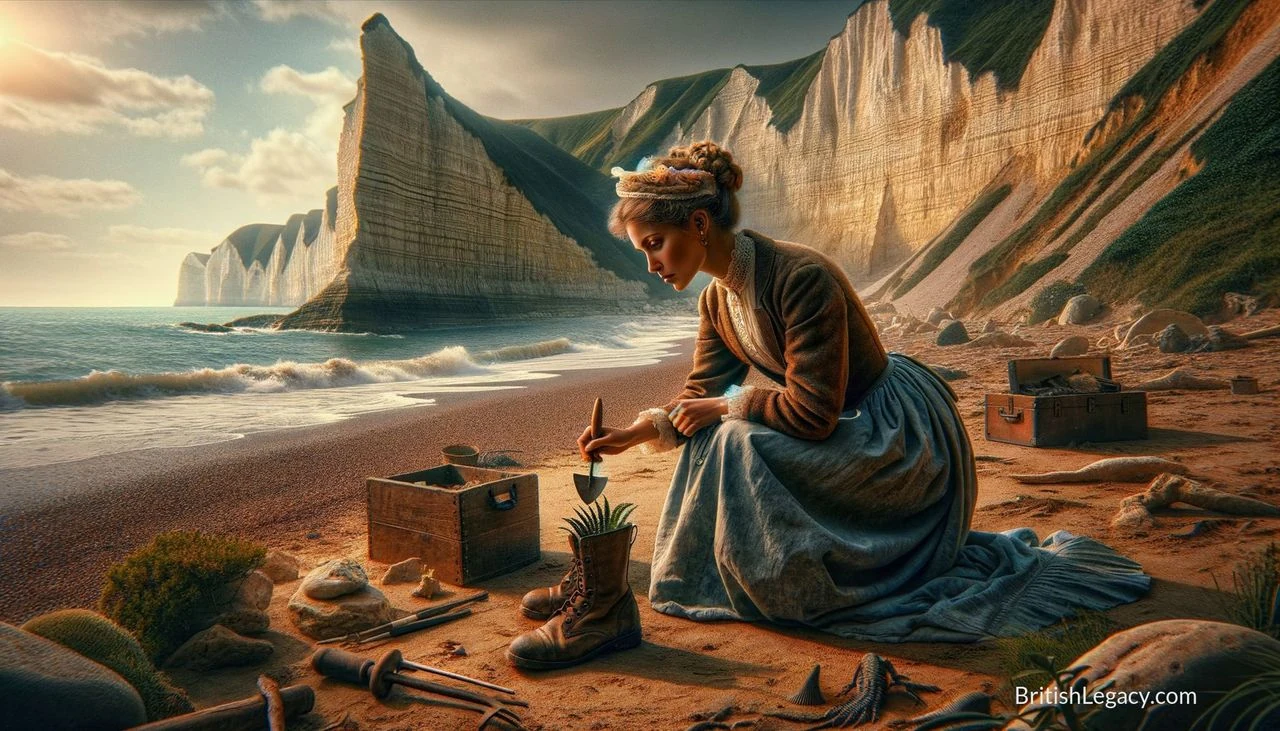
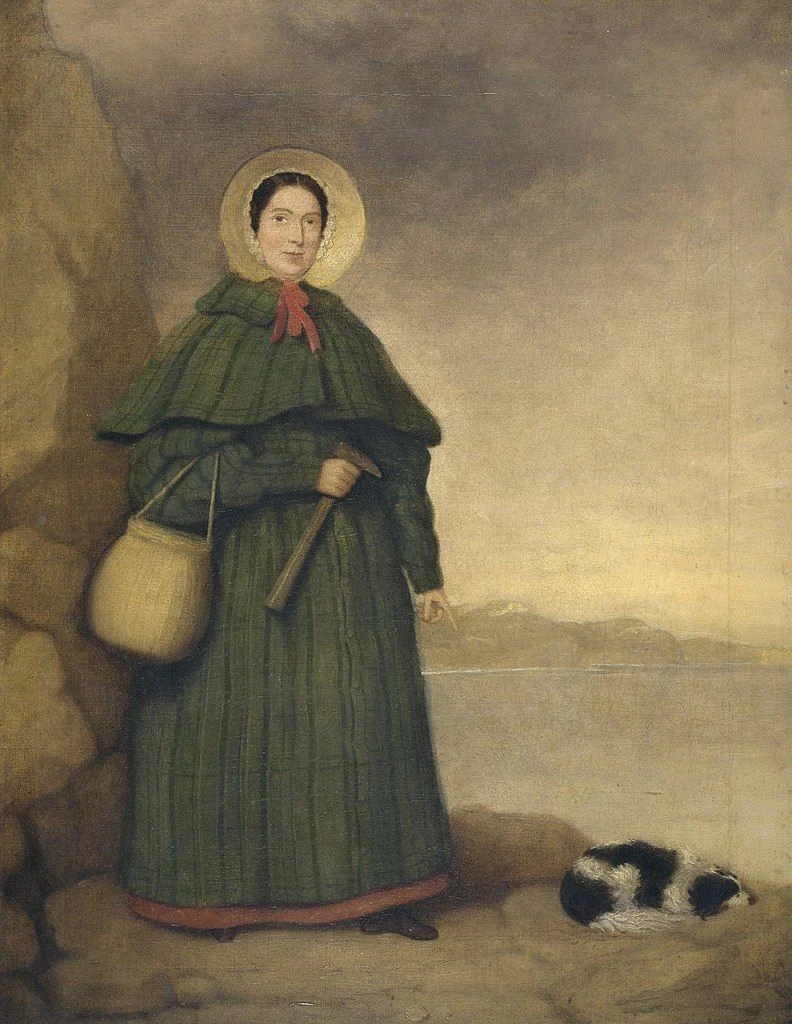
On the cliffs around Lyme Regis, a fossil could be revealed by a landslide and lost to the sea with the next tide. Mary Anning searched those unstable slopes through the winter, collecting and preparing remains that would transform scientific understanding of life in the distant past. Her discoveries included remarkably complete marine reptiles and a pterosaur; her observations also helped explain fossilised faeces and the ink sacs preserved inside belemnites. Yet the woman who found and studied these specimens was often left out of the published accounts.
A family business on the Dorset coast
Anning was born in Lyme Regis on 21 May 1799. Her father, Richard, was a cabinetmaker and carpenter who supplemented the family income by collecting fossils from the cliffs and selling them to visitors. Mary and her older brother Joseph joined him on collecting trips when they were children. They sold finds from a table outside their home, part of a local trade in fossils and other curiosities that was gradually becoming a serious scientific pursuit.
The family’s circumstances were precarious. Richard died in 1810, leaving debts and no savings; the Annings applied for poor relief. Mary’s mother, Molly, continued the fossil business, and Joseph remained involved while undertaking an apprenticeship. By the mid-1820s Mary had taken the leading role. In 1826, at 27, she bought a house with a glass-fronted shop window, where visitors could see specimens on display.
Collecting was not a safe occupation. Winter rain weakened the cliffs, and falling sections exposed new fossils but threatened anyone below them. A newspaper account in 1823 described Anning searching beneath the hanging cliffs for remains that had to be retrieved before the tide returned. In 1833 a landslide killed her dog, Tray, and buried the ground close to where she stood. Fossil hunting demanded not only specialist knowledge but speed, physical courage and an intimate understanding of the coast.
Discoveries that demanded new explanations
The find that first brought the Anning family to wider attention began in 1811, when Joseph uncovered an ichthyosaur skull. Mary found the rest of the skeleton a few months later. At more than five metres long, it was an extraordinary specimen: the first ichthyosaur skeleton to attract attention in scientific circles in London. It was displayed publicly, and accounts of the fossil prompted questions about the age of the Earth and the variety of creatures that had once lived.
Anning continued to find ichthyosaurs, including nearly complete skeletons. In 1823 she discovered a much more complete plesiosaur, an animal with an unusually long neck. The specimen caused such controversy that the French anatomist Georges Cuvier suspected it might have been assembled from bones of different animals. The Geological Society examined the evidence and concluded that it was genuine; Cuvier later accepted that his suspicion had been mistaken. The episode illustrates how important Anning’s finds were, but also how readily her work could be judged by others before she received recognition for it.
In 1828 she found a pterosaur skeleton, the first discovered outside Germany. William Buckland described it and credited Anning with the find. The following year she discovered a fossil fish later known as Squaloraja, notable for features that appeared intermediate between sharks and rays. She also found specimens of other fossil fish, extending a body of evidence that showed the sea had once been inhabited by animals unlike those alive today.
Her contribution was not confined to spectacular skeletons. Anning noticed that belemnite fossils could contain structures resembling the ink sacs of modern squid and cuttlefish, which she had dissected to understand the fossils. She also recognised that the objects then called “bezoar stones”, sometimes found near the abdominal regions of ichthyosaurs, could contain fossilised bones and scales. She suggested that they were fossilised faeces. William Buckland investigated the idea and named such remains coprolites; when he presented the finding, he acknowledged Anning’s role.
Knowledge without institutional membership
Anning’s education was limited, but she read scientific work wherever she could obtain it, copied papers by hand and developed detailed technical knowledge. She studied the anatomy of living fish and cuttlefish to make sense of fossilised animals. Visitors came to her shop to buy specimens and discuss anatomy and classification. Among those who sought her expertise were geologists Henry De la Beche and William Buckland, as well as the Swiss palaeontologist Louis Agassiz, who thanked Anning and her friend Elizabeth Philpot for their help with fossil fish.
Scientific recognition did not match her expertise. Women could not join the Geological Society of London or attend its meetings, and scientific papers often described specimens without naming the people who had found and prepared them. Anning’s discoveries helped other naturalists publish accounts of ancient animals, while her own scientific writing appeared only once in the scientific literature during her lifetime: an extract from an 1839 letter questioning a claim about fossil sharks. The exclusion was also financial. Fossil sales were uncertain, and economic hardship returned when demand fell and major finds were separated by long intervals.
Friends and colleagues sometimes offered practical support. In 1830 De la Beche commissioned a print based on his watercolour Duria Antiquior, a reconstruction of prehistoric life in Dorset drawn largely from fossils Anning had found. He sold prints to raise money for her. After she lost most of her savings in 1835, William Buckland persuaded the British Association for the Advancement of Science and the government to grant her an annual pension of £25 for her contributions to geology.
Her work, and the recognition that followed
Anning died of breast cancer in Lyme Regis on 9 March 1847, aged 47. The Geological Society, which still did not admit women, raised money to help meet her expenses after learning of her diagnosis. Its president, Henry De la Beche, delivered a eulogy after her death — an honour normally reserved for members. A stained-glass window at St Michael’s Church, where she was buried, was later dedicated to her memory and her contribution to geology.
Recognition has continued in different forms. In 2010 the Royal Society included Anning in a list of ten British women who had most influenced the history of science. A statue of her was unveiled in Lyme Regis on 21 May 2022, the anniversary of her birth, following a campaign to commemorate her in her home town. The Royal Mint issued commemorative 50p coins in 2021, and Royal Mail issued a set of stamps celebrating her and her discoveries in 2024. The coastline where she collected fossils is now part of the Jurassic Coast World Heritage Site.
Why Mary Anning deserves a place in British Legacy
Mary Anning deserves a place in British Legacy because her achievements joined fieldwork, practical skill and scientific insight. She did not simply uncover striking fossils: she identified, prepared and studied them, and made observations that helped naturalists understand what the specimens represented. Her finds of ichthyosaurs, plesiosaurs and a pterosaur gave scientists evidence of animals markedly different from those alive today. Her observations about belemnite ink sacs and coprolites extended that contribution beyond the famous skeletons, towards a more detailed understanding of ancient organisms and their environments.
Her story also reveals who could participate in British science, and who was credited for doing so. Anning’s expertise grew despite limited formal education and the exclusion of women from the Geological Society. Scientific accounts could make use of the fossils she found without fully acknowledging her part in the work. That imbalance does not diminish the discoveries; it makes accurate recognition more important. Anning’s legacy is visible in the science built on evidence from the Dorset coast, in the continued study of that landscape, and in the public commemorations established in her name. Remembering her gives British Legacy a specific account of achievement: a working fossil collector whose knowledge altered the study of Earth’s past, and whose contribution merits recognition in its own right.
Sources
Mary Anning — Wikipedia revision 1373466356
Adapted in part from Mary Anning by Wikipedia contributors, under CC BY-SA 4.0. Text has been edited and combined with the existing article; this adapted text is shared under the same licence. Contributor history.