In Measure for Measure, authority changes hands, but justice does not become more straightforward. The Duke of Vienna leaves Angelo to govern in his place, then disguises himself as a friar to watch what follows. Angelo revives a law against sex outside marriage and sentences Claudio to death; when Claudio’s sister Isabella pleads for him, Angelo demands her virginity in exchange for his life. Shakespeare builds a comedy around coercion, surveillance and unequal power, then leaves its resolution open to question.
A deputy takes control
Shakespeare is believed to have written the play in 1603 or 1604. Its earliest recorded performance was on 26 December 1604, and it was published in the First Folio of 1623, where it was classified as a comedy. The story takes place in Vienna. Duke Vincentio is due to leave the city on a diplomatic mission and appoints Angelo, a strict deputy, to rule during his absence. In reality, the Duke stays behind in disguise as Friar Lodowick, intending to observe his citizens and Angelo’s government.
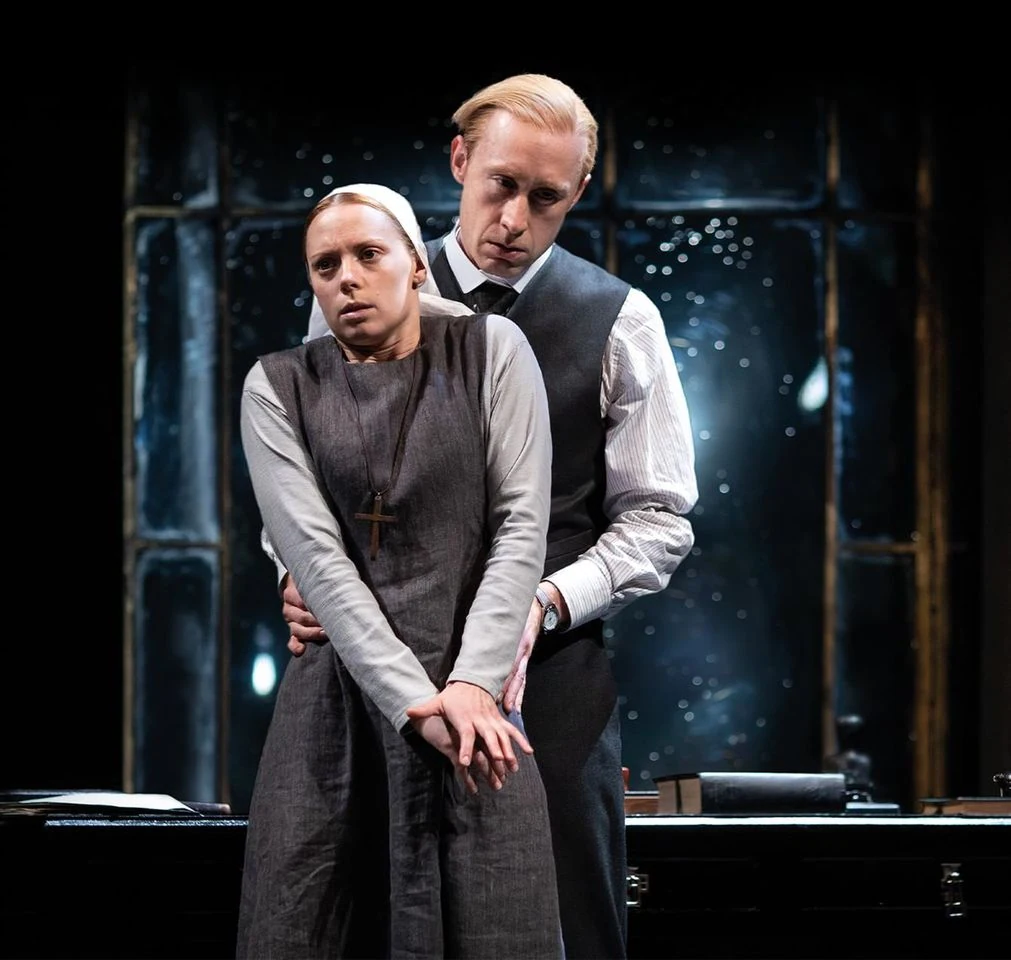
The change in leadership is felt quickly. Angelo enforces a neglected law that makes fornication punishable by death. Claudio and Juliet are engaged, but their marriage has not been completed according to the legal requirements; Juliet is pregnant, and Claudio is arrested. His friend Lucio asks Isabella, Claudio’s sister and a novice nun, to appeal to Angelo. She argues for mercy, but Angelo turns the encounter into an abuse of office: he offers to spare Claudio if Isabella has sex with him.
Isabella refuses and warns that she will expose Angelo. He believes his reputation will protect him from accusation. When she visits Claudio in prison, her brother begs her to yield. She remains unwilling to sacrifice her integrity to save his life, and the argument between them makes the play’s moral conflict personal: Angelo’s authority governs their choices, but the siblings must live with the consequences.
Substitution and the Duke’s return
The disguised Duke intervenes. Angelo had once been betrothed to Mariana, but rejected her after her dowry was lost at sea. Isabella agrees to a plan in which Angelo is told she will meet him in darkness and silence. Mariana takes Isabella’s place. Angelo believes he has obtained what he demanded, yet the encounter is with his former fiancée.
He nevertheless orders Claudio’s execution. The Duke arranges for another dead prisoner’s head to be sent in place of Claudio’s: Ragozine, a pirate who has recently died of a fever and resembles him. A separate plan to execute Barnardine fails when the prisoner refuses to be put to death while drunk. These manoeuvres delay Angelo’s design without resolving the question of justice.
When Vincentio returns openly, Isabella and Mariana bring their accusations before him. Angelo denies them, and the Duke initially appears to let him judge the case against Friar Lodowick. He then reveals his identity and confirms the women’s claims. Vincentio proposes Angelo’s execution, but Mariana pleads for his life. Isabella joins her, not yet knowing that Claudio is alive. The Duke eventually reveals Claudio’s survival, spares Angelo and requires him to marry Mariana. He then proposes marriage to Isabella; she gives no spoken answer. The ending offers reconciliation and mercy, but Isabella’s silence leaves the Duke’s proposal unresolved in the words of the play.
A comedy with a troubled tone
The First Folio’s classification has not settled how the play feels in performance. It uses comic devices including disguise, wordplay, irony and substitution, but its plot also brings threatened execution, sexual coercion and grave arguments about death. Claudio’s meditation on dying has often been compared with the speeches of tragic heroes. For this reason, the play is frequently described as a problem play: its comic resolution does not erase the damage or make the exercise of power seem uncomplicated.
The Duke’s disguise lets him observe the city while controlling events from behind the scenes. That arrangement is itself uneasy. He gathers information, stages deceptions and ultimately judges the people whose lives he has manipulated. Angelo’s harsh enforcement of the law exposes his own hypocrisy, but the Duke’s methods raise questions about the difference between wise government and theatrical control. The closing appeal to mercy tempers strict civil punishment, while leaving the audience to consider who has been able to choose freely.
The play also draws on earlier stories. Its principal source is the tale of Epitia in Cinthio’s Gli Hecatommithi, first published in 1565; Cinthio also presented the story as a play. George Whetstone’s two-part drama Promos and Cassandra (1578), itself based on Cinthio, supplied another source. Whetstone introduced comic elements and the bed and head tricks that also appear in Shakespeare’s plot. Shakespeare’s version reshapes this material: where Cinthio’s story ends in tragedy, Measure for Measure brings its characters to a negotiated, though unsettled, close.
The title appears in the play’s fifth act and echoes Matthew 7:2, the biblical saying that people will be judged by the measure they use for others. That reference suits a drama in which law, punishment and personal conduct repeatedly collide. Mercy is not simply the opposite of justice here; it is a proposed limit on the harm that strict enforcement can cause.
Changes in performance and interpretation
The play’s history on stage reflects the difficulty of balancing its comedy with its sexual and political themes. During the Restoration, Sir William Davenant adapted it as The Law Against Lovers, adding Benedick and Beatrice from Much Ado About Nothing, rehabilitating Angelo and ending with three marriages. Samuel Pepys saw the hybrid production in 1662 and praised its performance, particularly its singing and dancing. Charles Gildon’s 1699 adaptation, Beauty the Best Advocate, removed much of the low comedy and illicit sexuality. Neither version established itself as a lasting substitute for Shakespeare’s play; John Rich staged a version closer to the original in 1720.
In the nineteenth century the subject matter could provoke controversy. Adelaide Neilson’s appearance as Isabella in the 1870s drew an outcry. William Poel, by contrast, presented the play with minimal alterations, at the Royalty in 1893 and the Gaiety in Manchester in 1908. His approach to unlocalised staging and rapid, continuous delivery helped shape later performance practice, while also advancing psychological and theological readings of the drama.
Twentieth-century productions continued to test its possibilities. Charles Laughton played Angelo at the Old Vic in 1933; Peter Brook directed a 1950 Shakespeare Memorial Theatre production with John Gielgud as Angelo and Barbara Jefford as Isabella. The Royal Shakespeare Company staged it in 1962 with Marius Goring and Judi Dench in those roles. In 1981 Michael Rudman directed an all-black cast at the National Theatre. Later productions have relocated the story or altered its casting and emphasis, including Josie Rourke’s 2018 gender-reversal production at the Donmar Warehouse. A 2025 Royal Shakespeare Company production directed by Emily Burns removed the comic subplots, foregrounding another way to interpret the play’s political and moral tensions.
The work has also travelled beyond the stage. The BBC’s 1979 television adaptation, directed by Desmond Davis, was presented as a faithful version of the play. The BBC has made several radio productions, including broadcasts in 1950, 1951, 1955, 1964, 1976, 1994, 2004 and 2018. Its influence can also be traced in literature: Tennyson’s poem “Mariana” takes its name from Shakespeare’s character, while Alexander Pushkin used the plot in his poetic tale Angelo. Bertolt Brecht’s Round Heads and Pointed Heads began as an adaptation of the play.
Why Measure for Measure deserves a place in British Legacy
Measure for Measure belongs in British Legacy not because it offers a comfortable verdict on justice, but because it makes the exercise of authority impossible to take for granted. Shakespeare places a ruler, a deputy and a family caught under the law in the same moral contest. Angelo’s demand of Isabella exposes the danger of power used for private advantage; Claudio’s sentence shows how a dormant law can become a weapon when revived without proportion. The Duke’s eventual appeal to mercy offers an alternative to punishment, but his disguises and deceptions keep that alternative open to scrutiny. The play gives audiences no simple formula for good government. Instead, it dramatises the consequences of enforcing rules without compassion and the risks of placing unchecked discretion in the hands of a ruler.
Its British cultural legacy is also visible in the long record of performance and reinterpretation. From Restoration adaptations to productions at the Old Vic, the Royal Shakespeare Company, the National Theatre and the Donmar Warehouse, the play has remained available for new companies to question and reshape. Its afterlife in television, radio and writing, including Tennyson’s “Mariana” and Pushkin’s Angelo, shows how its characters and dilemmas have travelled beyond their original stage. The story’s blend of comedy and threat has invited successive generations to reconsider what justice requires, who gets to define morality and whether mercy can repair harm. That continuing capacity to provoke serious thought is a specific and enduring contribution to British theatre.
Sources
Adapted in part from Measure for Measure by Wikipedia contributors, under CC BY-SA 4.0. Text has been edited and combined with the existing article; this adapted text is shared under the same licence. Contributor history.