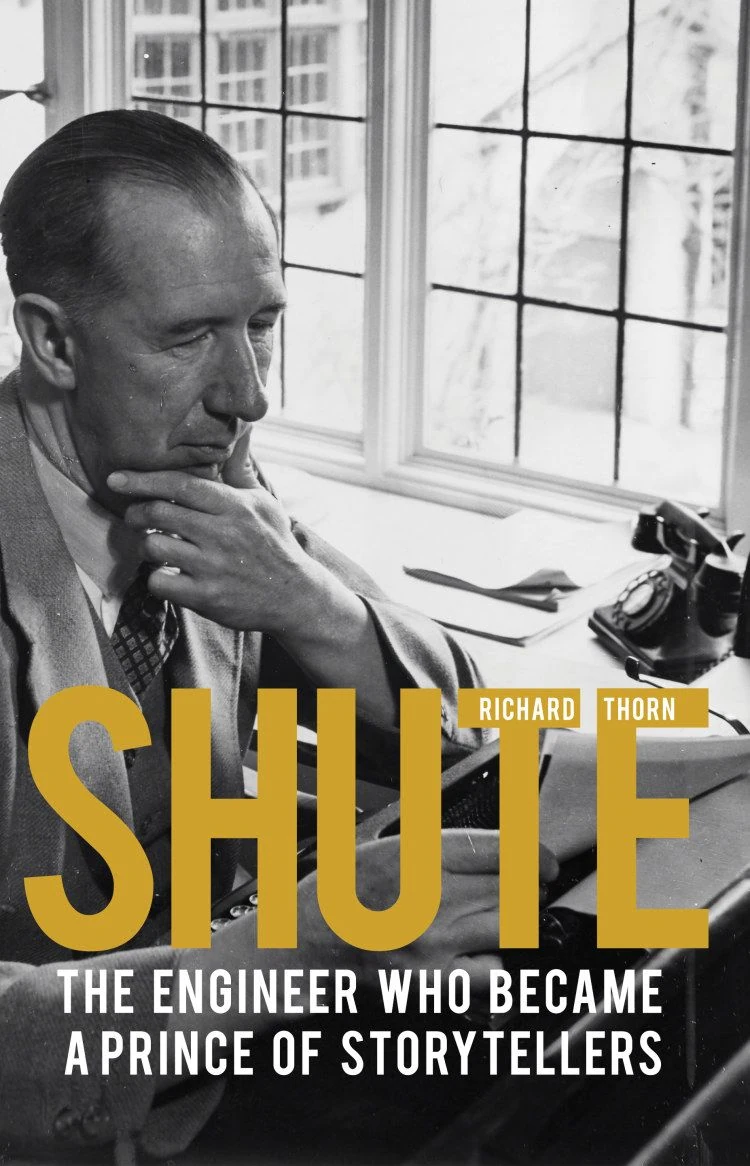
Nevil Shute Norway moved between two kinds of work that are often treated as separate: designing aircraft and writing novels. As an engineer, he helped develop the R100 airship and co-founded the company that produced the Airspeed Oxford, a trainer used widely by the RAF and Commonwealth air forces. As a novelist, he wrote books including A Town Like Alice and On the Beach. His experience of calculation, manufacture and practical responsibility informed fiction that made complex subjects accessible without losing sight of the people affected by them.
From Ealing to aeronautical engineering
Shute was born in Ealing, Middlesex, on 17 January 1899. He attended the Dragon School and Shrewsbury School before studying engineering science at Balliol College, Oxford, graduating in 1922. His route into adult life was interrupted by the First World War. He hoped to join the Royal Flying Corps, but believed his stammer prevented him from taking up a commission. He enlisted as a private in the Suffolk Regiment in August 1918 and served at the Isle of Grain and in military funeral parties during the influenza pandemic.
After the war, Shute began his engineering career with the de Havilland Aircraft Company and learned to fly. In 1924 he moved to Vickers, where he worked on the R100 airship project for the Airship Guarantee Company, a Vickers subsidiary. He used his full name for engineering and the shorter name Nevil Shute for his fiction. The separation was deliberate: he wanted to avoid the impression among employers or fellow engineers that writing novels made him less serious as a technical professional.
In his engineering work, Shute was responsible for close calculations rather than just broad ideas. He became chief calculator on R100, working on the stresses and structure of the airship. In 1929 he was promoted to deputy chief engineer under Barnes Wallis, and became chief engineer when Wallis left the project. The work demanded patience and exactness: Shute later described calculations for a single transverse frame as taking two or three months. That sustained attention to how machines were built and how they might fail would remain part of his professional identity and his writing.
R100, R101 and the end of the airship programme
The R100 was a privately developed airship intended for passenger travel within a wider imperial network. Its government-developed counterpart was the R101. The distinction matters: Shute worked on R100, not on the R101 that crashed in France in 1930. R100 made a successful return journey to Canada that year, with additional flights from Montreal to Ottawa, Toronto and Niagara Falls. The R101 disaster, however, ended British interest in large passenger airships. R100 was grounded and later scrapped.
Shute set out his experience of the airship projects in Slide Rule: Autobiography of an Engineer, published in 1954. His account is sharply critical of the decisions and management surrounding R101. It is also evidence of how strongly he believed that engineering required sound calculation and honest judgement, not confidence unsupported by technical work. His account should be understood as his own critical perspective, rather than treated as a neutral verdict on everyone involved. What is clear is that the R100 project placed him in the middle of a demanding British engineering undertaking, while its rival’s crash marked the abrupt end of the national programme.
The experience gave Shute material and a way of thinking that recurred in his fiction. He was interested in the distance between an ambitious plan and a working result: who notices a flaw, who is listened to, and what happens when an organisation fails to act on evidence. In his engineering autobiography, invention is not a solitary flash of inspiration but a process of calculation, argument, revision and responsibility. That practical understanding helps explain why so many of his fictional characters are judged by what they can do and how they do it.
Airspeed and the Oxford trainer
In 1931, after the R100 programme had been cancelled, Shute joined forces with the designer A. Hessell Tiltman to establish Airspeed Ltd. The company began in a former trolleybus garage in York. It developed the Envoy aircraft, which was selected for the King’s Flight, and later adapted the design into the Airspeed Oxford as war approached. This was a change from working within a large engineering organisation to helping create a business that had to design and sell aircraft.
The Oxford first flew in 1937 and became the RAF’s standard advanced multi-engined trainer, also used by the British Commonwealth. More than 8,500 were built. It served in pilot and aircrew training, as well as in communications, ambulance and calibration roles. Training aircraft do not usually attract the attention given to fighters or bombers, but the Oxford’s scale of production and range of uses made it an important part of the aviation system that prepared wartime crews. Shute’s contribution was not simply an engineering footnote: through Airspeed, he helped develop an aircraft that could be produced and put to work in large numbers.
Shute also worked on the Airspeed Courier, including the development of a hydraulic retractable undercarriage. His work on R100 and the Courier was recognised by his election as a Fellow of the Royal Aeronautical Society. The honours sit within a career grounded in the practical details of design: structures, mechanisms, manufacturing and the uses for which an aircraft was built.
War service and a growing literary career
Shute’s writing began early. His first novel, Stephen Morris, was written in 1923 but not published until 1961, after his death; its 1924 sequel, Pilotage, appeared with it. His first published novel, Marazan, came out in 1926. He went on to publish a steady run of books, with a six-year gap while he established Airspeed. His audience grew with each novel, and his literary fame increased sharply after On the Beach appeared in 1957.
During the Second World War, Shute joined the Royal Naval Volunteer Reserve. He worked in the Directorate of Miscellaneous Weapons Development, where he was involved in secret weapons projects, including the Panjandrum and the Rocket Spear, an anti-submarine missile. His work was engineering service in wartime, but he also reported on the Normandy landings and Burma as a correspondent. He finished the war as a lieutenant commander in the RNVR. These different roles—a technical specialist and a writer sent to report on events—reflect the unusual combination that had marked his career from the outset.
His novels are written in a direct, highly readable style. Shute often used a narrator outside the main action and built stories around clearly followed plots. The range of settings is broad: early aviation adventures, stories of the Second World War and novels set in Australia. Across them, the dignity of work is a recurring concern. His characters include mechanics, pilots, clerks, doctors and travellers, and their importance often lies in their skill, judgement or conduct rather than status. His fiction also examines barriers of class, race and religion, and the effects of scientific and technical change on ordinary lives.
Stories of rebuilding and catastrophe
A Town Like Alice, published in 1950, brings together wartime endurance and post-war reconstruction. Jean Paget’s experience in Malaya is only part of the story; she also acts on what she has lived through, helping to build a livelihood in the Australian outback. The novel’s attention to practical tasks—rebuilding, establishing work and creating a future—suits Shute’s interest in how people make damaged lives workable again. It was adapted as a British film in 1956 and later for Australian television and BBC radio.
On the Beach takes a very different subject. Published in 1957, it follows survivors in Australia after nuclear war as they wait for lethal fallout to reach them. Shute makes the catastrophe intimate by concentrating on everyday life: routine, work, relationships and attempts to face what is coming. Stanley Kramer’s film adaptation followed in 1959. Another novel, No Highway, draws on Shute’s knowledge of aircraft design and metal fatigue, turning a technical concern into the basis for a story. In different ways, these books show how his engineering experience could supply not just background detail but the structure of a plot and the risks its characters must confront.
His bibliography extends well beyond the best-known titles. It includes the wartime novels Pied Piper and Landfall: A Channel Story, as well as Round the Bend, The Far Country, Requiem for a Wren and Trustee from the Toolroom. Many of his books reached screens. Adaptations included Lonely Road, Pied Piper, No Highway and The Far Country, as well as the better-known screen versions of A Town Like Alice and On the Beach. This continued movement between page and screen helped carry his work to readers and viewers beyond its original readership.
Australia and the final years
In 1948 Shute flew his own Percival Proctor to Australia and back with the writer James Riddell, who later wrote about the journey. After returning, Shute decided to move with his family. In 1950 he settled on farmland at Langwarrin, south-east of Melbourne, with his wife, Frances Mary Heaton, whom he had married in 1931, and their two daughters. Several of his later successes were written in Australia, and many of his novels draw on Australian settings. His move altered where he lived, but did not erase his place in British engineering and literary history.
Shute died in Melbourne on 12 January 1960, aged 60, after a stroke. His novels continued to circulate after his death, and in 2009 Vintage Books reprinted his books. His unfinished late work, first drafted in the 1940s and revised under different titles, was published more than four decades after he died as The Seafarers. His afterlife as a writer has included adaptations, reprints and continuing attention to the engineering ideas that underpin some of his stories.
Why Nevil Shute deserves a place in British Legacy
Nevil Shute’s place in British Legacy rests on achievements that can be traced in both industry and literature. On the R100 he held responsibility for structural calculation and rose to become chief engineer. Through Airspeed, the company he founded with A. Hessell Tiltman, he helped develop the Airspeed Oxford, a trainer built in its thousands and used across the RAF and the Commonwealth. These are specific contributions to British aviation: not a claim that he single-handedly created an airship programme or won a war, but evidence of the engineering work and enterprise through which aircraft were designed, produced and put to use.
His books extend that legacy beyond the drawing office. Shute drew on engineering knowledge in novels such as No Highway, while A Town Like Alice and On the Beach brought stories of endurance, rebuilding and nuclear danger to a wide readership. His clear prose gave technical and moral questions room to reach readers without dressing them up as abstractions. The connection is not simply that he was British-born or that he later lived in Australia. It lies in the work he carried out in British aviation, the wartime training aircraft associated with his company, and the fiction through which he examined the consequences of human decisions. Shute’s career shows how practical skill can serve public needs and how an engineer’s attention to consequences can become a literary strength.
Sources
Adapted in part from Nevil Shute by Wikipedia contributors, under CC BY-SA 4.0. Text has been edited and combined with the existing article; this adapted text is shared under the same licence. Contributor history.