The University of Nottingham began as a college preparing students for University of London examinations. It became an independent university in 1948, after decades of expansion shaped by civic ambition, generous local support and a move to a spacious campus west of the city centre. Today its story connects Nottingham’s educational history with research, student life and an international presence in Malaysia and China.
A civic beginning and a new campus
The university traces its origins to adult education in Nottingham: an adult education school was established in 1798, and University of Cambridge extension lectures reached the city in 1873. The institution’s foundation is generally dated to 1881, when University College Nottingham opened to prepare students for University of London examinations. Its foundation stone had been laid in 1877 by former prime minister William Ewart Gladstone. Prince Leopold, Duke of Albany, formally opened the college’s neo-Gothic building on Shakespeare Street on 30 July 1881.
Four professors taught literature, physics, chemistry and natural science in the college’s first year. New subjects followed, including engineering in 1884, education in 1905 and mining in 1911. The college became formally independent under a royal charter in 1903, although its governance remained closely connected to Nottingham’s civic authorities.
In the 1920s, the college sought more room than its central Nottingham premises could offer. A proposed federal university for the East Midlands was abandoned after opposition, and Nottingham pursued university status independently. The move to University Park was made possible in part by local benefactors. Sir Jesse Boot gave 35 acres at Highfields to the city in 1921; the new campus, with its lake and parkland, was completed in 1928. Boot’s gift was intended to support a place of learning while also providing recreation for city residents.
The Trent Building, designed by Morley Horder, became a defining feature of the new campus. King George V formally opened it on 10 July 1928. During this period Nottingham welcomed speakers including Albert Einstein, H. G. Wells and Mahatma Gandhi. Einstein’s lecture blackboard remains on display in the university’s physics department.
University status and changing campuses
Until 1948, University College Nottingham students took examinations and received degrees through the University of London. A royal charter that year gave the institution university status and the power to award its own degrees. The university continued to develop after the war: the Midlands Agricultural and Dairy College at Sutton Bonington joined it as the School of Agriculture, and a medical school opened in 1970, described in the encyclopaedia account as the first new medical school in the UK in the 20th century.
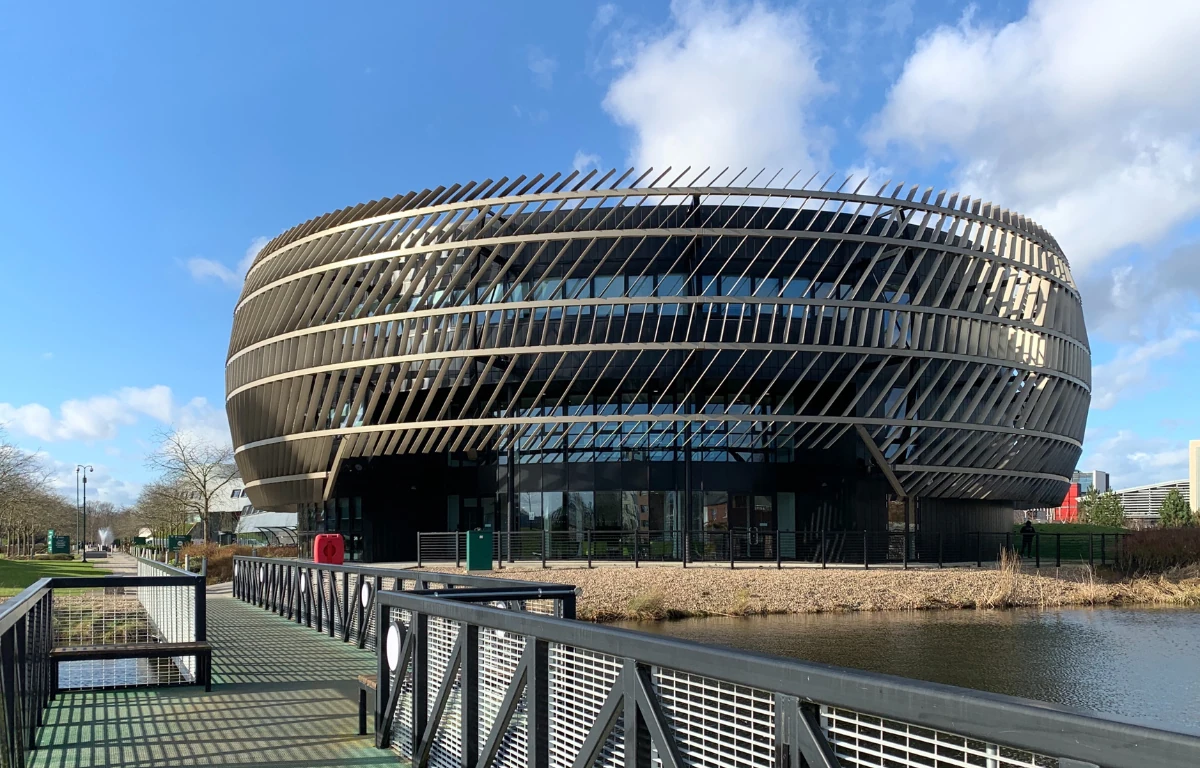
Later campus growth brought new purposes as well as new buildings. Jubilee Campus opened in 1999 on the former site of the Raleigh Bicycle Company, about a mile from University Park. Designed by Sir Michael Hopkins, it houses education and computer science, as well as the business school. Its development was associated with environmental awards, and the GlaxoSmithKline Carbon Neutral Laboratory was the first carbon-neutral laboratory in the UK. The campus also includes Aspire, a 60-metre freestanding artwork.
Other sites reflect the breadth of the university’s work. The medical school is based at Queen’s Medical Centre, with further sites at Nottingham City Hospital and the Royal Derby Hospital. Sutton Bonington is home to biosciences, veterinary medicine and the university farm. The Lakeside Arts Centre at University Park provides a public arts facility and performance space, with galleries and theatre among its facilities. Together, these places show how the university’s footprint extends from teaching and research into healthcare, agriculture and public culture.
Research, teaching and student life
Nottingham is a member of the Russell Group and the international Universitas 21 network. The 2021 Research Excellence Framework assessed research quality across UK higher education; an analysis by Times Higher Education placed Nottingham joint 25th by grade point average and seventh for research power. Its academic community has been associated with three Nobel Prizes and a Fields Medal. Among those named in connection with the university are Peter Mansfield, whose work on magnetic resonance imaging earned him the 2003 Nobel Prize in Physiology or Medicine, and Andre Geim, awarded the 2010 Nobel Prize in Physics for the discovery of graphene.
Research and teaching sit alongside a substantial student community. The students’ union is based in the Portland Building and has more than 200 affiliated societies and 70 sports clubs. Its activities include the magazine Impact, University Radio Nottingham and the Nottingham New Theatre. The student fundraising organisation Karnival raised £1.6 million for charity in 2012, a European record for a student-run group, according to the encyclopaedia account.
Sport is another prominent part of university life. Nottingham competes in national British Universities and Colleges Sport events and takes part in an annual Varsity Series against Nottingham Trent University. The university has also received the Times and Sunday Times sports university of the year title in 2019, 2021 and 2024. These traditions give students routes into organised competition alongside the university’s academic and cultural activities.
A university beyond Nottingham
The university opened an international campus in Malaysia in 2000; it moved to a purpose-built site at Semenyih in 2005. A second international campus followed in Ningbo, China, in 2004. The Ningbo campus was officially opened by the UK’s deputy prime minister, John Prescott, in February 2006. These campuses extend the institution’s teaching and organisation beyond England while retaining a connection to its Nottingham base.
The international presence adds a practical dimension to the university’s reach: students and staff are part of an institution operating across three countries, rather than a single-city college. The campuses are each led by a provost and pro-vice-chancellor. Their development also forms part of the university’s longer history of institutional change, from local adult education and a city college to a university with international operations.
That expansion has not removed the university from the concerns of its home city. Its campuses, teaching hospital, arts facilities and student organisations are all based in or around Nottingham, while its history includes an explicit civic bargain: the University Park site was developed both for higher education and for public recreation. Its identity therefore rests on both local roots and international activity.
Why University of Nottingham deserves a place in British Legacy
The University of Nottingham deserves a place in British Legacy because its history illustrates how higher education can grow through a partnership between a city and its educational institutions. From adult education and extension lectures to University College Nottingham, the institution developed alongside Nottingham’s civic life. The 1920s move to University Park was not simply an expansion of classrooms: Jesse Boot’s gift helped create a campus while setting aside space for public recreation. That connection between learning and the life of the city gives the university a specifically local legacy within the wider story of British education.
Its later achievements add substance to that history. The institution gained the power to award its own degrees in 1948, expanded into medicine and agriculture, and became part of the Russell Group. Its research community includes Nobel laureates, while its teaching, student organisations, sport and public arts facilities contribute to life in Nottingham. Campuses in Malaysia and China show how an institution founded in one English city extended its operations internationally. Taken together, these developments make Nottingham’s legacy more than a claim to prestige: it is a record of educational growth, civic investment, research and cultural activity, with effects felt both in its home region and beyond it.
Sources
Adapted in part from University of Nottingham by Wikipedia contributors, under CC BY-SA 4.0. Text has been edited and combined with the existing article; this adapted text is shared under the same licence. Contributor history.