Sir Nicholas Grimshaw brought the workings of a building into view. A pioneer of high-tech architecture, he made structure, industrial materials and new technologies part of the architectural expression rather than elements to be concealed. The approach took him from an early partnership with Terry Farrell to major commissions in Britain and overseas, including Waterloo International and the Eden Project in Cornwall.
Education and an early partnership
Grimshaw was born in Hove, East Sussex, on 9 October 1939. He studied at Wellington College, then at Edinburgh College of Art from 1959 to 1962. A scholarship took him to the Architectural Association School of Architecture in London, where he studied under the influence of Peter Cook, one of the founders of the experimental architectural group Archigram. Grimshaw graduated in 1965 with an honours diploma. He joined the Royal Institute of British Architects in 1967, after entering a partnership with Terry Farrell.
Grimshaw and Farrell worked together for 15 years. Their joint projects included 125 Park Road in London, the Herman Miller factory in Bath and the BMW UK headquarters in Bracknell. The partnership gave Grimshaw experience across housing, manufacturing and commercial work. It also placed him within a generation of architects testing how construction and building services could be made legible in the finished design.
High-tech architecture developed out of modernism, with an emphasis on structural expression, industrial materials and technological systems. Grimshaw became one of its leading practitioners. His influences included the nineteenth-century engineers and architects Joseph Paxton and Isambard Kingdom Brunel, as well as Buckminster Fuller and Charles and Ray Eames. That mix of engineering, geometry and modern design would be especially visible in his later public projects.
From factories to public landmarks
In 1980, Grimshaw established Nicholas Grimshaw & Partners. The practice grew beyond Britain, with offices in London, Paris, Los Angeles, New York, Dubai, Melbourne and Sydney. Among its early achievements, the Financial Times printworks in east London received a Royal Institute of British Architects national award in 1989. Grimshaw also designed the British pavilion at Expo ’92 in Seville, a commission that brought his work to an international audience.
Waterloo International, completed in London in 1993, was designed for Eurostar services between Britain and continental Europe. Its long, curved glass-and-steel enclosure and undulating roof made the station’s scale and movement part of the experience of arriving and departing. It served as the London terminus for Eurostar trains until 2007. In 1994, the terminal was named RIBA President’s Building of the Year and received the Mies van der Rohe Award for European Architecture. The project showed how a major transport building could be both an engineering work and a recognisable civic presence.
Grimshaw’s practice also worked on the redevelopment of Paddington station, a project whose design paid homage to Brunel’s original station. Other work ranged from the Lord’s Cricket Ground Grandstand and the National Space Centre in Leicester to the igus headquarters and factory in Germany. The list reflects the variety of the practice’s commissions: transport, culture, sport, research and manufacturing, in Britain and abroad.
The Eden Project and architectural systems
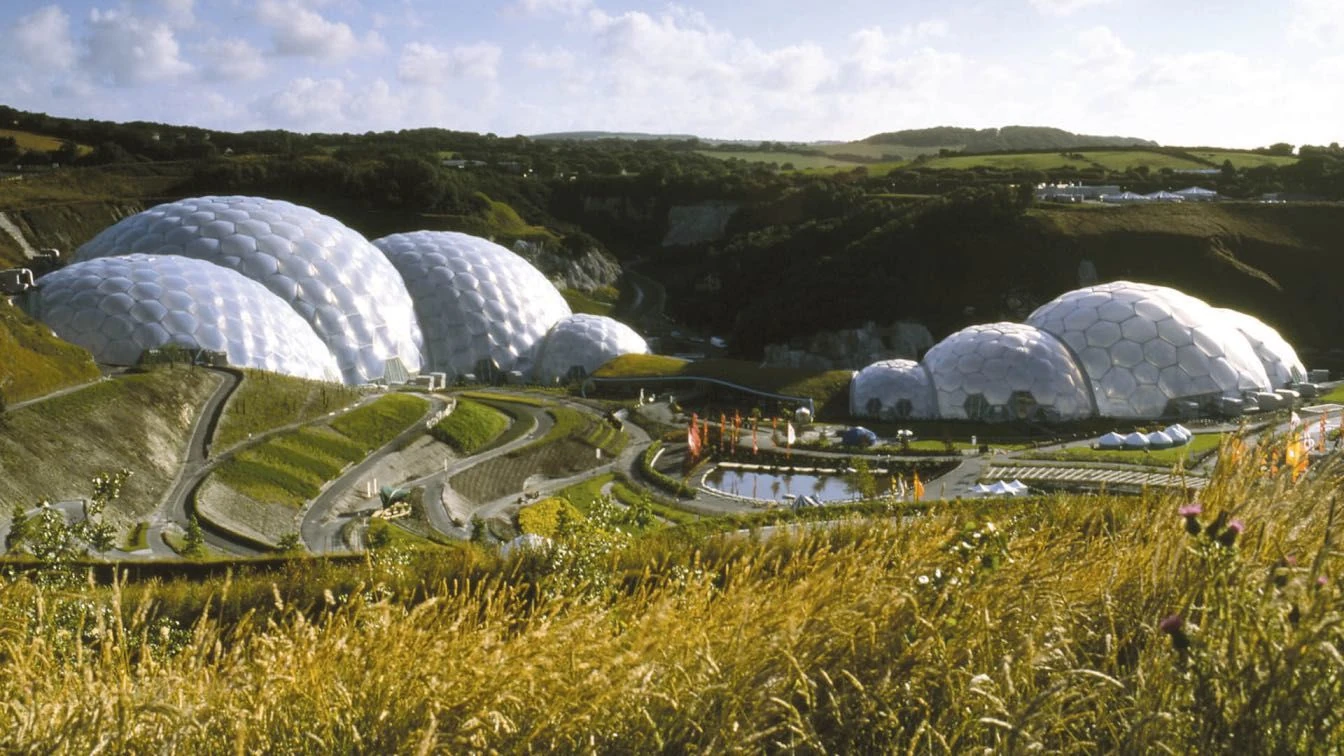
The Eden Project in Cornwall, completed in 2001, brought Grimshaw’s interest in structure and geometry into a different setting. The project comprises two large biomes for plant species from different climates. Their light, expansive enclosures use steel frames arranged in hexagonal and pentagonal patterns and clad in ETFE. This combination allowed the design to form large domed spaces while admitting natural light.
The biomes made a striking contrast with their surroundings and gave the project an identifiable architectural form. Eden’s purpose as a place for plants and environmental education also made the building’s relationship with its contents central to the visitor experience. Grimshaw designed the Core, a further Eden Project building completed in 2005. Together, the works show how his practice applied a technology-led approach to a public destination as well as to transport and industrial projects.
The Eden Project was part of a wider body of work that included the National Space Centre, the redevelopment of Paddington station and projects such as Thermae Bath Spa. His international commissions included the Southern Cross railway station in Melbourne and the Fulton Center in New York. The settings and functions differed, but the practice’s work consistently treated structure and construction as visible parts of the architectural language.
Leadership, recognition and later career
Grimshaw’s career extended beyond the design of individual buildings. He was elected president of the Royal Academy of Arts in 2004 and held the position until 2011. He remained chairman of Grimshaw Architects until 2019, when Andrew Whalley succeeded him. The practice’s expansion and the range of its work gave his architectural approach a lasting institutional setting beyond his own direct leadership.
He was appointed a CBE in 1993 and made a Knight Bachelor in the 2002 New Year Honours for services to architecture. Heriot-Watt University awarded him an honorary doctorate in 2004. In 2019, he received the RIBA Royal Gold Medal, one of the profession’s leading honours. His career was also documented in three Phaidon monographs: Architecture, Industry and Innovation, on work from 1965 to 1988; Structure, Space and Skin, covering 1988 to 1993; and Equilibrium, examining work up to 2000.
Grimshaw died on 14 September 2025, aged 85. By then, projects associated with his practice could be found across Britain and in Europe, Australia and North America. His work had carried the principles of high-tech architecture into stations, factories, galleries and public attractions, while his role at the Royal Academy connected an architect’s practice with the wider cultural life of the country.
Why Nicholas Grimshaw deserves a place in British Legacy
Nicholas Grimshaw deserves a place in British Legacy because he helped make engineering an explicit part of British architecture. At Waterloo International, the station’s sweeping glass-and-steel enclosure turned the demands of an international rail terminus into a memorable public building. At the Eden Project, he applied structural geometry and lightweight cladding to create large, light-filled environments for plants from different climates. These projects are distinct in purpose, but both demonstrate his ability to make a building’s construction contribute to its identity and use.
His British legacy is not confined to two landmarks. The Financial Times printworks, Paddington station redevelopment, the National Space Centre and other commissions show how his practice brought a technology-conscious approach to workplaces, transport and public culture. His partnership with Terry Farrell, the practice he founded in 1980 and his presidency of the Royal Academy also place his influence within the professional and cultural life of Britain. Recognition through a knighthood and the RIBA Royal Gold Medal marked a career whose reach extended internationally while remaining strongly represented in British buildings. Grimshaw’s work offers a specific example of how design can draw on engineering without reducing architecture to utility: structure can be practical, expressive and central to the way people understand a place.
Sources
Nicholas Grimshaw — Wikipedia revision 1342506376 · Nicholas Grimshaw — Wikipedia
Adapted in part from Nicholas Grimshaw by Wikipedia contributors, under CC BY-SA 4.0. Text has been edited and combined with the existing article; this adapted text is shared under the same licence. Contributor history.