In Noises Off, a theatre company tries to perform a farce called Nothing’s On. The joke is not simply that the production goes wrong. Michael Frayn makes the audience see the same show from sharply different angles: first in rehearsal, then from backstage during a performance, and finally as the company’s control gives way. Missed cues, misplaced props and private tensions become parts of an elaborate theatrical mechanism.
The idea behind the play
Frayn’s starting point was an observation made while watching one of his own plays from backstage. The actors’ activity out of sight of the audience had an unintended comic quality. He saw that the backstage view could itself become the subject of a play, exposing the gap between the orderly performance in front and the complicated work required to sustain it.
That premise gives Noises Off its double focus. The fictional production of Nothing’s On supplies the visible farce, while the company’s behaviour supplies another layer of comedy. The performers must deliver their roles even as they contend with missed entrances, rivalries and escalating strains. The audience is invited to watch both the show and the effort to keep it going.
The play’s effects depend on precise timing and coordinated movement. A prop or entrance that appears trivial in one moment can become central to the next, and events on one side of the stage shape what can happen on the other. Frayn’s construction makes theatrical craft part of the subject: the comedy comes not only from disorder, but from the exactness needed to stage it.
Three views of a production coming apart
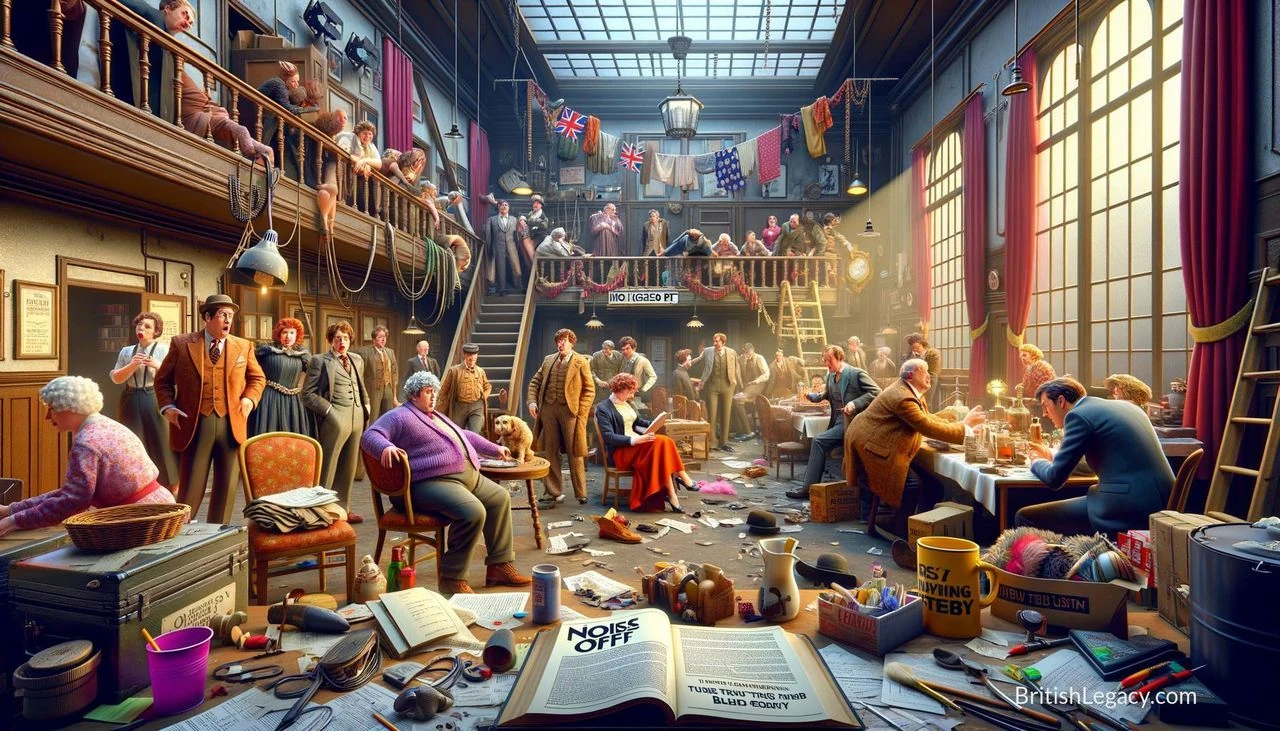
The three acts shift the audience’s vantage point as the fictional company attempts to put its farce before the public. The first takes place during a final rehearsal. The cast struggle with lines and cues, while blocking and stage directions remain unsettled. The props include sardines and pegs; misplaced scripts and uncertain movements make clear that the company has not yet mastered the performance it is preparing to give.
In the second act, the action moves entirely backstage during a performance. The audience sees the actors’ offstage behaviour rather than simply watching Nothing’s On unfold from the front. Missed entrances, personal rivalries, illicit affairs and rising tensions complicate the work of maintaining the show. The contrast between what the audience inside the fictional theatre sees and what the real audience sees is central to the play’s design.
By the third act, the accumulated problems have become harder to contain. Props go missing, lines are jumbled and the performance breaks down. The company’s public appearance and private confusion can no longer be kept apart. Across the acts, Frayn turns the familiar hazards of live performance into a carefully escalating sequence: the repeated material and shifting viewpoint let the audience see how the production’s failures build on one another.
London success and an international life
Noises Off opened at the Lyric Theatre, Hammersmith, in 1982. The original production was directed by Michael Blakemore. It ran in London for five years before transferring to Broadway, and the play has since had numerous revivals. Its movement from a London theatre to Broadway, followed by further productions, reflects a work whose central theatrical situation can be staged for audiences beyond its first setting.
The play has also been translated into several languages and performed in many countries. Its subject is theatre itself, but its comic structure makes the distinction between the polished event and the disorder behind it immediately legible: a performance depends on people, timing, props and coordination, all of which can go awry. That recognisable pressure gives directors and actors a demanding framework in which timing and physical action matter as much as dialogue.
Frayn’s approach brings the backstage world into the foreground without losing sight of the performance the characters are trying to give. Rather than treating a failed entrance or a missing prop as an isolated mishap, the play makes these practical problems feed into its form. The resulting farce requires close control from the people staging it, even as the fictional company appears to lose control altogether.
Why Noises Off deserves a place in British Legacy
Noises Off deserves a place in British Legacy as a work of British theatre that makes theatrical labour its comic subject. First staged at the Lyric Theatre, Hammersmith, in 1982, it takes the familiar division between the stage and the wings and turns it into the organising idea of the play. Its three-act structure makes the audience reconsider what it has seen: rehearsal, backstage activity and performance are not separate subjects, but connected views of one company struggling to keep a production together.
That design also helps explain the play’s continuing life beyond its first London run. The original production, directed by Michael Blakemore, played in London for five years before transferring to Broadway; later revivals and performances in other countries have carried Frayn’s theatrical puzzle further. Its comedy depends on precision, coordination and physical timing, giving actors and directors a substantial practical challenge as well as an entertaining story. By revealing the labour and vulnerability behind a supposedly finished performance, Noises Off celebrates theatre without pretending that it is effortless. Its contribution is specific: it makes the machinery of a production visible, then uses that machinery to build the farce.