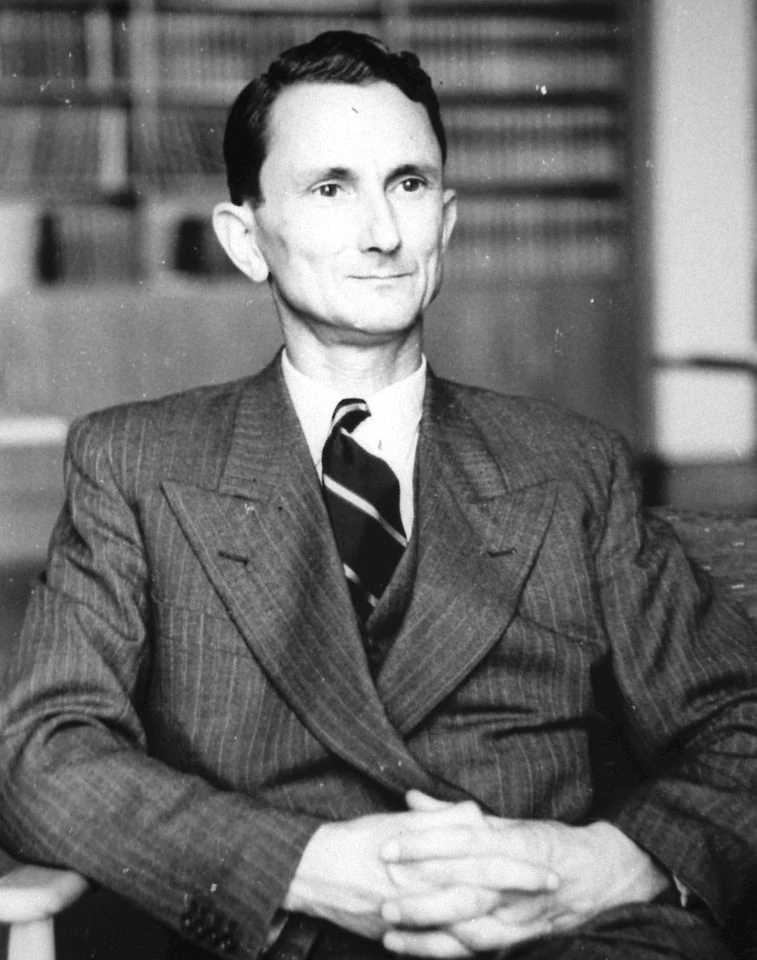
Alexander Fleming’s discovery of penicillin in 1928 was a starting point, not a treatment ready for patients. The mould’s active substance had to be recovered, purified and produced in sufficient quantity. At Oxford, Norman Heatley tackled those practical difficulties with a combination of scientific care and inventive engineering. His work helped turn a promising substance into a drug that could be tested in people, and helped expose the next challenge: producing enough penicillin to treat them.
Heatley was one member of a collaborative effort, not the sole inventor of penicillin or the creator of its later industrial production. His particular importance lies in the steps he helped make workable: purifying the drug, devising ways to grow the mould and recover its product, and improving yields through work in the United States. His career offers a view of medical progress from the laboratory bench, where a discovery must become measurable, repeatable and useful before it can change clinical practice.
A practical scientist in Oxford
Norman George Heatley was born in Woodbridge, Suffolk, on 10 January 1911. He attended Westbourne House School and Tonbridge School, then studied Natural Sciences at St John’s College, Cambridge. He graduated in 1933 and continued with doctoral research, receiving his PhD in 1936. That year he moved to the University of Oxford, became a fellow of Lincoln College and joined a research team working under Howard Florey.
Florey, an Australian pathologist, led the Oxford programme. Ernst Chain, a German-born biochemist who had fled Nazi Germany, was among the scientists working with him. Their strengths and responsibilities differed. Heatley’s was the practical development of methods and apparatus: finding ways to handle a substance that was unstable and initially available only in small amounts. The team was not simply trying to repeat Fleming’s observation. It needed to find out whether penicillin could be made, purified and administered in a form that would help combat bacterial infection.
Fleming had observed that a mould inhibited bacterial growth, but the discovery had not yet become a dependable medicine. The Oxford group began investigating its potential in 1939. Heatley’s technical contribution included a process known as back-extraction, which used changes in acidity to move penicillin between liquids and recover it in a cleaner form. The method addressed a crucial production problem: how to purify the active substance in bulk rather than leave it mixed in a culture broth.
This was not a single solution to every obstacle. The mould’s growth had to be encouraged; the drug had to be recovered and handled despite its instability; and researchers needed a way to compare samples. The Oxford team established units for measuring penicillin’s potency and circulated calibrated samples so that results could be compared. This work on measurement mattered alongside the more visible experiments. A treatment could not be assessed or administered consistently if its strength was unknown.
From mice to the first patient
In May 1940, experiments on mice provided important evidence that penicillin merited further study. Heatley recorded trials in which infected mice treated with penicillin survived while untreated control animals died. The results supported the case for testing the drug’s potential, but they also made the problem of supply more pressing. A human trial would require much more material than the team could readily produce.
Heatley’s ingenuity extended from chemistry to the vessels used to grow the mould. Penicillium grew well when spread over a broad surface, so the team needed many shallow containers. With ordinary equipment in short supply during the war, Heatley recognised that bedpan-shaped vessels could be adapted to this purpose. Modified ceramic versions were manufactured for the work. The solution was practical rather than elegant, but it answered a real constraint: the researchers needed a way to grow more mould with materials and resources they could obtain.
He also designed apparatus to extract, purify and concentrate the small quantities of penicillin produced. Oxford’s laboratories became an improvised production operation, though one still far from the scale required for routine treatment. The work involved a chain of linked problems. Growing the mould did not by itself produce a usable medicine; the active substance had to be separated from the culture, processed and conserved. Improving one stage could help, but each stage remained dependent on the others.
On 12 February 1941, Albert Alexander, a 43-year-old police constable with a severe infection, received penicillin at the Radcliffe Infirmary. Within a day his condition improved: his temperature fell, his appetite returned and the infection began to subside. The supply, however, was insufficient to complete his treatment. Florey and colleagues recovered penicillin from Alexander’s urine in an attempt to reuse it, but the drug ran out after several days. Alexander died about a month later.
The outcome was tragic, and it marked the limits of the Oxford team’s production capacity. It also showed that penicillin could have a striking effect in a seriously ill patient. The obstacle had shifted: the question was no longer only whether the drug might work, but how to produce enough of it to sustain treatment. Heatley’s work had helped bring the substance to a human trial; the trial made the need for larger production unmistakable.
Taking the production problem to the United States
Wartime conditions made large-scale production in Britain difficult. In 1941, Heatley and Florey travelled to the United States seeking help to produce penicillin in much greater quantities. The journey linked the Oxford programme with American research facilities and industrial capabilities. It did not erase the contributions made in Britain: Oxford had developed methods and demonstrated the drug’s promise, while further work in the United States helped address the problem of scale.
In Peoria, Illinois, Heatley worked with A. J. Moyer on ways to improve yields. Changes to the growth medium included adding corn-steep liquor, a by-product of starch extraction, and substituting lactose for glucose. These adjustments helped increase production. Heatley later worked at Merck in New Jersey before returning to Oxford in 1942. The progression from small laboratory cultures towards greater yields depended on practical refinement as well as on the broader resources available to researchers and manufacturers.
The collaboration in Peoria was not without difficulty. Wikipedia’s account records that Moyer eventually stopped sharing some of his work with Heatley and later published results without acknowledging Heatley’s contribution, despite an agreement for joint authorship. It also reports that Moyer applied for patents as sole inventor. Heatley later said he was amused rather than upset by the episode. The account offers a reminder that collaborative science involves questions not only of method and credit, but also of publication and ownership. It does not change the evidence of Heatley’s contribution to the work on production.
Industrial penicillin eventually relied on deep-tank fermentation, a later development that enabled production on a much larger scale. Heatley should not be credited with creating that industry single-handedly. His part was to help carry the Oxford work across a vital boundary: from a substance that could be studied in the laboratory to methods that could be adapted and improved in pursuit of manufacturable quantities. That distinction makes his role more precise, not less significant.
Recognition and remembrance
When the Nobel Prize in Physiology or Medicine for work on penicillin was awarded in 1945, the laureates were Fleming, Florey and Chain. Heatley was not included. His omission contributed to a public account in which the discovery and the best-known names could eclipse the practical work required to develop the drug. The distinction between discovering an effect and making it usable is central to understanding his contribution.
Heatley was appointed an Officer of the Order of the British Empire in the 1978 Birthday Honours for services to scientific research. In 1990, Oxford awarded him an honorary Doctorate of Medicine, an unusual distinction for a non-medical graduate. His papers are held by the Wellcome Collection. These forms of recognition place his scientific record alongside the lasting evidence of the work itself: methods, documents and equipment that reveal the material challenges behind the development of penicillin.
Oxford established a Norman Heatley Postdoctoral Award for researchers showing ingenuity and problem-solving ability. His former home on Oxford Road received a commemorative blue plaque in 2010; another plaque at the Sir William Dunn School of Pathology also names him alongside Florey and Chain. Heatley died at his home near Oxford on 5 January 2004, aged 92. The award, plaques and archived papers keep attention on a career whose results were often practical processes rather than a single dramatic discovery.
Why Norman Heatley deserves a place in British Legacy
Norman Heatley deserves a place in British Legacy because his work shows how a scientific discovery can become a practical benefit. He did not discover penicillin, and it would be misleading to describe him as the sole creator of mass production. His particular contribution was to address obstacles that stood between the Oxford research and a treatment: purifying penicillin, finding suitable vessels for growing the mould, designing equipment and helping researchers assess the drug. Those steps helped make a human trial possible and revealed how urgently production needed to improve. The treatment’s development depended on many people, but Heatley’s problem-solving helped connect scientific promise with clinical evidence.
His British connection is specific: he was born in Suffolk, educated at Cambridge and did important work at Oxford. In wartime Britain, the Oxford team adapted scarce materials to grow the mould and prepare penicillin; Heatley later carried practical knowledge into collaboration with American researchers seeking higher yields. This is not a claim that Britain alone produced the antibiotic, but an account of important work undertaken in British institutions and extended through international cooperation. Oxford’s award and plaques, together with the archive of his papers, give future researchers ways to encounter that history. Heatley’s legacy also broadens the idea of scientific achievement. Careful measurement, adaptable equipment and persistent work on production can matter as much as the first observation. By helping make penicillin testable and improving the means of producing it, Heatley contributed to a medicine that could reach patients—and to a more complete understanding of the people whose practical work makes medical advances useful.
Sources
Norman Heatley — Wikipedia revision 1374495057 · Norman Heatley — Wikipedia
Adapted in part from Norman Heatley by Wikipedia contributors, under CC BY-SA 4.0. Text has been edited and combined with the existing article; this adapted text is shared under the same licence. Contributor history.