St Paul’s Cathedral has stood above the City of London through more than three centuries of change. Its dome, completed as part of Sir Christopher Wren’s rebuilding after the Great Fire, became a landmark on the capital’s skyline. But St Paul’s is not only an architectural monument: it is an active Church of England cathedral, where daily services continue alongside ceremonies that have marked moments in national life.
Before Wren: a long history on Ludgate Hill
The dedication of St Paul’s reaches back to the first cathedral church on this site, founded in AD 604. The present cathedral is the fifth on the location. The medieval building, generally known as Old St Paul’s, was begun after a fire in 1087. Further damage and rebuilding followed; its Gothic form was consecrated in 1240, with an enlargement completed over the following decades.
Old St Paul’s was a major presence in medieval and early modern London. Its churchyard and St Paul’s Cross were places of public activity, while the cathedral itself was altered during the Reformation and suffered neglect and damage during the Civil War. A fire in September 1666 gutted the building. Rather than rebuild it in its former form, the authorities decided on a new cathedral for a city already facing a vast programme of reconstruction.
Wren’s cathedral takes shape
Christopher Wren was formally assigned the design of the replacement in 1669. His task was to create a functioning church and a prominent London landmark. The design developed over several years, and the building eventually combined the long plan of an English cathedral with the classical forms and dome that made Wren’s work distinctive. Construction began in 1675; the cathedral was consecrated in 1697, while work continued. The final stone was set on the lantern in 1708. The building was completed in 1710, and Parliament declared it officially complete the following year.
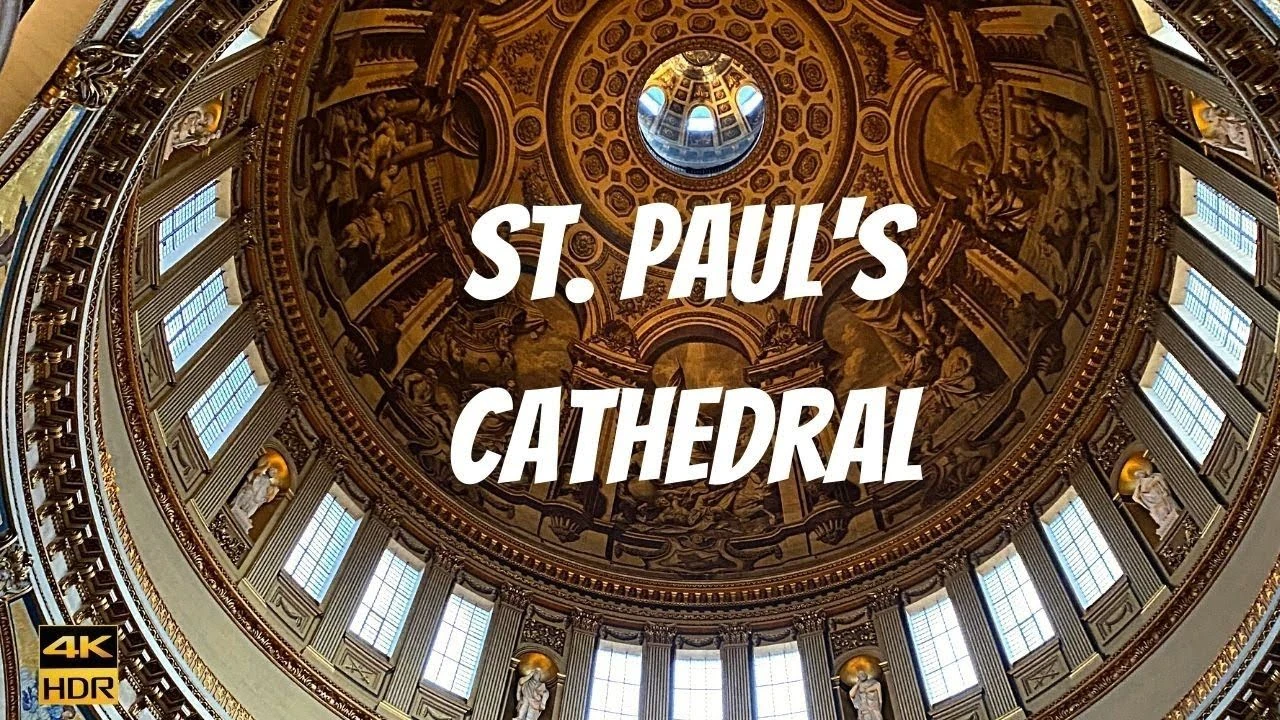
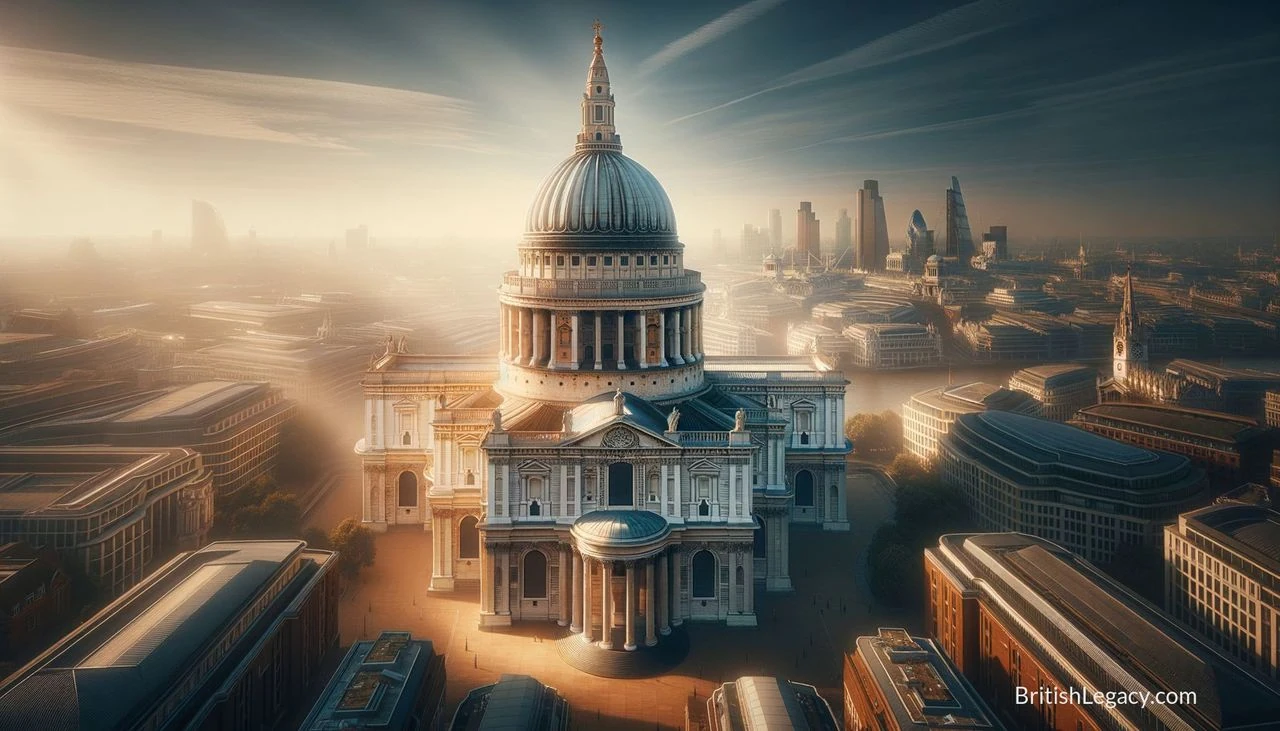
The dome rises 111 metres to its cross. Wren’s solution was more than a dramatic outline: a brick cone between the inner and outer domes supports the lantern and helps carry the structure’s weight. The cathedral’s height made it the tallest building in London from 1710 until 1963. Beneath the dome, the Whispering Gallery is known for the way a quiet sound against its wall can be heard at another point around the gallery. The crypt, which extends beneath the building, also helps distribute the weight of the structure.
Inside, the nave, choir and transepts lead into the central space beneath the dome. The building brings together work by a number of craftsmen and artists. Grinling Gibbons carved fittings and stonework; Jean Tijou made decorative ironwork; and Sir James Thornhill painted scenes from the life of St Paul inside the dome. The choir’s mosaics include work by Sir William Blake Richmond. The result is not the work of one designer alone, but a large architectural undertaking shaped by builders, sculptors, painters and metalworkers.
A cathedral in public life
St Paul’s has repeatedly provided a setting for national services and funerals. Admiral Lord Nelson was buried in the crypt after his funeral in 1806; the Duke of Wellington was buried there after his state funeral in 1852. The cathedral also held the state funeral of Winston Churchill in 1965 and the ceremonial funeral of Margaret Thatcher in 2013. Its spacious interior and position in the City have made it a suitable setting for large services of thanksgiving and remembrance, including occasions marking royal jubilees and the end of the First and Second World Wars.
On 29 July 1981, Prince Charles and Lady Diana Spencer were married at St Paul’s. They chose it over Westminster Abbey in part because the cathedral could accommodate more people. The ceremony brought a worldwide audience to a building that had long been used for public occasions, while adding a very different event to its history of state services and memorials.
War, damage and repair
During the Second World War, St Paul’s was struck by bombs on 10 October 1940 and 17 April 1941. The first destroyed the high altar; the second damaged the north transept. In September 1940, a time-delayed bomb that had struck the cathedral was removed by a Royal Engineers bomb-disposal team before it exploded. Lieutenant Robert Davies and Sapper George Cameron Wylie each received the George Cross for their actions.
Photographer Herbert Mason’s image of the dome above smoke during the bombing of 29 December 1940 became one of the best-known pictures of wartime London. The photograph’s reach helped make St Paul’s a potent image of the city under attack, but the building’s survival was not untouched or effortless: restoration of war damage continued in the 1950s and 1960s. A major programme of work on the dome and other parts of the cathedral was completed in 2011, after 15 years.
Memorials, music and a living congregation
The cathedral’s memorials record a wide range of public lives. Its crypt contains the tombs of Nelson and Wellington, as well as the grave of Wren. Monuments and memorials also commemorate figures including Florence Nightingale, Samuel Johnson, J. M. W. Turner and Alexander Fleming. The American Memorial Chapel, dedicated in 1958, honours more than 28,000 Americans who died while travelling to or stationed in the United Kingdom during the Second World War. Its creation was paid for by donations from people in Britain.
Music remains part of the cathedral’s regular life. A professional choir sings at services, and St Paul’s holds several services each day. In 2022, the cathedral announced that girls would be admitted to the choir; two girls joined as full choristers in June 2024. Visitors encounter a building with a continuing religious purpose as well as a long history: the cathedral remains a working church, not simply a ceremonial venue or a backdrop for the City skyline.
The building’s public meaning is also being reconsidered. In 2023, St Paul’s began a partnership with Stepney Community Trust to provide historical context for memorials connected with people whose careers and actions were associated with harm to communities in South Asia. A printed guide and linked information help visitors read the memorials in a broader historical setting, rather than encounter their commemorative language without context.
Why St Paul’s Cathedral deserves a place in British Legacy
St Paul’s belongs in British Legacy because its history connects architecture with the changing life of London. Wren’s cathedral was built after the Great Fire as both a place of worship and a civic landmark. Its dome was an ambitious work of design and engineering, rising above a building made by a network of craftsmen and sustained by generations of repair. The structure therefore tells more than a story of architectural achievement: it records how a city rebuilt, adapted and maintained one of its central institutions.
Its national significance is equally concrete. The funerals of Nelson, Wellington and Churchill, the 1981 royal wedding and services marking wartime remembrance show how a working church has provided space for public ceremony. At the same time, daily worship, its choir and the American Memorial Chapel connect that public role to ongoing religious and commemorative life. The cathedral’s recent work to contextualise memorials adds another important dimension: heritage is not only preserved, but explained and examined. St Paul’s deserves its place not as a generic emblem of Britain, but as a London institution whose architecture, ceremonies, worship and evolving interpretation have all shaped how the country remembers its past.
Sources
St Paul's Cathedral · St Paul's Cathedral
Adapted in part from St Paul's Cathedral by Wikipedia contributors, under CC BY-SA 4.0. Text has been edited and combined with the existing article; this adapted text is shared under the same licence. Contributor history.