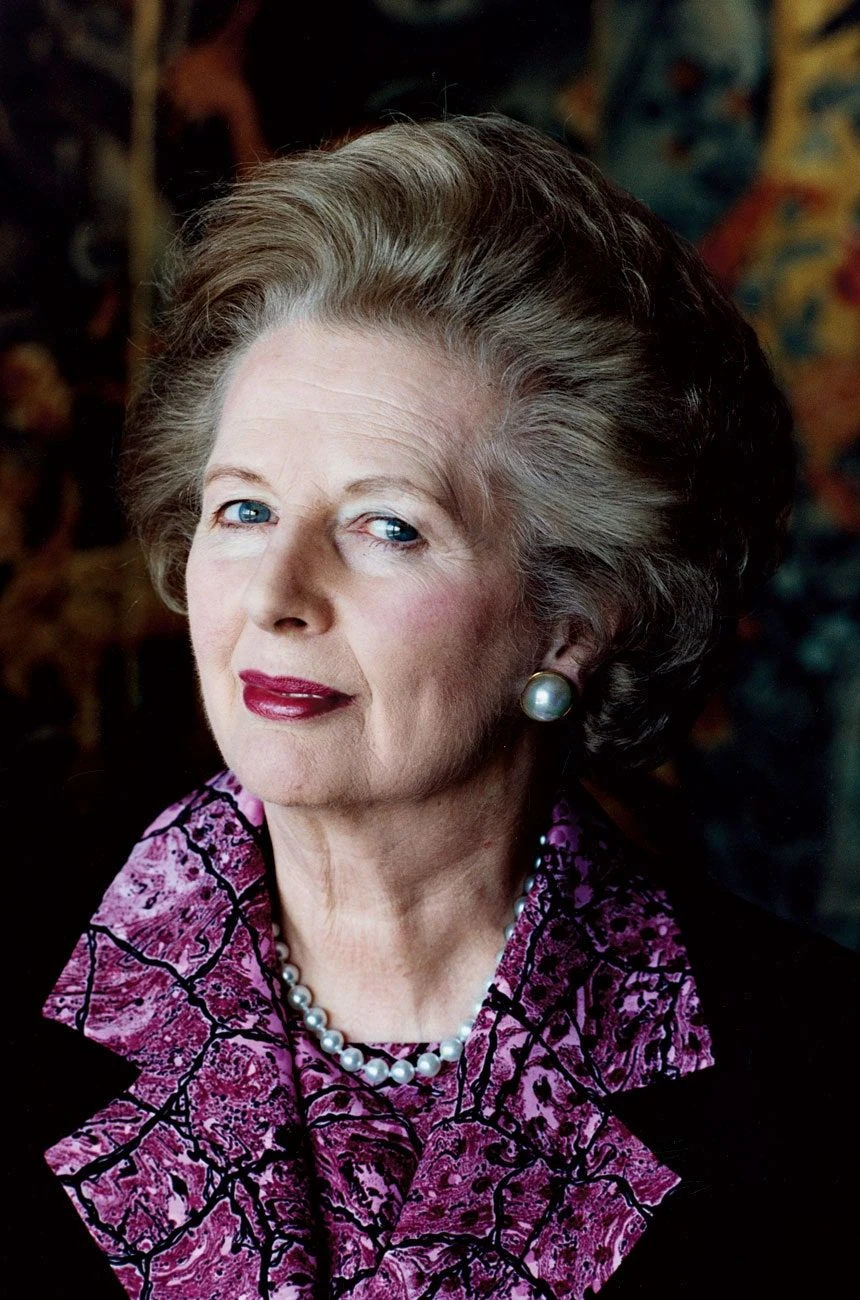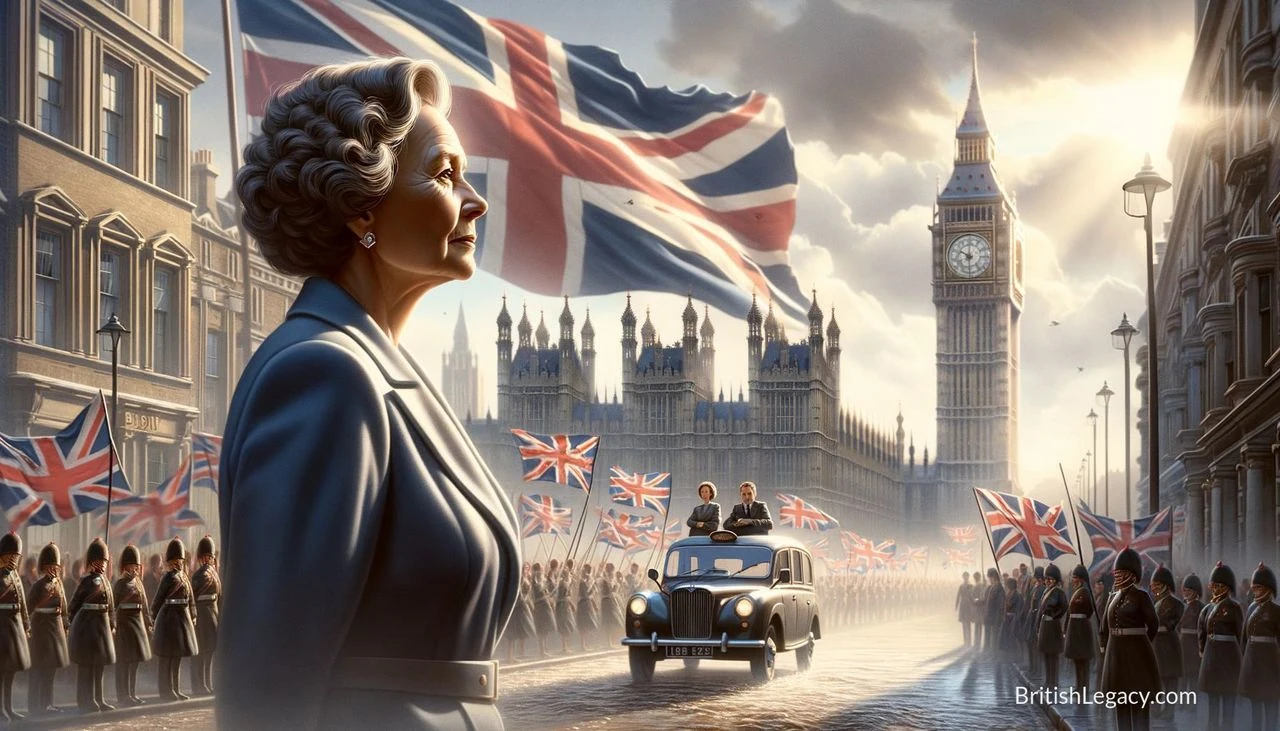
Margaret Thatcher’s rise from a Grantham shopkeeper’s daughter to Britain’s first woman prime minister was remarkable; the changes she made in office were more consequential still. From 1979 to 1990, she led the country through economic upheaval, industrial conflict and the Falklands War, while pursuing policies that altered the relationship between government, markets and trade unions. Her record remains contested: admirers credit her with changing Britain’s economic direction, while critics point to unemployment, inequality and communities left behind.
From Grantham to the Conservative leadership
Born Margaret Hilda Roberts in Grantham, Lincolnshire, on 13 October 1925, she grew up above the grocery and tobacconist’s shop owned by her father, Alfred Roberts. She won a scholarship to Kesteven and Grantham Girls’ School and went on to study chemistry at Somerville College, Oxford. After graduating, she worked as a research chemist before training as a barrister, specialising in taxation. Her scientific education was an unusual foundation for a future prime minister, and she later described becoming Britain’s first prime minister with a science degree as a source of particular pride.
Roberts stood unsuccessfully for the Conservatives in Dartford at the 1950 and 1951 general elections. She married businessman Denis Thatcher in 1951; their twins, Carol and Mark, were born in 1953. In 1959 she was elected Member of Parliament for Finchley, a seat she represented for more than three decades. Her early parliamentary work included support for legislation requiring local authority meetings to be held in public. In 1970, Prime Minister Edward Heath appointed her Secretary of State for Education and Science.
As education secretary, Thatcher became known nationally after the government ended free school milk for most children aged seven to eleven. The decision, taken amid spending cuts, brought a storm of protest and the nickname “Margaret Thatcher, Milk Snatcher”. It was an early lesson in the political cost of a policy that could be defended as economy but was widely experienced as a cut to children’s provision.
After the Conservatives lost office in 1974, Thatcher challenged Heath for the party leadership. She won in 1975, becoming both Conservative leader and Leader of the Opposition—the first woman to lead a major British political party. In opposition, she promoted lower taxes, a smaller role for the state and greater freedom for businesses and consumers. Her political vocabulary and approach came to be known as Thatcherism.
Government, markets and industrial conflict
The Conservatives won the 1979 general election and Thatcher became prime minister on 4 May. Her government set out to reduce inflation and change the direction of the economy. It cut direct taxes on income while increasing indirect taxes, raised interest rates and restrained public spending. It also privatised state-owned industries, sold council houses to tenants and legislated to restrict trade union powers. These measures were part of a wider effort to move economic activity away from direct state control.
The programme brought sharp costs as well as lasting changes. The early 1980s recession was accompanied by rising unemployment; in 1982, the number out of work exceeded three million for the first time since the 1930s. Economic recovery followed, with inflation falling and growth strengthening, but unemployment remained high and manufacturing employment declined. The effects were uneven, and arguments over whether the reforms modernised the economy or weakened its industrial base have continued.
Industrial relations reached their most dramatic confrontation in the miners’ strike of 1984–85. The National Coal Board proposed mine closures and job cuts; the National Union of Mineworkers, led by Arthur Scargill, called a strike. Thatcher’s government refused the union’s demands, and the dispute ended after a year with the miners returning to work without a settlement. Subsequent mine closures cost tens of thousands of jobs and damaged communities dependent on coal. The strike became a defining episode in the government’s conflict with organised labour and in the decline of union power.
Financial deregulation and privatisation also changed the structure of the economy. The government sold nationalised industries and council housing, and the 1986 “Big Bang” removed restrictions on London’s financial markets. Some privatised industries improved productivity, but the overall results were mixed: industries with limited competition required new regulation, and the benefits were not uniform. Thatcher’s governments also replaced domestic rates with the Community Charge, or poll tax. Introduced in Scotland in 1989 and in England and Wales the following year, it provoked widespread opposition and a large, violent demonstration in London in March 1990. Her successor, John Major, abolished it.
War, diplomacy and the end of her premiership
In April 1982, Argentina invaded the Falkland Islands. Thatcher established and chaired a small War Cabinet and authorised a naval task force to retake the islands. Argentina surrendered in June. The conflict cost the lives of 255 British service personnel and three Falkland Islanders. The outcome strengthened Thatcher politically, although her government was also criticised for the state of the islands’ defences before the invasion.
Her foreign policy combined close ties with the United States with direct engagement with the Soviet Union. She developed a strong working relationship with US president Ronald Reagan and backed the deployment of American nuclear missiles in Britain. At the same time, she was among the first Western leaders to respond warmly to Soviet leader Mikhail Gorbachev, meeting him in 1984 and later describing the relationship between East and West as moving beyond the Cold War. The end of the Cold War was a broad international process; it should not be reduced to the actions of one leader.
Thatcher’s government also negotiated with China over Hong Kong. In 1984 she signed the Sino-British Joint Declaration, agreeing to the transfer of sovereignty in 1997. In Northern Ireland, she signed the 1985 Anglo-Irish Agreement with Irish Taoiseach Garret FitzGerald, giving the Republic of Ireland an advisory role in Northern Ireland’s affairs. The agreement faced fierce unionist opposition. In 1984 she narrowly escaped injury in the IRA bombing of the Conservative Party conference hotel in Brighton, in which five people were killed.
Her third government faced growing division over Europe, economic policy and leadership. Britain joined the Exchange Rate Mechanism in 1990, a move Thatcher had opposed. After senior ministers resigned and Michael Heseltine challenged her for the Conservative leadership, she withdrew from the contest. On 28 November 1990 she left Downing Street and was succeeded by John Major. She retired from the House of Commons in 1992 and took a life peerage as Baroness Thatcher.
After office and public memory
After leaving Parliament, Thatcher wrote two volumes of memoirs, The Downing Street Years and The Path to Power, and continued to speak and write about politics. She received a life peerage in 1992 and sat in the House of Lords. Her later public appearances became less frequent after doctors advised her to stop speaking engagements in 2002. In 2007 she became the first living British prime minister to be honoured with a statue in the Houses of Parliament.
Thatcher died in London on 8 April 2013, aged 87, after a stroke. Her death prompted sharply divided responses, reflecting a reputation that had never settled into simple consensus. To supporters, she was a decisive leader who restored enterprise and confidence; to opponents, her policies deepened inequality and inflicted lasting harm on industrial communities. Both the scale of her political achievement and the depth of opposition to it are central to understanding her place in modern Britain.
Why Margaret Thatcher deserves a place in British Legacy
Margaret Thatcher belongs in British Legacy because her premiership changed the country’s political and economic landscape. As the first woman to become prime minister, she broke a barrier at the highest level of British government and led the country for more than eleven years. Her three successive election victories gave her the authority to pursue a programme that reshaped public ownership, taxation, financial regulation and the power of trade unions. The effects reached well beyond Westminster: millions of tenants bought their council homes, state industries were sold, and the financial sector developed under a new regulatory framework. Her response to the Falklands invasion and the agreements her government negotiated over Hong Kong and Northern Ireland also form part of the record of a government acting on the international stage.
Her significance is not a verdict that her policies were uniformly successful or beneficial. The recession, high unemployment, the miners’ strike, mine closures and the poll tax made the costs of her programme tangible, particularly in communities whose economic foundations were being dismantled. That contrast is why her legacy remains worth examining. Thatcher’s career shows how a leader’s convictions can alter institutions and set political terms that opponents later inherit, while leaving consequences that remain disputed. For British Legacy, her story offers both a landmark in women’s political representation and a clear account of the choices, conflicts and enduring divisions produced by a transformative period in British public life.
Sources
Margaret Thatcher — Wikipedia, revision 1379631769
Adapted in part from Margaret Thatcher by Wikipedia contributors, under CC BY-SA 4.0. Text has been edited and combined with the existing article; this adapted text is shared under the same licence. Contributor history.