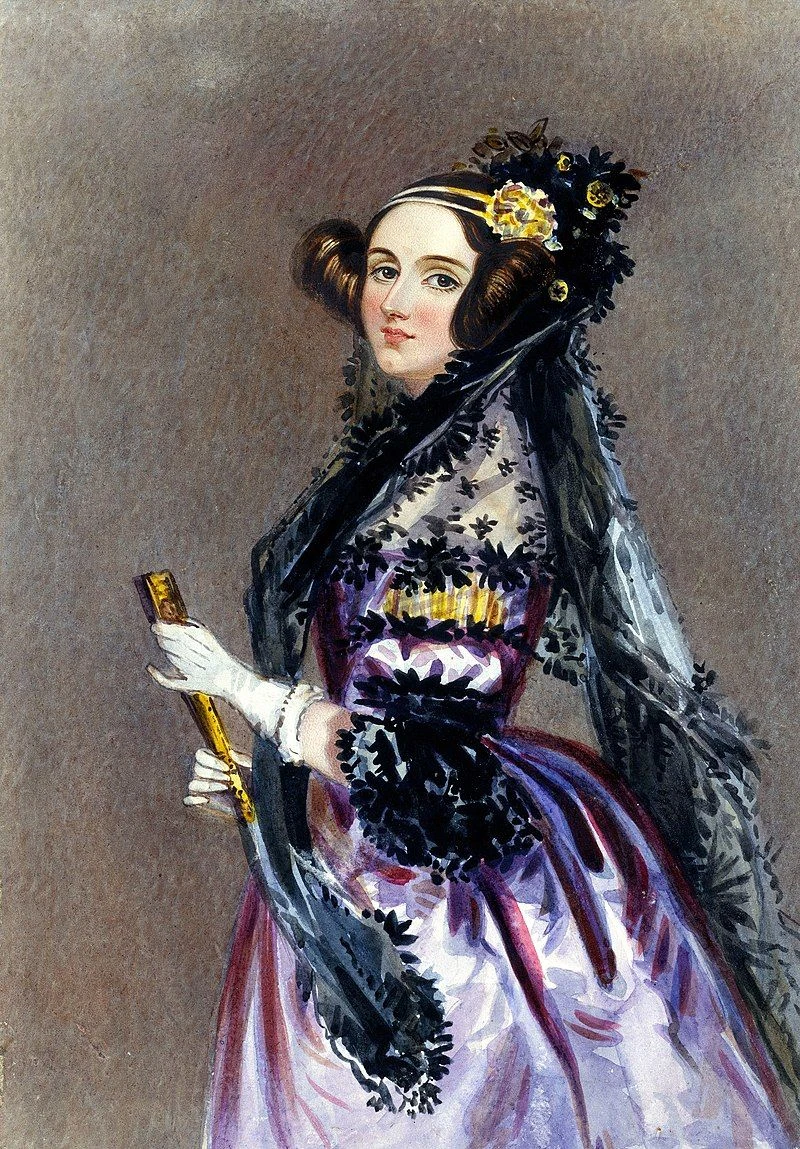
Ada Lovelace’s most enduring contribution to computing was not simply a set of instructions for a machine that was never built. In her 1843 notes on Charles Babbage’s proposed Analytical Engine, she explained how it might process information beyond arithmetic, including musical notation. The notes also set out a method for calculating Bernoulli numbers, now often described as the first published computer programme. Lovelace is frequently called the first computer programmer, though that label needs qualification: Babbage had prepared earlier, unpublished programmes for the engine.
A childhood shaped by study
Augusta Ada Byron was born in London on 10 December 1815, the only legitimate child of the poet Lord Byron and Anne Isabella Milbanke. Her parents separated when she was an infant; her father left England soon afterwards and had no relationship with her. He died in 1824, when Ada was eight. Her mother, who was interested in mathematics, arranged for her daughter to study the subject from an early age. Ada was privately taught mathematics and science by William Frend, William King and Mary Somerville, the researcher and scientific author who became a close friend.
Ill health interrupted her childhood. After measles left her paralysed in 1829, she spent a prolonged period at rest and later used crutches before recovering the ability to walk. Her curiosity nevertheless ranged widely. At twelve, she planned a project about flight, studying birds and considering materials for wings. She imagined recording her work in a book called Flyology. The project combined observation, calculation and invention: habits of mind that would also inform her later interest in machinery.
Her education continued into advanced mathematics. In the 1840s, Augustus De Morgan helped her study topics including calculus and Bernoulli numbers. Lovelace valued both scientific reasoning and imagination, describing her approach as “poetical science”. She was interested in how mathematical ideas could illuminate questions beyond calculation, and referred to herself as an “Analyst (& Metaphysician)”.
Meeting Babbage and the Analytical Engine
Lovelace met Charles Babbage in 1833 through Somerville. Babbage was developing the idea of the Analytical Engine, a proposed mechanical general-purpose computer. Lovelace became a close intellectual collaborator and took a particular interest in what the machine could do. Babbage later called her the “Enchantress of Number”. Their association mattered not because she designed the engine, but because she analysed its possible operations and explained them to readers.
In 1840, Babbage lectured on the Analytical Engine at the University of Turin. Luigi Menabrea, an Italian engineer, published an account of the lecture in French. Charles Wheatstone commissioned Lovelace to translate it into English. She worked on the translation during 1842–43, adding seven substantial notes, labelled A to G. The notes, published with the translation in 1843, were about three times as long as the original article.
Note G described a procedure for calculating a sequence of Bernoulli numbers. Because the engine was never completed, the procedure was never tested on it. Babbage had written programmes for the proposed machine several years earlier, but Lovelace’s method appeared in print and is often called the first published computer programme. The distinction is important: her place in computing history rests on the published explanation and its insight, not on a claim that nobody had previously written instructions for the engine.
Seeing beyond arithmetic
Lovelace understood that a programmable machine might manipulate symbols if those symbols could be represented in a form the machine could process. She used music as an example: if the relationships between notes could be expressed in this way, she argued, the engine might compose music. This was a significant extension of the idea of a calculating machine. It suggested that the same mechanism could work on different kinds of information, not only numbers.
Her notes also separated the engine’s mechanical construction from its logical operation. A machine’s physical parts and the mathematical processes arranged for it were different, though connected, problems. That distinction helped make a complicated proposal more intelligible. Babbage’s engine remained unrealised, and Lovelace’s writing did not bring about electronic computing. Its importance is in the clarity with which she described a general-purpose machine and considered what symbolic processing might make possible.
There are limits to the familiar image of Lovelace as a lone inventor of modern programming. Babbage had drafted earlier programmes, and historians have differed over the extent of her contribution to the Bernoulli-number method. She is often credited with the first published programme, while accounts also emphasise her role in explaining the engine and recognising the range of information it might process. Those distinctions preserve the achievement without turning a complex collaboration into a simple origin story.
Work, illness and remembrance
Lovelace’s interests extended beyond Babbage’s machine. She considered whether mathematical methods might describe the relation between the brain, thought and feeling, and in 1844 visited the electrical engineer Andrew Crosse to learn about electrical experiments. She also wrote about the possible relation between mathematics and music. These projects did not reach the same published form as her notes on the Analytical Engine, but they reflect her persistent interest in how mathematical ideas might be applied.
In 1835 she married William King, later the Earl of Lovelace, and became the Countess of Lovelace when he received that title in 1838. They had three children. Ada Lovelace died in London on 27 November 1852, aged 36, after an illness then described as uterine cancer. At her request, she was buried beside her father at St Mary Magdalene Church in Hucknall, Nottinghamshire.
Her name has since been attached to a programming language, awards and educational initiatives. Ada Lovelace Day, which began in 2009, celebrates women in science, technology, engineering and mathematics. In Britain, the British Computer Society awards the Lovelace Medal, and the Ada National College for Digital Skills teaches digital skills in London and Manchester. These commemorations keep her name connected both to computing and to the visibility of women’s work in technical fields.
Why Ada Lovelace deserves a place in British Legacy
Ada Lovelace deserves a place in British Legacy for a specific intellectual achievement: she helped explain what a programmable machine could be. Her 1843 notes did more than translate Menabrea’s account of Babbage’s Analytical Engine. They described a method for the machine to calculate Bernoulli numbers and considered how it might process information represented as symbols. Her example of music gave concrete form to a far-reaching idea: machinery designed for calculation might also work with other kinds of structured information. The engine was never built, and the first-programmer label is debated, but neither qualification erases the significance of her published analysis.
Her legacy also links mathematical education, scientific writing and public remembrance. In a period when women’s access to formal scientific and mathematical work was restricted, Lovelace pursued advanced study with the help of tutors and collaborators, and produced a substantial technical account under her initials. Today, British recognition includes the Lovelace Medal, Ada Lovelace Day and a specialist digital-skills college bearing her name. These are tangible connections between her nineteenth-century work and present-day efforts to recognise women’s contributions to technology and encourage participation in digital fields. Remembering Lovelace in British Legacy means acknowledging both the particular ideas she put into print and the careful, collaborative history behind them.
Sources
Ada Lovelace — Wikipedia revision 1379797630
Adapted in part from Ada Lovelace by Wikipedia contributors, under CC BY-SA 4.0. Text has been edited and combined with the existing article; this adapted text is shared under the same licence. Contributor history.