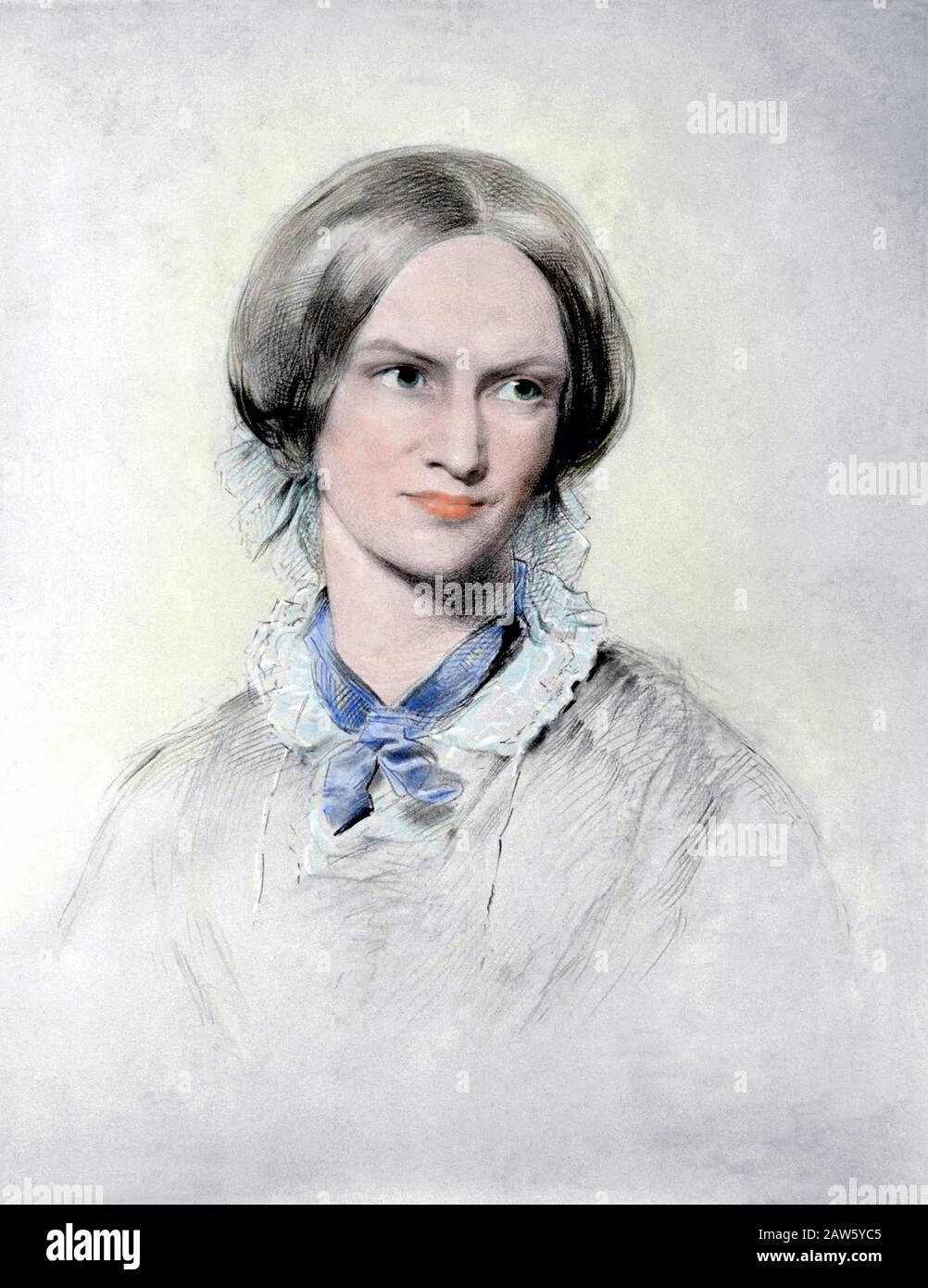
Published in 1847 under the name Currer Bell, Jane Eyre gave readers a heroine who insisted on her own moral judgement and independence. Its success made Charlotte Brontë a celebrated novelist, but the book grew from a life of teaching, governess work, family loss and sustained literary ambition. Her fiction drew on experience without simply reproducing it: schools, employment and time spent in Brussels became material for stories that placed women’s choices and desires at the centre.
Childhood, loss and the making of a writer
Charlotte Brontë was born on 21 April 1816 in Thornton, Yorkshire, the third of six children of Maria Branwell and Patrick Brontë, an Anglican clergyman. The family moved to Haworth in 1820, where Patrick became perpetual curate of St Michael and All Angels Church. Charlotte was five when her mother died in 1821. Her maternal aunt, Elizabeth Branwell, helped care for the children.
In 1824, Charlotte and her sisters Maria, Elizabeth and Emily were sent to the Clergy Daughters’ School at Cowan Bridge in Lancashire. Conditions were harsh, with poor food, insanitary surroundings and outbreaks of disease. After an outbreak of typhus in 1825, Maria and Elizabeth fell ill and died shortly afterwards at home. Charlotte later associated her ill health with her time at the school, and used Cowan Bridge as a model for Lowood in Jane Eyre.
Back at Haworth, the children read widely and invented stories together. Charlotte and her brother Branwell developed the imaginary world of Angria, while Emily and Anne created Gondal. These shared games grew into written narratives and small homemade publications. Charlotte’s early writing was not a passing diversion: she continued to create poems and stories as she moved between home, school and work.
In 1831, she became a pupil at Roe Head School in Mirfield. She left the following year to teach her younger sisters at home, then returned to Roe Head as a teacher from 1835 to 1838. The work could be lonely, and her writing offered an imaginative escape. In 1836 she wrote to poet laureate Robert Southey about her ambition to write; his response discouraged a literary career for women. Charlotte nevertheless continued to pursue one.
Work, Brussels and a first publication
Charlotte’s early employment included governess posts. Such work exposed her to the dependence and constrained position of women employed within other people’s households. In 1842, she and Emily travelled to Brussels to study at the Pensionnat Heger, a girls’ boarding school run by Constantin Heger and his wife. The sisters hoped to gain the skills needed to open a school of their own. Charlotte later returned to Brussels alone to teach, but homesickness and her growing attachment to Heger made the position difficult. Her experiences there later informed The Professor and Villette.
The sisters did try to establish a school at Haworth, advertising for pupils, but the project failed to attract enough interest and was abandoned in 1844. Their first book appeared two years later: in May 1846, they paid to publish a volume of poems under the names Currer, Ellis and Acton Bell. Charlotte chose Currer Bell. The book sold only two copies, but publishing under pseudonyms allowed the sisters to put their writing before readers while avoiding the prejudices they feared would attach to women authors.
Charlotte’s first novel, The Professor, was rejected by a publisher. She then sent a second manuscript to Smith, Elder & Co. Jane Eyre appeared in 1847 and was an immediate commercial success, attracting both praise and controversy. Its first-person narration brings the reader close to Jane’s thoughts, while its account of an orphan’s childhood, school years and employment as a governess gives the heroine’s emotional and moral life unusual weight. The novel combines personal experience with fiction, romance and Gothic drama.
After Jane Eyre: grief, novels and public life
The success of Jane Eyre brought Charlotte into contact with London’s literary circles, although she continued to live mainly at Haworth. The identities behind the Bell pseudonyms became public in 1848. Her next novel, Shirley, appeared in 1849. Written against a background of industrial unrest, it also examines women’s place in society. Its publication followed a period of profound family loss: Branwell died in September 1848, Emily in December, and Anne in May 1849. Charlotte returned to writing after Anne’s death and completed the novel while grieving for her siblings.
Charlotte also wrote an introduction to a new edition of Emily’s Wuthering Heights. She suppressed the republication of Anne’s The Tenant of Wildfell Hall, a decision that has remained controversial among the sisters’ biographers. This part of her story shows the complications of her role as a surviving sister and literary executor, not only her success as an author.
Villette, published in 1853, returned to a first-person female perspective. Its heroine, Lucy Snowe, travels to a fictional town inspired by Brussels, teaches in a boarding school and faces isolation and social restrictions. The novel’s treatment of desire and independence extended concerns already present in Jane Eyre, while drawing on Brontë’s own experience abroad.
In 1854, Charlotte married Arthur Bell Nicholls, her father’s curate. She died on 31 March 1855, aged 38, while pregnant. The cause remains uncertain in the account given here: her death certificate recorded phthisis, while biographers have suggested complications from severe pregnancy sickness. Her first novel, The Professor, was published posthumously in 1857.
A literary inheritance
Brontë’s novels continue to invite writers into conversation with her work. Jane Eyre has been a source of inspiration for later fiction, including Daphne du Maurier’s Rebecca and Jean Rhys’s Wide Sargasso Sea, which reimagines the story of Rochester’s first wife. Brontë’s own novels, particularly Jane Eyre and Villette, have also been cited by contemporary writers as important influences. Her story has reached audiences beyond the page through screen portrayals, including the BBC television film To Walk Invisible.
Her writing career was shaped by the conditions in which she lived: women’s limited employment choices, the expectations attached to feminine conduct, and a publishing world in which the sisters chose to conceal their identities. Yet the point is not simply that Brontë overcame barriers. In her fiction, questions of work, class, education and personal autonomy are part of the drama itself. Jane’s insistence on dignity and self-determination gives those questions a voice that remains recognisable to readers.
Why Charlotte Brontë deserves a place in British Legacy
Charlotte Brontë deserves a place in British Legacy because she changed what a Victorian novel could ask readers to attend to. In Jane Eyre, the heroine’s inner life is not a minor ornament to romance: it is the narrative’s centre. Jane’s experiences as an orphan, pupil and governess give the story a clear social setting, while her insistence on moral independence makes her more than a passive figure in it. Brontë’s use of first-person narration draws readers into that struggle and helped make the novel enduringly influential.
Her achievement was also the product of a working literary life. She wrote through years of teaching and governess work, studied and taught in Brussels, pursued publication after the rejection of her first novel, and continued after the deaths of her siblings. Shirley and Villette extended her examination of women’s place, work and desire, while the later influence of Jane Eyre can be traced in writers such as Jean Rhys and Daphne du Maurier. Brontë’s British legacy is therefore not a general claim about national character: it lies in the specific power of her novels to make women’s experience, judgement and independence central to literary life.
Sources
Charlotte Brontë — Wikipedia, revision 1371774901
Adapted in part from Charlotte Brontë by Wikipedia contributors, under CC BY-SA 4.0. Text has been edited and combined with the existing article; this adapted text is shared under the same licence. Contributor history.