Christopher Wren’s most recognisable achievement is St Paul’s Cathedral, but architecture was only one part of a career spanning mathematics, astronomy, experiment and public service. After the Great Fire of London in 1666, he became responsible for rebuilding churches across the City. The cathedral that emerged under his direction, completed in 1710, gave that recovery a defining landmark. Wren’s career joined scientific curiosity to the practical demands of designing and overseeing major public buildings.
A scientific education in Oxford and London
Wren was born in East Knoyle, Wiltshire, on 30 October 1632. He entered Wadham College, Oxford, in 1650, taking his BA in 1651 and MA in 1653. At Oxford he became part of the circle around John Wilkins, whose discussions and experiments contributed to the formation of the Royal Society. Wren was elected a fellow of All Souls’ College in 1653 and pursued research across subjects that included astronomy, mechanics, optics and physiology.
His scientific interests were practical as well as theoretical. He worked on instruments for observation, studied the Moon and investigated ways of measuring longitude. His experiments included injecting fluids into the bloodstream of a dog, and he designed a tipping-bucket rain gauge. He also devised a weather clock intended to record temperature, humidity, rainfall and barometric pressure; Robert Hooke completed a working instrument based on Wren’s design in 1679.
Wren’s university posts took him from Oxford to London and back. He became professor of astronomy at Gresham College in 1657 and Savilian Professor of Astronomy at Oxford in 1661. The meetings at Gresham helped lay the groundwork for the Royal Society, which received its royal charter in 1662. Wren was one of its active early members and served as president from 1680 to 1682. His scientific standing was recognised by contemporaries including Robert Hooke, and his interests brought a mathematician’s attention to measurement, structure and physical forces into his later architectural work.
From experiment to architecture
Wren’s first architectural commission was the chapel at Pembroke College, Cambridge, funded by his uncle Matthew Wren. Completed in 1665, it was followed by the Sheldonian Theatre in Oxford and work at Trinity College, Oxford, and Emmanuel College, Cambridge. He travelled to Paris in 1665, where he encountered French architecture and the work of Gian Lorenzo Bernini. It was his only recorded journey abroad, but it came at a moment when his academic career was opening into a new profession.
Wren had already been consulted about repairs to the old St Paul’s Cathedral before the Great Fire destroyed it. In September 1666, he surveyed the damage in London and submitted a plan for rebuilding the city to Charles II. The scheme, which proposed a more orderly street pattern, was not adopted. Wren nevertheless became central to the reconstruction of public buildings. He was appointed Surveyor of the King’s Works in 1669, and was responsible for rebuilding more than fifty City churches, though the designs and contributions of his office varied. Nicholas Hawksmoor and other colleagues also played important roles in the work.
The scale of the destruction did not mean that Wren could simply impose a single vision. The plans for St Paul’s changed as he negotiated royal approval, church requirements, cost and construction. A grand design known as the Great Model was followed by the more constrained Warrant Design. The cathedral ultimately built differed from that warrant. Work continued for decades, and the first service took place in 1697. Parliament declared the cathedral complete in 1711; its celebrated dome had been built under Wren’s direction, while its interior was later painted by James Thornhill.
A capital shaped by public buildings
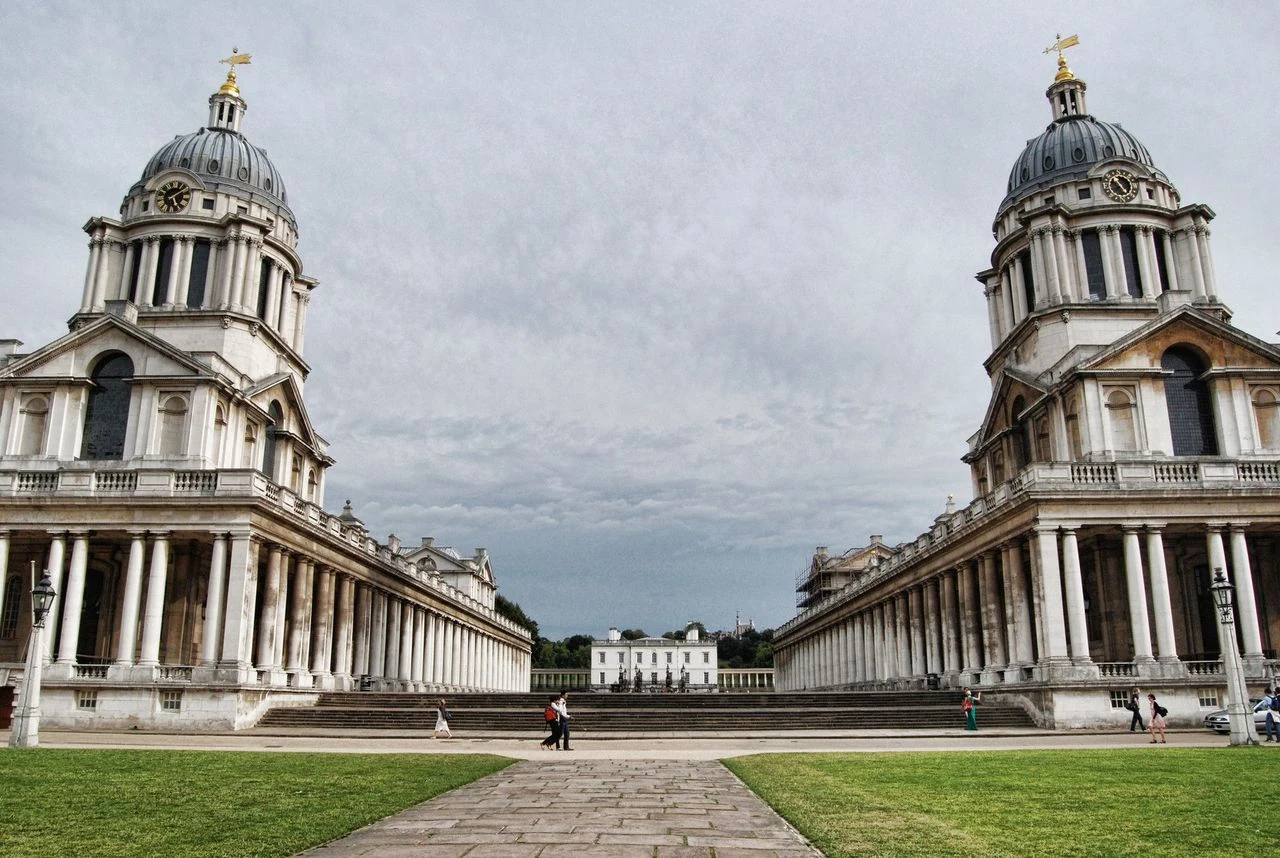
St Paul’s became the centrepiece of a much wider body of work. Wren designed or oversaw churches including St James’s, Piccadilly, and St Mary-le-Bow. His secular commissions included the Monument to the Great Fire, developed with Robert Hooke, the Royal Observatory at Greenwich and the Wren Library at Trinity College, Cambridge. He also worked on the Royal Hospital Chelsea, the Old Royal Naval College at Greenwich, and royal buildings at Hampton Court and Kensington Palace.
These projects show the range of responsibilities attached to Wren’s office. He did not merely draw buildings: as Surveyor of the King’s Works, he was involved in public and royal construction over many years. His architectural language drew on classical forms and the Baroque, while his scientific interests informed an approach attentive to geometry, structure and the use of space. The result was not a uniform style imposed on every commission, but a body of work in which ceremonial buildings, churches and institutions answered different practical and public needs.
Wren’s urban vision was more ambitious than the reconstruction that London’s authorities allowed. His proposed plan for the city after the fire would have replaced much of its tangled street pattern with broader routes and open spaces, but it remained on paper. Rebuilding proceeded within the constraints of existing property boundaries and the laws passed after the fire. Wren’s role was therefore both influential and limited: he helped direct the rebuilding of major civic and religious buildings, but did not remake the city according to his own complete design.
Office, family and final years
Wren was knighted in 1673. His public career also included service in Parliament, although he sat only briefly and his elections for New Windsor were declared void. He married Faith Coghill in 1669; she died in 1675, after the birth of their two sons. In 1677 he married Jane Fitzwilliam, with whom he had a daughter and a son. She died in 1680. Wren did not marry again.
His long tenure as Surveyor of the King’s Works ended in 1718, when he was replaced by William Benson. By then, Wren’s authority and architectural taste had faced criticism, including objections to his control of royal works and to the design of St Paul’s. He lived to see the cathedral finished, having directed its construction for 36 years. Wren died in London on 8 March 1723, aged 90, and was buried in the crypt of St Paul’s Cathedral.
The inscription associated with his memorial includes the words Lector, si monumentum requiris, circumspice—“Reader, if you seek his monument, look around you.” It is an apt epitaph for an architect whose work remains visible in buildings across London and beyond. Among later measures of that continuing recognition, Greenwich Hospital, designed largely by Wren, was inscribed on UNESCO’s World Heritage List in 1997.
Why Christopher Wren deserves a place in British Legacy
Wren deserves a place in British Legacy because his work connected scientific enquiry with the rebuilding of public life. His route from Oxford’s mathematical and experimental circles to responsibility for major construction was not a simple change of profession: the habits of observation and problem-solving evident in his scientific work also mattered in the design and execution of buildings. As Surveyor of the King’s Works, he helped direct the reconstruction of churches after the Great Fire, while St Paul’s Cathedral became the most enduring expression of that work. Its completion in 1710 gave London a new landmark and made visible the effort to rebuild after a disaster that had destroyed much of the City.
His legacy is also broader than a single famous dome. Wren’s commissions included religious buildings, scientific institutions, hospitals, libraries and royal projects. They served different purposes, from worship and education to public administration and care. His proposed plan for a more orderly London was not carried out, a reminder that the shape of a city depends on law, ownership and public decisions as well as architectural ideas. Yet the churches and institutions built under his direction helped define the capital’s post-fire landscape, and Greenwich Hospital’s later World Heritage recognition underlines the lasting cultural value of one of his major projects. Wren’s place in British history rests on this combination: scientific range, public responsibility and buildings that continue to give form to the city’s past.
Sources
Christopher Wren — Wikipedia revision 1379799809
Adapted in part from Christopher Wren by Wikipedia contributors, under CC BY-SA 4.0. Text has been edited and combined with the existing article; this adapted text is shared under the same licence. Contributor history.