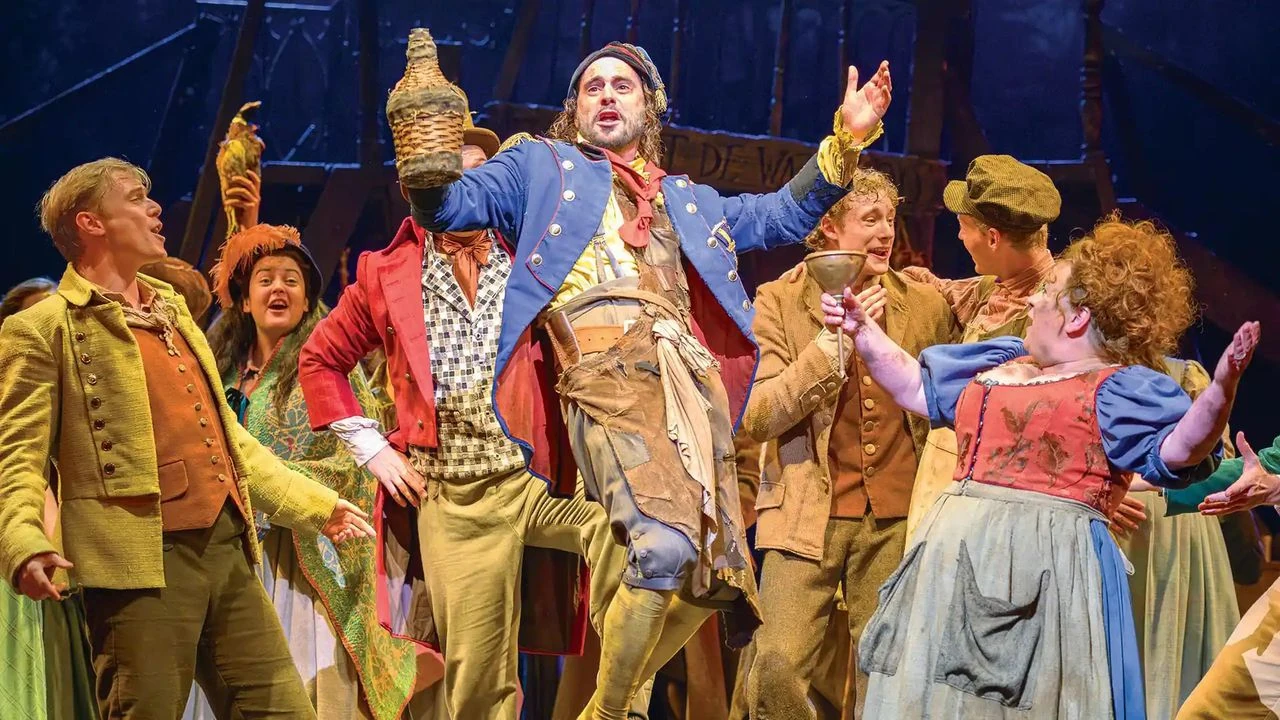
When Les Misérables reached the Barbican in London in 1985, it brought a French story and a French musical to an English-language stage. The adaptation would become a long-running West End production, but its story is rooted in a specific moment in Paris: the June Rebellion of 1832. At its centre is Jean Valjean, a former convict trying to build an honest life while the law and his past continue to pursue him.
From Hugo’s novel to the London stage
Victor Hugo’s Les Misérables was first published in 1862. The novel follows lives shaped by poverty, social exclusion and political upheaval, with Valjean’s attempt at redemption providing its main thread. Its story begins in 1815 and culminates in the 1832 June Rebellion. The musical is one of many adaptations of the novel; its English-language version premiered at the Barbican Centre on 8 October 1985.
The stage adaptation has music by French composer Claude-Michel Schönberg and lyrics by Herbert Kretzmer, following an original French libretto by Alain Boublil and Jean-Marc Natel. The musical first appeared in French in 1980, before the London production brought the work to English-speaking audiences. The 1985 production was directed by Trevor Nunn and John Caird and produced by Cameron Mackintosh.
After its Barbican premiere, the production transferred to the Palace Theatre and later to the Queen’s Theatre, now the Sondheim Theatre. Its continuing West End presence has made it one of the longest-running musicals in the history of that theatre district. The production’s rotating stage became a distinctive element of its staging, helping move between locations and action. The longevity of the show rests not only on its scale, but on the way its songs and intertwined character stories carry the narrative forward.
A story of poverty, law and compassion
Valjean has served 19 years in prison for stealing bread and attempting to escape. Released on parole, he finds that his status as a former convict closes off the chance of an ordinary life. The bishop of Digne responds to him with mercy, an encounter that becomes the turning point in Valjean’s effort to change. He takes a new identity and tries to use his position and resources for good, but Inspector Javert remains determined to bring him back under the law.
Valjean’s promise to protect Cosette links his story to that of Fantine, her mother. After Fantine is abandoned by Cosette’s father, she leaves the child with the Thénardiers, innkeepers who exploit her and demand more money. Fantine is dismissed from her work after her daughter’s existence becomes known. To meet the innkeepers’ demands, she sells her hair and teeth and turns to prostitution. Valjean, whose factory has contributed to her hardship, intervenes when Javert arrests her and undertakes to find Cosette.
He rescues Cosette from the Thénardiers and raises her. Later, she falls in love with Marius Pontmercy, a young man caught between his family’s politics and the revolutionary students with whom he associates. Éponine, the Thénardiers’ daughter, loves Marius without hope of winning him. Around them, Javert’s absolute faith in the law and Valjean’s acts of mercy press the same question: what should justice mean when enforcing the rules can cause harm?
These characters and their conflicts come from Hugo’s novel, which examines law and grace, poverty, political life and romantic and familial love. The musical’s story culminates in the Paris uprising of 5–6 June 1832, following the death of General Lamarque. This is not the French Revolution of 1789: it is a later rebellion, and the distinction matters to the setting of the story. The barricades bring the students’ political struggle into direct contact with Valjean’s personal choices.
Songs, spectacle and a long West End life
The musical joins the personal stories to the unrest around them. Songs including “I Dreamed a Dream”, “On My Own”, “Do You Hear the People Sing?” and “One Day More” give voice to characters facing loss, unrequited love, political action and uncertainty. The songs are part of a score that moves between individual experience and collective struggle, helping an audience follow several lives as they converge.
The scale of the production also relies on stagecraft. Its rotating stage supports swift changes of place and gives the action a visual momentum, particularly as the story approaches the barricades. The London production’s transfer from the Barbican to the Palace Theatre, and then to the Queen’s Theatre, carried the show into the West End’s long-running theatrical life. Its later home at the Sondheim Theatre connects the production’s successive venues to the same London story.
Les Misérables has travelled far beyond London: the article reports performances in more than 40 countries and translations into 22 languages. Its adaptations include the 2012 film of the musical, which brought the story and songs to another audience. These versions belong to a much longer history of retelling Hugo’s novel across stage and screen. The musical’s West End run is one particularly visible part of that international history, and an example of a London production becoming a continuing cultural reference point.
Why Les Misérables deserves a place in British Legacy
Les Misérables deserves a place in British Legacy because its London history is a substantial achievement in British theatre, even though the story and the original musical came from France. The English-language production opened at the Barbican in 1985 under the direction of Trevor Nunn and John Caird, with Cameron Mackintosh as producer. Its subsequent transfers to the Palace Theatre and the Queen’s Theatre, now the Sondheim Theatre, established a sustained West End presence. That chronology gives the British connection specificity: London was not the origin of Hugo’s novel or the first home of the musical, but it became the home of a major English-language production.
The work’s stage life also gives British audiences an enduring encounter with a story about poverty, exclusion, political unrest and the demands of compassion. Its rotating stage and its combination of individual songs with a large ensemble narrative help make that story legible as theatre, while songs such as “I Dreamed a Dream” and “Do You Hear the People Sing?” have carried it beyond the theatre. The production’s international reach, reported across more than 40 countries, gives the West End run a further significance: a London staging formed part of a work that travelled widely. Its legacy is not a claim that the musical is British in origin, but recognition of the role London theatre played in its long public life.
Sources
Les Misérables — Wikipedia revision 1378847917 · Les Misérables — Wikipedia
Adapted in part from Les Misérables by Wikipedia contributors, under CC BY-SA 4.0. Text has been edited and combined with the existing article; this adapted text is shared under the same licence. Contributor history.