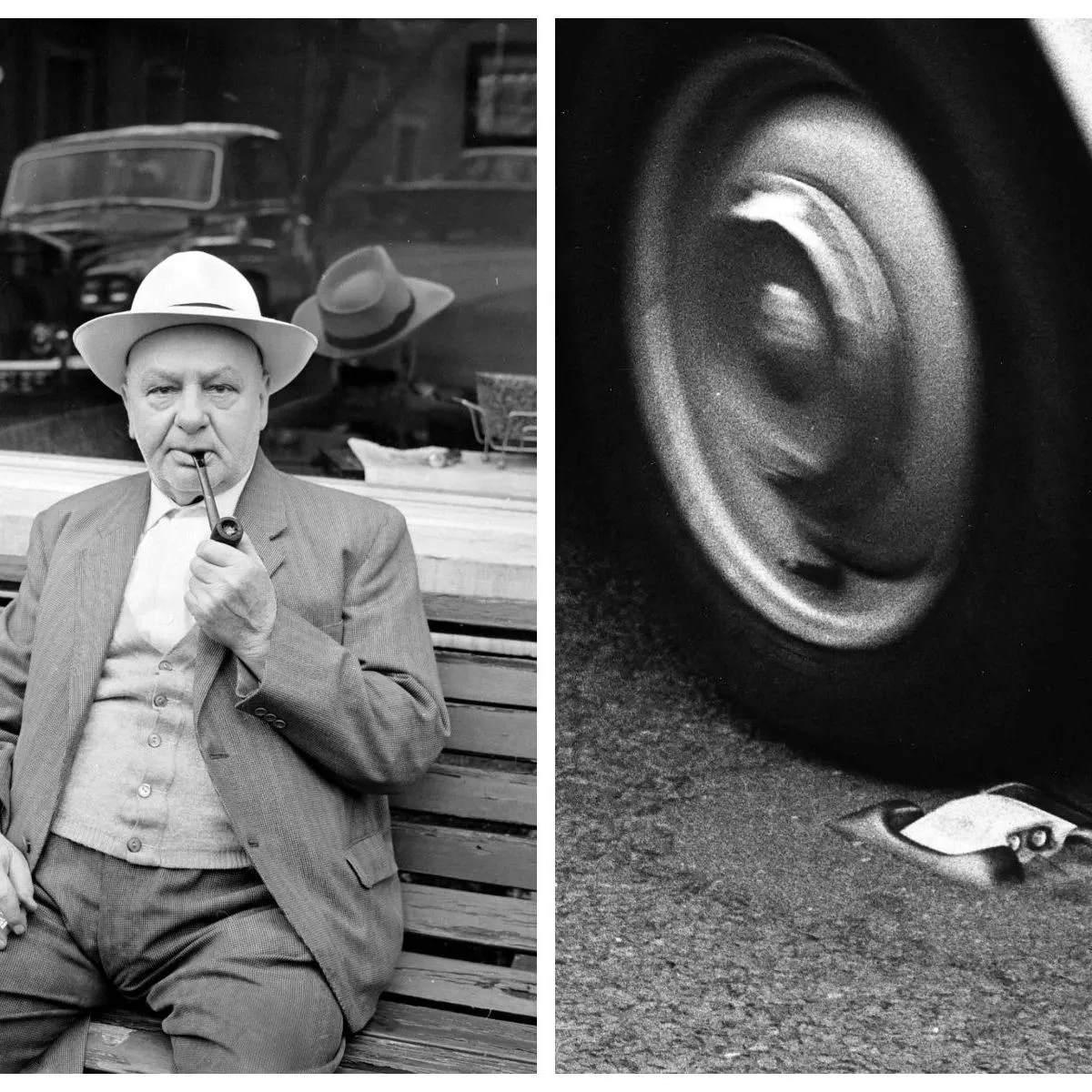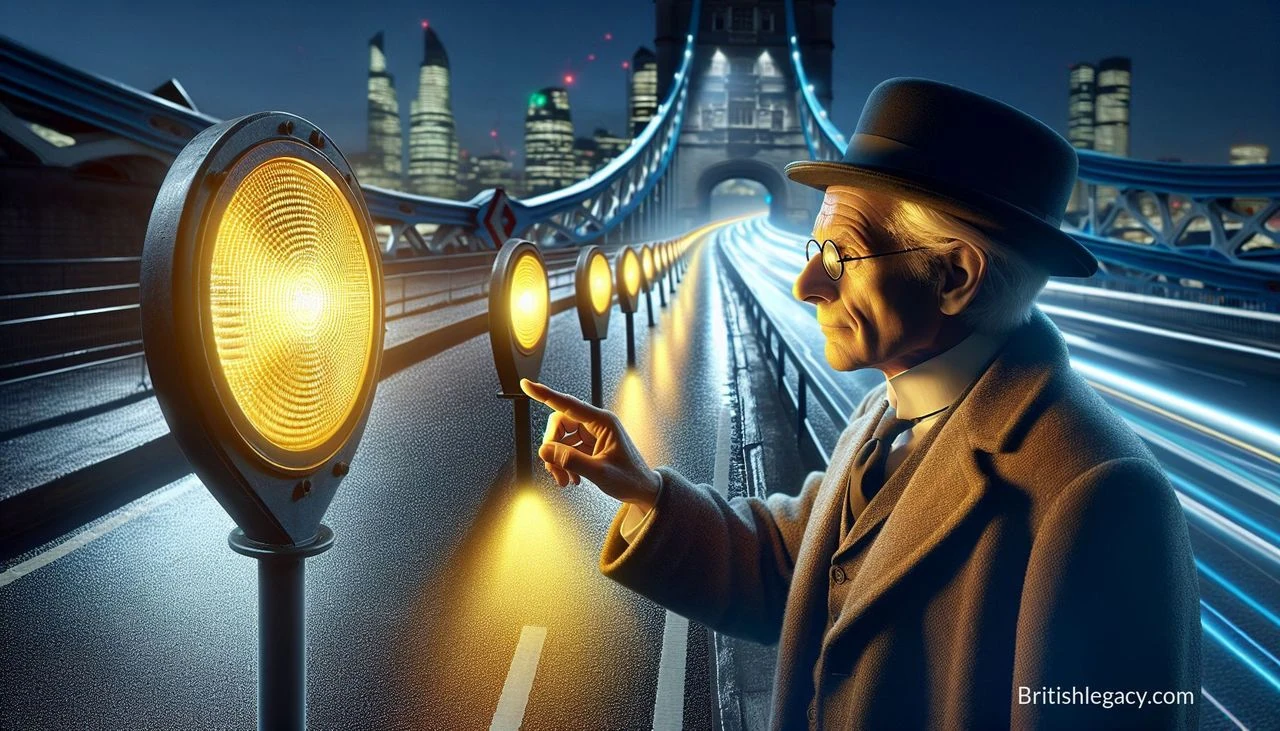
At night, a driver needs more than a visible destination: the road itself must be legible. Percy Shaw, an inventor and businessman from Halifax, addressed that problem with a small reflector set into the carriageway. His cat’s eye returned a vehicle’s headlamp light towards its driver, helping to show the line of the road in darkness. Shaw patented the invention in 1934 and established a company to manufacture it in 1935. Its success came not from optics alone, but from adapting the idea to the harsh conditions of a working road.
The story reaches from a Halifax road contractor’s experience to wartime demand and an expanding export business. It also carries an uncertainty familiar in invention histories: several accounts explain how Shaw first conceived the device, and the supplied record does not settle which is correct. What is clear is the sequence that followed: a patented design, a manufacturing company in Boothtown, Ministry of Transport approval and a product that became useful far beyond Yorkshire.
From Boothtown school to road contracting
Percy Shaw was born in Halifax, in the West Riding of Yorkshire, on 15 April 1890. His father, James Shaw, was a dyehouse labourer at a local mill; his mother, Esther Hannah Morrell, was James’s second wife. Percy was the fourth child and second son of that marriage. In 1892, the family moved to Boothtown, where Shaw lived for most of his life.
He attended Boothtown Board School and left at 13 to work as a labourer in a cloth mill. He later became apprenticed to a wire drawer. The wages on offer did not attract him, and he moved instead through a succession of unskilled jobs in local engineering works. These were not years of formal engineering study. They placed him among the trades and workplaces of an industrial town, where machinery had to function and be repaired.
During the First World War, Shaw joined his father in a business repairing small machine tools used in munitions production. When his father died in 1929, Shaw began a small road-contracting business of his own. He repaired roads and continued as a contractor until his death. That working life matters to the invention’s history: the cat’s eye was intended for the road surface, not a laboratory demonstration. It would have to remain visible in the place where wheels, water and dirt met.
Shaw’s story is consequently tied to both a particular place and a practical trade. Halifax was his home, and Boothtown was not simply the location of a factory added later to an otherwise distant biography. The company that manufactured his invention was established near his home. The local setting helps explain the route from road work to road design, while the product’s subsequent spread shows how an improvement made in one district could meet a need elsewhere.
Several accounts of the idea
The best-known account places Shaw on the difficult road between Clayton Heights and Halifax. A cat on a fence looked towards his car; the reflection from its eyes helped him keep his bearings near a steep drop. It is a memorable origin story, but it is not the only one associated with him.
In an interview with Alan Whicker, Shaw gave a different account: on a foggy night, he began thinking about moving the reflective studs used on road signs down to the road surface. Schoolchildren who visited the factory in the late 1970s were also told that the idea followed from seeing his headlights reflected by polished tram tracks in fog. The accounts should not be made into one definitive anecdote. Taken together, they describe a practical question: how might a driver follow the road when darkness or poor visibility makes its course difficult to see?
Shaw patented the road-stud invention in 1934. The supplied biographical record notes that its design drew on an earlier patent for a retroreflecting lens by Richard Hollins Murray. Retroreflection sends light back towards its source rather than scattering it widely. For a driver, that means the vehicle’s own headlamps can illuminate a marker and receive reflected light in return. The stud could therefore provide a point of guidance without needing its own powered lamp.
The device’s significance was not just that it reflected light. It had to be placed at road level, where a reflector faced repeated traffic and the grime of the carriageway. A concept that worked only when clean and untouched would have offered little dependable help. Shaw’s design addressed that challenge with a mechanism that moved when a vehicle passed over it, helping to clean the glass eyes.
Making a reflector work on the road
The road stud’s construction combined glass lenses, a rubber shoe and a cast-iron base. The later design included a rainwater reservoir in the rubber shoe. As a car drove over the stud, the resulting movement could use water to wash the glass. This self-cleaning action addressed one of the basic problems with putting an optical marker in a dirty, exposed location: a lens that became obscured could no longer return a useful signal.
Shaw’s patents recorded the development of the invention, including a later refinement to its cleaning mechanism. The design was not simply a reflector placed on the road; it was a device arranged to work under the pressure of passing vehicles and to maintain its visibility. In practical terms, the optical principle and the moving construction belonged together. One returned the headlamp beam; the other helped keep the lenses clear enough to do so.
That combination helps explain why the cat’s eye could become infrastructure rather than remain a striking idea. It needed to perform repeatedly in its intended setting. Shaw’s work connected road contracting, mechanical design and manufacture: the invention had to be made in quantity as well as function in use. Its form addressed a problem drivers could encounter on any unlit road, but its production began close to Shaw’s own home.
In 1935, he formed Reflecting Roadstuds Ltd to manufacture the devices in Boothtown. Sales were initially slow. The existence of a useful design did not by itself ensure adoption; institutional approval and demand were also necessary. The Ministry of Transport approved the device, and wartime conditions soon made the case for visible road guidance more urgent.
Blackouts and the growth of the business
During the Second World War, blackout restrictions reduced street lighting. Drivers faced roads with fewer familiar visual references, while adding conventional illumination was not the answer to the conditions. A cat’s eye used the approaching vehicle’s own headlamps: it marked the road without needing to shine a separate light. That made the device useful precisely when darkness had become a more immediate obstacle to travel.
The supplied biographical record describes Ministry approval and the wartime blackout as the combination that gave production and the firm a major boost. The device did not remove the risks of night driving, but it offered a means of reading the course of the road through reflected points of light. Its appeal was direct: the marker sat where the driver needed to understand the road, and its light came from the vehicle already approaching it.
After the war, Reflecting Roadstuds Ltd expanded. The Boothtown factory produced more than a million road studs a year, and the business exported them around the world. The growth connected a local manufacturing operation with a widely shared difficulty: roads in many places become harder to read when visibility fails. The product’s usefulness was not confined to the circumstances that had accelerated its wartime adoption.
Export success also helps put Shaw’s honour in context. In 1965, he was appointed an Officer of the Order of the British Empire for services to exports. The recognition related not only to an invention but to the manufacturing enterprise that made it available at scale. The cat’s eye was a patented design, a road product and the basis of a business; these parts of the story are linked rather than competing explanations of his achievement.
Halifax, recognition and remembrance
Shaw remained closely associated with Boothtown and Halifax. The supplied biographical account says that he lived in Boothtown for all but two of his 86 years. That continuity distinguishes his story from one in which a local invention quickly becomes detached from its origins. His work travelled, but the manufacturing base and the person behind it remained rooted in the town.
Local commemoration has carried that connection forward. A blue plaque was erected by the Halifax Civic Trust, and a pub in Broad Street, Halifax, was named for Shaw. The University of Huddersfield also renamed its Queen Street Studios building Percy Shaw House. These tributes recognise both the individual and the connection between his work and the area in which he lived and established the manufacturing business.
Shaw died at Boothtown Mansion, Halifax, on 1 September 1976. His lasting public presence does not depend only on plaques or a building name. The road stud became familiar as a practical feature of roads, while the account of its development traces an invention from a local contractor’s working life through patenting, manufacturing and export. The contrast between its modest scale and its broad use is central to the story.
Why Percy Shaw deserves a place in British Legacy
Percy Shaw deserves a place in British Legacy because he turned a common difficulty of night driving into a practical design that could be installed where the difficulty arose. The cat’s eye returned vehicle headlamp light towards the driver, helping make the road’s course visible without a separate powered light. Shaw’s achievement depended on more than recognising that reflection might help. He patented a road stud, developed a construction with a self-cleaning action and established a company to manufacture the device. Design, use and production all mattered to its eventual reach.
His British connection is specific. Shaw was born and worked in Halifax; his road-contracting experience preceded an invention manufactured by a company established in Boothtown. The wartime blackouts created conditions in which its value became more evident, and the business that grew around it exported road studs around the world. His 1965 OBE for services to exports records that commercial dimension. Local commemoration in Halifax and Huddersfield keeps the Yorkshire origins visible alongside the international reach.
The cat’s eye did not eliminate danger, and the evidence does not justify claims that it saved a particular number of lives. Its documented contribution is more precise: it gave drivers a reflective guide to the road, and its design was suitable for manufacture and use at scale. That is a substantial legacy in its own right. Shaw’s career shows how experience in a local trade can inform an invention with wider application, and how a useful idea becomes consequential when it is made durable, accepted and produced in quantity. The small marker on the road carries a story of applied engineering, British manufacturing and a lasting link to Halifax.
Sources
Adapted in part from Percy Shaw by Wikipedia contributors, under CC BY-SA 4.0. Text has been edited and combined with the existing article; this adapted text is shared under the same licence. Contributor history.