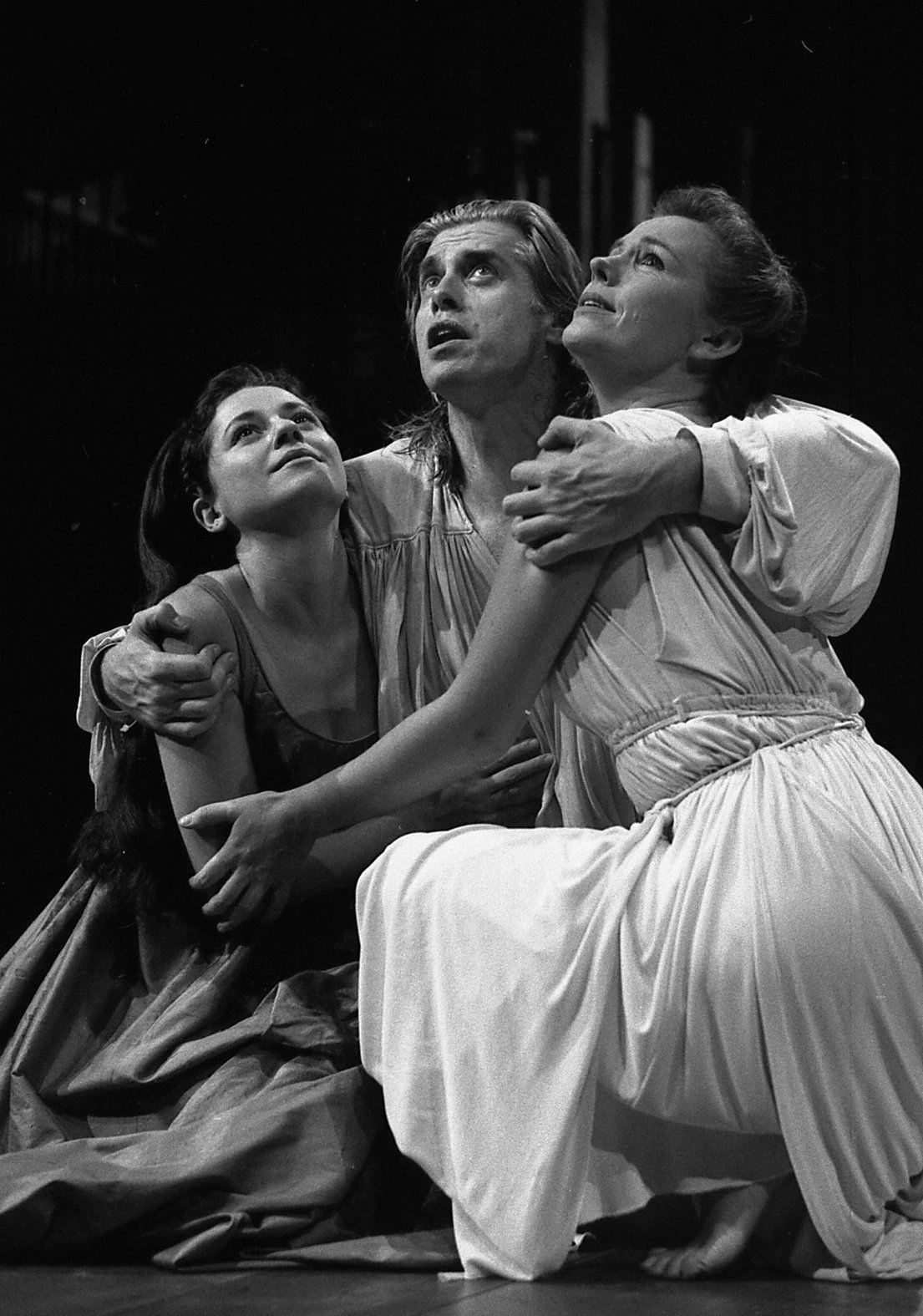
In Pericles, Prince of Tyre, a prince escapes a murderous court only to be carried through a succession of voyages, losses and improbable reunions. Its story ranges from a riddle about incest to a shipwreck, a daughter’s disappearance and a final family reunion. The play’s shifting locations and episodic structure have challenged critics and theatre-makers, but also give it the scale and movement of a story told across the sea.
A play with more than one author
Pericles is a Jacobean play associated with William Shakespeare, but its authorship has long been debated. Modern textual scholarship generally assigns Shakespeare about half the play, principally the later portion following Pericles and Marina, while the first two acts are often attributed to a collaborator. George Wilkins is the leading candidate: he wrote a prose version of the story, and stylistic comparisons have been used to support his involvement. Some editors, however, have argued that Shakespeare wrote the whole play. The collaboration is therefore a widely held account, not an undisputed fact.
The play draws on the story of Apollonius of Tyre in John Gower’s Confessio Amantis and on Lawrence Twine’s prose retelling, The Pattern of Painful Adventures. Gower also appears as the play’s Chorus, introducing its acts and helping audiences follow a story that spans years and several distant settings. The work reflects an older narrative tradition as well as the theatre of Shakespeare’s period: its adventures come through a combination of inherited story, stage spectacle and direct narration.
Pericles was printed in quarto in 1609, but was not included in Shakespeare’s First Folio of 1623. It entered the collected Shakespeare canon in the Third Folio of 1664. The surviving quarto text is widely regarded as corrupt, with passages that are difficult to make sense of. Some modern editions have used material from Wilkins’s prose version to reconstruct a more readable text, an editorial choice that itself depends on arguments about the play’s composition.
From Antioch to the sea
The plot begins in Antioch, where King Antiochus offers his daughter in marriage to any suitor who can answer a riddle. Pericles understands that it exposes the king’s incestuous relationship with her. An answer could bring death, but so could silence: Antiochus sends an assassin after the prince, who flees. Back in Tyre, Pericles leaves his trusted adviser Helicanus as regent and sails to Tarsus, where he gives grain to the famine-stricken city.
A storm wrecks his ship and carries him to Pentapolis. Rescued by fishermen, Pericles learns that King Simonides is holding a tournament, with his daughter Thaisa’s hand as the prize. He enters in weathered armour, wins and marries her. A later storm strikes while the couple are at sea. Thaisa appears to die giving birth to Marina, and the sailors insist that her body be committed to the water. Her casket reaches Ephesus, where the physician Cerimon revives her. Believing Pericles dead, she becomes a priestess of Diana.
Pericles leaves Marina with Cleon and Dionyza, the rulers of Tarsus, while he returns to Tyre. As Marina grows up, Dionyza plots her murder, but pirates abduct her and sell her to a brothel in Mytilene. Marina resists her exploitation by persuading men to pursue virtue; she is subsequently employed teaching music and other accomplishments. Meanwhile, Pericles returns to Tarsus and is told that his daughter has died. Grief drives him back to sea.
In Mytilene, its governor Lysimachus brings Marina to the silent, despairing Pericles. Father and daughter recognise one another through their stories. A vision of Diana then leads Pericles to Ephesus, where he discovers that Thaisa is alive. The family is reunited; Marina is to marry Lysimachus, and Pericles returns to rule Tyre. The play’s ending turns its long succession of separations into a restoration, though not without leaving the violence and exploitation of the journey in view.
A difficult text, a changing stage life
The precise date of composition is uncertain; many scholars place the play in 1607 or early 1608. Its quarto was reprinted several times between 1609 and 1635, evidence of its early circulation. The earliest performance known with certainty took place at court in May 1619. The first edition’s title page says it had often been performed at the Globe, and a performance there is recorded in 1631. These traces point to a play that found an audience in Shakespeare’s own theatrical world, despite the difficulties of its surviving text.
Its fortunes later shifted. John Rhodes staged it at the Cockpit soon after the theatres reopened in 1660, with Thomas Betterton in the title role. It then disappeared from the stage for nearly two centuries, until Samuel Phelps revived it at Sadler’s Wells in 1854. Victorian sensibilities led to cuts or softening of its frank treatment of incest and prostitution. Walter Nugent Monck brought it back in 1929 at the Maddermarket Theatre in Norwich, cutting the opening act; the production later appeared at Stratford with Paul Scofield as Pericles.
Twentieth-century productions made different choices about how to give the play coherence. Tony Richardson’s 1958 Stratford production used a large ship as a unifying stage image, while Terry Hands’s 1969 staging used a nearly bare stage, extensive doubling and Emrys James as Gower. Later directors have often embraced rather than concealed the changes of place, tone and time. Phyllida Lloyd’s 1994 National Theatre production used a mechanised wheel to suggest movement through time and space. In 2015, Shakespeare’s Globe presented the play in the candlelit Sam Wanamaker Playhouse, with Sheila Reid as Gower and James Garnon as Pericles.
Performance has also extended beyond the theatre. The BBC adapted the play for its television Shakespeare series, first broadcast in 1984, and later produced radio versions, including broadcasts in 2005 and 2017. In 2024, the Royal Shakespeare Company staged a Stratford-upon-Avon production directed by Tamara Harvey, with Alfred Enoch as Pericles, before taking it to Chicago Shakespeare Theater. Each version has had to answer the same practical question: how to make a story of distant places and long intervals legible in a live performance.
Why Pericles, Prince of Tyre deserves a place in British Legacy
Pericles deserves a place in British Legacy not because every claim made for its influence can be measured, but because its history illuminates the movement of British theatre across centuries. Printed in Shakespeare’s lifetime, omitted from the First Folio and later added to the collected works, it preserves a striking case of uncertainty about authorship and textual survival. Its engagement with Gower and the Apollonius story also shows Shakespearean drama working with material from an earlier English literary tradition rather than emerging in isolation.
The play’s stage history makes that legacy tangible. Its return at the Cockpit after the Restoration, its long absence, and its revival at Sadler’s Wells and Stratford show how each period has decided what can be performed, what must be cut and how an episodic story can be made coherent. Later productions at the National Theatre, Shakespeare’s Globe and the Royal Shakespeare Company have kept the work in conversation with audiences through new staging choices, while BBC television and radio have carried it beyond the playhouse. Its contribution is not a simple, uninterrupted triumph: it is a continuing record of British performers and institutions reinterpreting a difficult, collaborative and enduringly theatrical work.
Sources
Pericles, Prince of Tyre — revision 1375497516
Adapted in part from Pericles, Prince of Tyre by Wikipedia contributors, under CC BY-SA 4.0. Text has been edited and combined with the existing article; this adapted text is shared under the same licence. Contributor history.