Peter Cook’s architectural career has moved between imagined cities and buildings that people can enter. As a founder of Archigram, he helped develop a strikingly flexible, technology-minded vision of urban life. Later, projects including the Kunsthaus Graz brought his distinctive approach into built form. Alongside design, Cook has taught, written and curated exhibitions, sustaining a career that links British architectural education and debate with work and audiences around the world.
Training in Bournemouth and London
Born in Southend-on-Sea, Essex, on 22 October 1936, Cook studied architecture at Bournemouth College of Art from 1953 to 1958. He then went to the Architectural Association School of Architecture in London, graduating in 1960. That sequence took him from art-college training to one of London’s established architectural schools at a time when he and his peers were looking for new ways to communicate architectural ideas.
Cook’s early recognition included a mention in the 1961 Piccadilly Circus competition and first prize in the 1962 Gas Council House Design competition. In 1965, he was selected for the Sunday Times exhibition “Young British Designers”. These milestones preceded the work that would make his name internationally: a series of proposals developed with Archigram, where architecture could be explored on the page as well as through conventional plans for construction.
Archigram’s architecture in print
Cook co-founded Archigram with Warren Chalk, Ron Herron, Denis Crompton, Michael Webb and David Greene in the early 1960s. The name brought together “architecture” and “telegram”, expressing the group’s interest in circulating ideas quickly. Its magazines provided a platform for speculative designs that challenged expectations about how buildings and cities should look or work. The group’s proposals put technology, movement and change at the centre of architectural thinking.
Plug-In City imagined a metropolis assembled from replaceable or upgradeable elements. Rather than treat the city as a finished, unchanging composition, the proposal pictured an environment able to adapt as its needs changed. Walking City took mobility further: urban structures on telescopic legs could move from place to place. These were proposals, not completed cities, but their vividness made them ways to test assumptions about permanence, infrastructure and the scale of urban life.
Archigram’s practice extended beyond particular designs. Cook’s books included Architecture: Action and Plan (1967), Experimental Architecture (1970) and Archigram (1972). His later publications ranged from Melting Architecture and Arcadia: The Search for the Perfect Suburb to Drawing: The Motive Force of Architecture and Architecture Workbook: Design through Motive. Taken together, the titles document an interest in architecture as a process of thinking and drawing, not only as the delivery of a finished building.
Teaching, institutions and international work
Cook’s influence in Britain also developed through education and cultural institutions. He directed London’s Institute of Contemporary Arts from 1970 to 1972 and chaired architecture at the Bartlett School of Architecture, University College London, from 1990 to 2006. His academic appointments have included professorships at the Royal Academy, UCL and the Hochschule für Bildende Künste (Städelschule) in Frankfurt. He has also been a Senior Fellow of the Royal College of Art and a Professor Emeritus at UCL.
He has worked as a director of Art Net in London and curated the British Pavilion at the Venice Architecture Biennale in 2004. His curatorial work has included the Cyprus Pavilion in 2006, while exhibitions of Archigram’s work have travelled to cities including Vienna, Paris, New York, London, Chicago, Seoul and Taipei. Personal exhibitions have also been held in places including Los Angeles, Tokyo, Oslo and Berlin. The range of settings reflects a career in which teaching, public display and architectural practice have developed alongside one another.
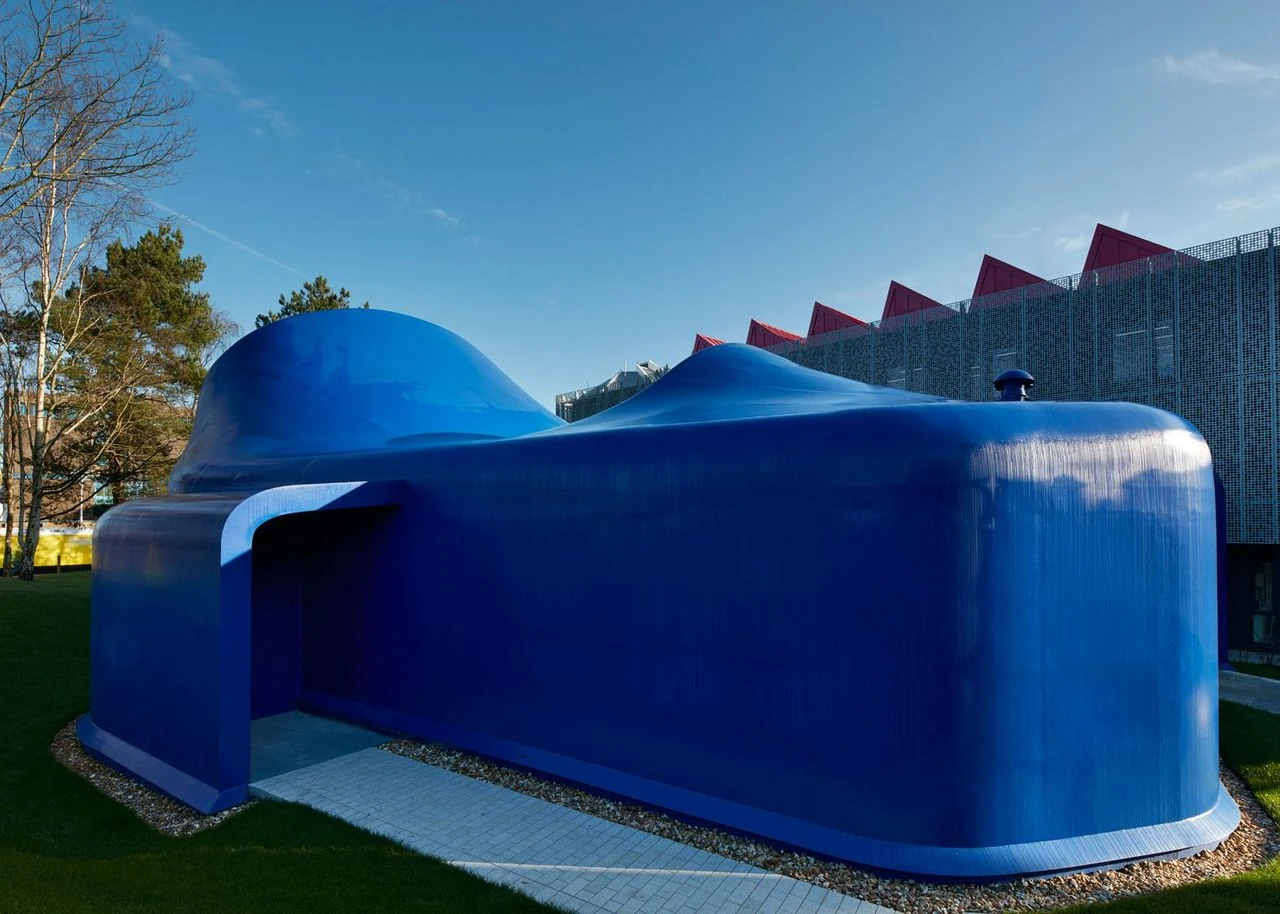
Cook’s work is not confined to Britain. He has built in Osaka, Nagoya, Berlin and Madrid. In 2000, he and Colin Fournier won the Kunsthaus Graz competition; the arts building was constructed in Graz, Austria, and opened in 2003. Known as the “Friendly Alien”, it brought Cook’s experimental approach to a public building and a wider audience. He later worked with Gavin Robotham on projects including a law faculty and central administration building for Vienna University of Economics and Business, completed in 2013, and with Robotham and Brit Andresen on the Abedian School of Architecture at Bond University in Australia. His first building in the UK, a drawing studio at Arts University Bournemouth, opened in 2016; an Innovation Studio there followed in 2021.
Recognition and continuing practice
Cook and the other Archigram members received the Royal Institute of British Architects’ Royal Gold Medal for the group’s achievements. Cook’s individual honours include the Jean Tschumi Medal from the International Union of Architects in 1996, the RIBA’s Annie Spink Award, jointly with David Greene, in 2002, and France’s Commandeur de l’Ordre des Arts et des Lettres in 2003. He was knighted in 2007 for services to architecture. Later recognition included the Mario Pani Award for Architecture in 2010 and an honorary doctorate of technology from Lund University in the same year.
His work has continued through design, teaching and public programmes. In 2025, he collaborated with LEGO on a Play Pavilion for Serpentine London, which opened on 11 June. Cook’s published work also continued into 2026, with Art of Architecture, written with Hans Ulrich Obrist. The pattern is consistent: his practice moves between drawings and buildings, individual projects and shared work, and the institutions through which architecture is taught and presented.
Why Peter Cook deserves a place in British Legacy
Peter Cook deserves a place in British Legacy because his work connects British architectural education and experimentation with a wider international conversation. Through Archigram, he helped make speculative design a public and collaborative activity. Plug-In City and Walking City were not building programmes brought to completion; they were imaginative proposals that asked what might happen if urban structures could change, adapt or move. Their importance lies in the questions they opened up and in the vivid means by which a group of architects communicated those questions. Cook’s writing and exhibitions helped carry that spirit of enquiry beyond the studio.
His contribution also has a practical and institutional dimension. Cook taught and led architecture at the Bartlett for many years, held roles at the ICA and Art Net, and curated the British Pavilion at Venice. He continued to design, working with collaborators on buildings in Austria, Australia and the UK, among them the Kunsthaus Graz and Arts University Bournemouth projects. His honours recognise both architectural work and teaching, while the Royal Gold Medal acknowledged Archigram as a group. This combination—British education, collaborative invention, public communication and built work—gives Cook’s legacy its substance. It offers a specific account of how architectural ideas formed in Britain can travel, invite debate and eventually take physical shape elsewhere.
Sources
Peter Cook (architect), revision 1361350370 · Peter Cook (architect)
Adapted in part from Peter Cook (architect) by Wikipedia contributors, under CC BY-SA 4.0. Text has been edited and combined with the existing article; this adapted text is shared under the same licence. Contributor history.