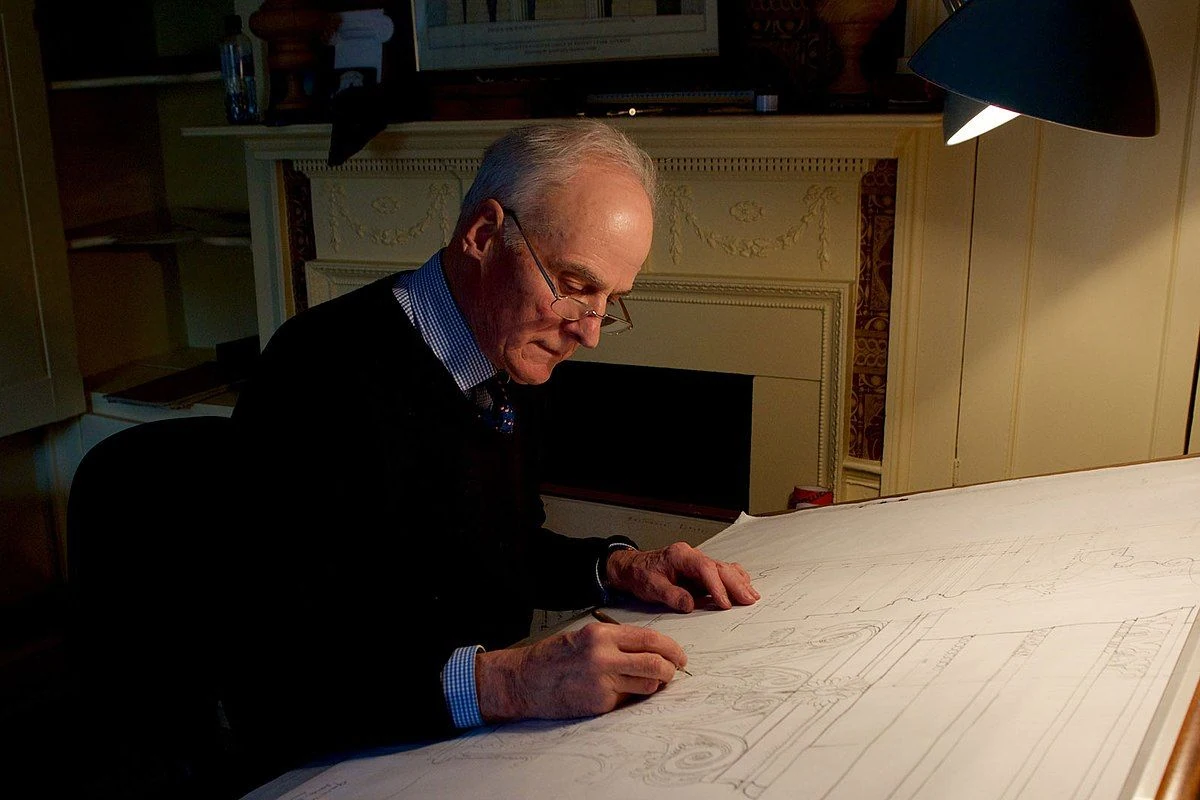
Quinlan Terry built in a style that was often out of favour with the architectural establishment. His work drew on Palladian and English classical traditions, yet it was made for modern homes, institutions and public settings. From a riverside development in Richmond to the interiors of 10 Downing Street, he argued through buildings that historical forms could remain part of contemporary life.
Training and a classical practice
John Quinlan Terry was born in Hampstead, London, on 24 July 1937. He studied at Bryanston School and the Architectural Association School of Architecture, then became a pupil of architect Raymond Erith. The two formed the practice Erith & Terry. Terry’s early work included a major role in the design of Kings Waldenbury, a Hertfordshire house completed for the Pilkington family in 1971. At a time when classical new-build architecture was unfashionable among many architects, the house established the kind of work he would pursue: buildings shaped by historical precedent rather than a break with it.
Terry worked principally in classical Palladian styles. The later practice, Quinlan Terry Architects, continued the tradition Erith had begun in 1928, specialising in high-quality traditional buildings, often in classical idioms. Its work was based in Dedham, Essex. Terry’s interest in classical architecture was not simply a matter of applying ornament. His designs returned to questions of proportion, plan, materials and the way a building meets its setting. The results could be traditional in language without being replicas of a single historical building.
Public buildings and urban settings
Richmond Riverside, a mixed-use development in Richmond upon Thames, brought classical design into a prominent town-centre setting. The original account dates its completion to 1984 and describes a sequence of buildings with columns and cornices. Its value lies in the way it placed a traditional architectural vocabulary within a late twentieth-century development, rather than treating classical design as a style reserved for historic buildings. The scheme became one of the projects most closely associated with Terry’s public profile.
Other commissions show the range of settings in which he used classical forms. At Downing College, Cambridge, his Maitland Robinson Library was completed in 1992 and won the Building of the Year Award in 1994. He also designed a new Georgian theatre for the college. In Essex, his work at Brentwood Cathedral was a major extension to a nineteenth-century Roman Catholic church. Rather than imitate the existing Gothic Revival building, Terry designed the extension in an English Baroque manner, drawing on James Gibbs and Thomas Archer. Its portico refers to the south portico of St Paul’s Cathedral, designed by Christopher Wren; the extension used all five classical orders.
In the 1980s, Prime Minister Margaret Thatcher appointed Terry to renovate the interiors of 10 Downing Street. The work followed an earlier restoration by Erith after wartime damage, but Terry’s treatment was more assertive. At Regent’s Park, he designed three villas for the Crown Estate Commissioners, completed from 1989. Their plans were closely related to Palladio’s Villa Saraceno, while their exteriors differed, taking on Gothic, Italian Mannerist and neoclassical features. New building in the park was controversial; the villas were presented as a modern response to the Prince Regent’s unrealised plans for the area.
His commissions also included the restoration of St Helen’s Bishopsgate, where a reorientation of the medieval church and changes to its interior provoked controversy. In Poundbury, his work included Queen Mother Square. He designed the external envelope of the New Margaret Thatcher Infirmary at the Royal Hospital Chelsea, working with Steffian Bradley Architects as lead consultant and planners. Other projects included offices, shops and homes at Tottenham Court Road and Baker Street, and a classical residence in the United States based on Marble Hill House in Twickenham.
Arguments about tradition
Terry became a prominent representative of New Classical architecture and lectured frequently on the relationship between traditional architecture and sustainability. His practice’s approach kept classical design in active use, but it also made his work a focus of disagreement. Admirers, including architectural historian David Watkin and writer Roger Scruton, championed his challenge to modernist assumptions. Watkin’s monograph on Terry’s work appeared in 2006; Scruton praised his architecture in a 2009 article.
Critics saw the same commitment differently. Architectural historian Gavin Stamp, quoted in a 2015 article in the RIBA Journal, described Terry’s work as stiff and uninspiring, with classical details attached to dull boxes. In 2020, Jonathan Meades reiterated Stamp’s criticisms and rejected Scruton’s praise. Stephen Bayley also criticised Terry’s close association with the Prince of Wales, later King Charles III, and with the circle of architectural advisers around him. These opposing judgements are part of Terry’s significance: his buildings did not settle the argument over classical design but made it visible in contemporary British architecture.
Recognition and retirement
Terry received the Philippe Rothier European Prize for the Reconstruction in 1982. In 2003, the British Georgian Group named Ferne House in Wiltshire Best Modern Classical House. Two years later he won the Driehaus Prize, an award for classical and traditional architecture. He was appointed Commander of the Order of the British Empire in the 2015 New Year Honours for services to classical architecture.
He retired as senior partner in July 2026, with long-time collaborator Roger Barrell succeeding him. The practice he helped shape continued the classical tradition established by Erith, while Terry’s own body of work remained present in British streets, colleges and institutions. His retirement marked the close of his working role, not the end of the debate his buildings had helped sustain.
Why Quinlan Terry deserves a place in British Legacy
Terry deserves a place in British Legacy because he made classical architecture a continuing, practical choice in modern Britain. Richmond Riverside brought a classical vocabulary into a mixed-use town-centre development. At Downing College, Cambridge, the Maitland Robinson Library and Georgian theatre placed it in an academic setting; at 10 Downing Street, Terry applied it to the working interiors of the prime minister’s residence. His extension to Brentwood Cathedral showed that he was willing to interpret historical forms in a new building rather than merely copy an existing one. These projects give a concrete account of how an architectural tradition can be adapted and contested, rather than preserved only as a relic.
His legacy is not a unanimous verdict on the merits of his style. Critics objected to what they considered pastiche, while supporters valued his challenge to modernism. That disagreement matters to Britain’s built heritage: it demonstrates that the appearance and purpose of shared places are subjects of public argument. Terry’s commissions across London, Essex and Cambridge made that argument tangible, in buildings encountered as homes, workplaces, places of worship and education. His practice also carried forward the working relationship begun with Raymond Erith. Together, those contributions make Terry a significant figure in the story of British architecture: an architect who maintained a classical alternative and brought it into the institutions and everyday settings of contemporary life.
Sources
Quinlan Terry — revision 1377036199 · Quinlan Terry
Adapted in part from Quinlan Terry by Wikipedia contributors, under CC BY-SA 4.0. Text has been edited and combined with the existing article; this adapted text is shared under the same licence. Contributor history.