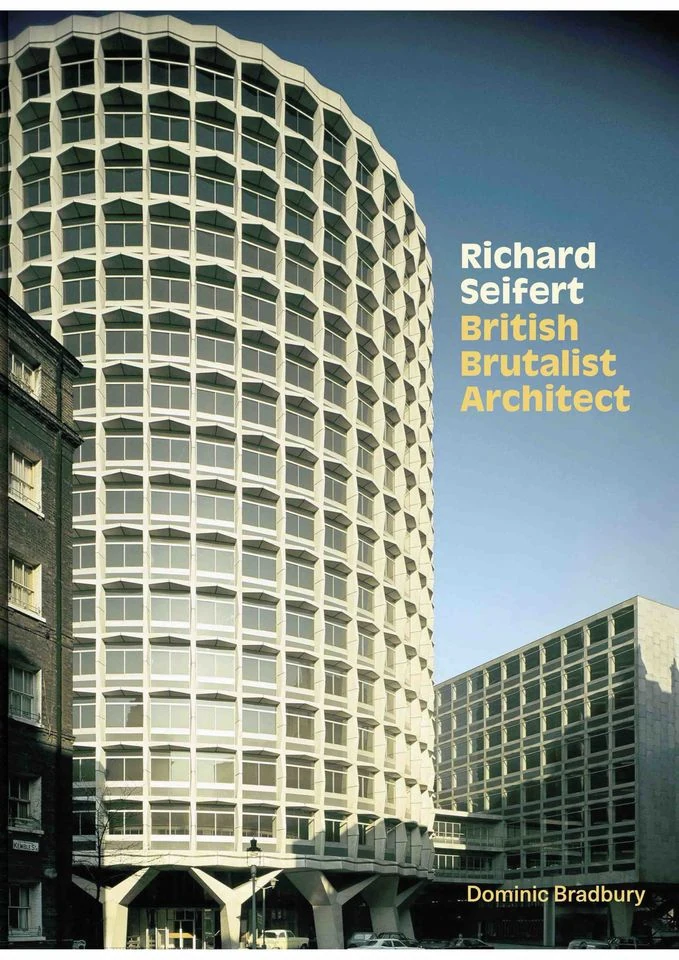
Richard Seifert’s buildings are difficult to miss. Centre Point stands above the streets around Tottenham Court Road; Tower 42 rises over the City of London. Both became landmarks, but they were only two of more than 500 office blocks designed by Seifert and his practice across the UK and Europe. His career linked the post-war transformation of London with major urban projects in other British cities.
From Zürich to the Bartlett
Seifert was born in Zürich on 25 November 1910 to a Swiss family. His birth name was Reubin Seifert, not Erno Goldfinger, as the earlier account of his life stated. He came to London when young, attended Central Foundation Boys’ School and won a scholarship to the Bartlett School of Architecture at University College London. He graduated in 1933.
During the Second World War, Seifert served in the Royal Engineers. He later established an eponymous architectural practice, R. Seifert and Partners, subsequently known as the R. Seifert Company and Partnership. The practice was at its most prolific during the 1960s and 1970s. It designed major offices in central London as well as large urban regeneration projects in other British cities.
The scale of the practice is central to understanding Seifert’s place in British architecture. His name is often attached to two conspicuous towers, yet his work also included hotels, stations, leisure facilities and commercial buildings. His projects formed part of the changing built environment in London and beyond, including cities such as Birmingham, Glasgow, Liverpool, Manchester and Brighton.
Centre Point and a changing London
Completed in 1966, Centre Point is a 117-metre tower at the junction of New Oxford Street and Tottenham Court Road. Its Y-shaped plan and deeply recessed windows give the building a strongly articulated profile. The pattern of its façades, with windows set into a grid of stone cladding, makes it read as more than a plain vertical slab.
The building was initially intended as speculative office space. Its height and prominent position brought it into view across a part of central London still dominated by a much older urban fabric. It attracted attention and divided opinion, becoming both a recognisable architectural landmark and a marker of the ambitions of 1960s London.
Centre Point was one element of a much broader London portfolio. Seifert’s projects included the Royal Lancaster Hotel, Euston Station, the London Metropole Hotel and the Kensington Forum, as well as office developments such as Space House and South Bank Tower. Some of his buildings have since been demolished or substantially altered. The list illustrates the variety of commissions undertaken by the practice, and the continuing changes to the city in which those buildings were made.
Tower 42 and work beyond the capital
The NatWest Tower, now officially named Tower 42, was completed in 1980. At 183 metres, it became the tallest building in the United Kingdom and held that distinction until 1990. Its plan is often described as X-shaped, with projecting sections arranged around a central core; the form was conceived to echo the NatWest logo. The tower’s height and structure made it a prominent new presence in the City.
Seifert’s work was not confined to London. Outside the capital, his practice designed Alpha Tower in Birmingham, Gateway House in Manchester, Sussex Heights in Brighton and buildings in Glasgow, including the Anderston Centre and Heron House. Other commissions included the Metropole Hotel in Birmingham and Concourse House in Liverpool. Some projects have since been partly or wholly demolished, but the geographical spread of the work shows how the practice participated in the redevelopment of several British cities.
Seifert and his company are credited with designing more London buildings than Sir Christopher Wren, and with producing more than 500 office blocks across the UK and Europe. The comparison with Wren is striking, but the number of buildings is the more revealing point: Seifert’s influence came not just through a handful of celebrated towers but through the repeated presence of his practice in urban centres.
A practice on a city-wide scale
Seifert’s architecture is often associated with the large commercial buildings that transformed the appearance of post-war cities. Centre Point and Tower 42 make that transformation especially visible: each claimed a place on the skyline and became a recognisable part of London’s image. Yet his portfolio was wider than those two structures, spanning offices, hotels, transport buildings, housing and public facilities.
That range matters when considering his legacy. A building may become famous through its height or location, while the work of an architectural practice is also measured in less celebrated commissions and the cumulative effect of many projects. Seifert’s practice operated at a scale that connected central London with redevelopment elsewhere in Britain. Its buildings remain part of the architectural record of the decades in which cities adapted to new commercial and civic demands.
Seifert was interviewed in 1996 for the British Library’s Architects’ Lives oral-history collection. He died on 26 October 2001, aged 90. The surviving record of his career encompasses both individual landmarks and a large body of work, some of which has been changed or lost as the cities around it have continued to develop.
Why Richard Seifert deserves a place in British Legacy
Richard Seifert deserves a place in British Legacy because his career left a substantial, visible mark on the built environment of Britain. Centre Point and Tower 42 are among London’s best-known modern towers, but they are not the whole story. His practice designed more than 500 office blocks across the UK and Europe and undertook major urban regeneration projects in other British cities. The buildings associated with his name extend from London to Birmingham, Glasgow, Manchester, Liverpool and Brighton. This breadth makes his contribution significant not simply as a designer of landmarks, but as a participant in the remaking of urban centres across the country.
His work also gives a concrete way to consider how Britain’s cities changed after the war. Centre Point and Tower 42 brought new scale and forms into London’s historic streetscape; commissions elsewhere placed the practice within the development of other city centres. Some of those buildings have been demolished or altered, while others remain prominent. Taken together, they show how architecture can shape daily surroundings as well as skylines. Seifert’s legacy is therefore both a pair of instantly recognisable towers and a much wider body of work that helped define the appearance of modern British urban life.
Sources
Adapted in part from Richard Seifert by Wikipedia contributors, under CC BY-SA 4.0. Text has been edited and combined with the existing article; this adapted text is shared under the same licence. Contributor history.