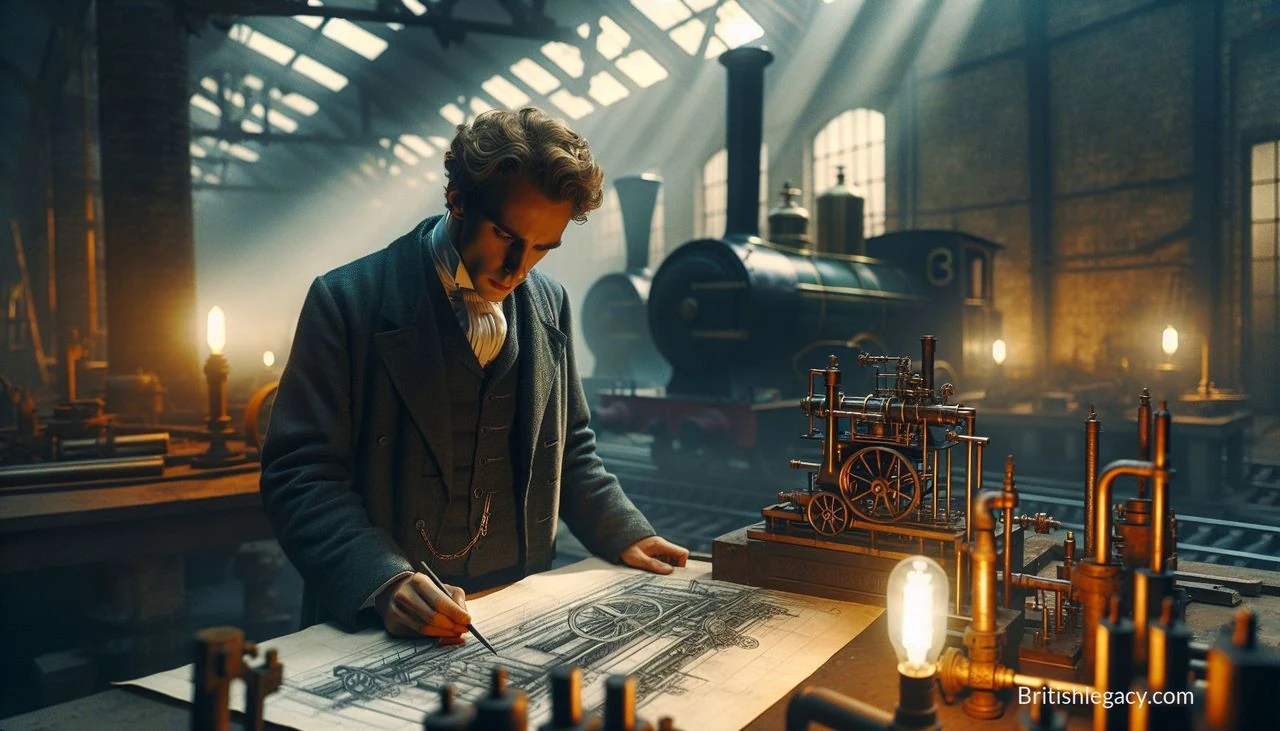
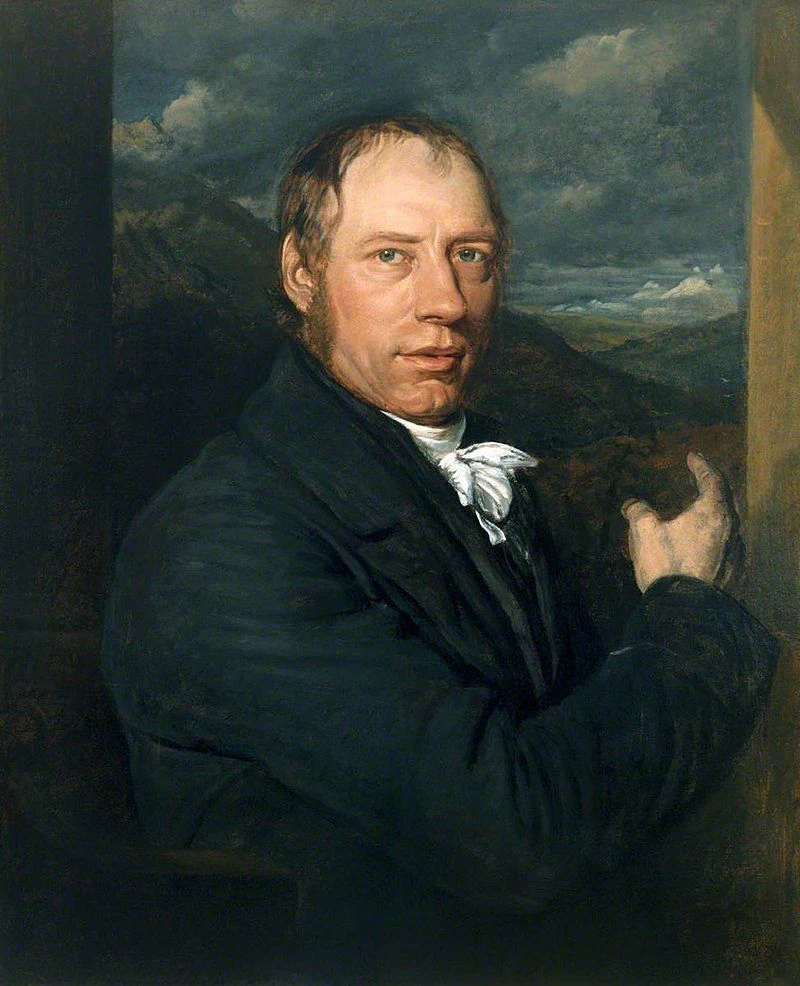
Richard Trevithick’s achievement was not simply to put a steam engine on wheels. He helped solve the harder problem of making steam power compact and forceful enough to move itself and a useful load. In the late eighteenth century, engines were chiefly large, fixed machines: they pumped water from mines but were ill suited to travel. Trevithick, a Cornish mining engineer, pursued high-pressure steam and put it to work in road and rail locomotives, as well as in mines, mills and farms. His 1804 locomotive journey in south Wales was an important demonstration, but it belonged to a much wider career of practical engineering, ambitious projects and financial reversals.
A Cornish childhood among mines and engines
Trevithick was born on 13 April 1771 at Tregajorran, in the parish of Illogan, between Camborne and Redruth. His father, Richard Trevithick, was a mine captain; his mother, Ann Teague, was the daughter of a miner. The family lived in a region where tin and copper mining depended on machinery to keep water out of deep workings. As a child, Trevithick watched steam engines pumping from the mines. Engineering was part of the working landscape around him, not a remote subject.
He attended the village school at Camborne but made little use of its lessons. Arithmetic was an exception: he was able, though said to reach answers by unconventional methods. He was tall and athletic and became a champion Cornish wrestler. At 19 he began work at East Stray Park Mine. His knowledge and enthusiasm quickly brought him a consulting role, unusual for someone so young. Miners also respected him as the son of a prominent mine captain.
His work took place in a crowded field of steam experiments. William Murdoch, who had demonstrated a model steam carriage, lived near Trevithick for a time. Trevithick’s own contribution developed from the engineering demands of Cornwall’s mines and from the possibility that steam could do more than drive stationary pumps. Existing engines were powerful, but their size and weight limited their uses. A mobile engine needed to generate useful force without carrying the bulk of a large pumping installation.
Making high-pressure steam useful
Trevithick pursued what he called “strong” steam: pressure high enough to drive a piston directly, without the separate condenser associated with earlier engines. With improved boilers, he reasoned, a high-pressure engine could use a smaller cylinder and take up less space and weight. That combination offered a way to make steam power portable. He was not the first person to consider high-pressure steam, but he became one of its important practical developers.
In 1797 he became engineer at Ding Dong Mine, where he worked with Edward Bull on high-pressure steam. His engineering also intersected with the commercial and legal disputes surrounding James Watt’s patents. In 1802 Trevithick took out a patent for his high-pressure steam engine. At Coalbrookdale in Shropshire, he built a stationary engine that year to demonstrate its power by pumping water to a measured height. It ran at 40 piston strokes a minute, with a reported boiler pressure of 145 pounds per square inch.
The same principles could serve more than locomotion. Trevithick worked on engines for mining, hammers, mills, rolling work and blast-furnace blowers. He looked for ways to make machinery do useful work with less space, weight or fuel. His designs made self-propelled steam power more plausible, but each application still depended on the equipment and infrastructure around it. A locomotive could be strong enough to pull a load and still be too heavy for the track beneath it.
Road experiments and the Penydarren journey
In 1801 Trevithick built a full-sized steam road carriage at Camborne and named it Puffing Devil. On Christmas Eve it carried six passengers up Fore Street and continued towards Beacon. The demonstration showed that steam could propel a vehicle and its passengers on a road. It was not a practical commercial service: the carriage could not maintain steam pressure for long periods, and during later tests it broke down. Left under shelter with its fire still burning, it overheated when the boiler ran dry and was destroyed. Trevithick attributed the loss to the operators rather than to a flaw in the design.
He continued to experiment with road transport. In 1803 he built the London Steam Carriage, which attracted public and press attention when he drove it from Holborn to Paddington and back. It was uncomfortable for passengers and more expensive to run than a horse-drawn carriage, so the project was abandoned. Trevithick’s transport experiments were demonstrations of possibility, not yet the basis of a dependable service.
His best-known railway experiment followed in south Wales. Trevithick had supplied a high-pressure engine to Penydarren Ironworks, where it was used to drive a hammer. With assistance from the ironworks, the engine was mounted on wheels to run on the existing tramroad. On 21 February 1804, the locomotive hauled about 10 tons of iron, five wagons and around 70 men from Penydarren to Abercynon. The journey covered about 9.75 miles and took 4 hours and 5 minutes.
This was a practical test of steam haulage on rails, not a railway system in the later Victorian sense. The locomotive showed that its own weight could provide the grip needed to pull a substantial load on an iron road. Its exhaust steam also passed up the chimney, helping the draught through the fire. But the existing cast-iron plates were intended for lighter, horse-drawn wagons and some broke under the locomotive. After the trial, the tramroad returned to horse power and the engine went back to its stationary work. The result was both proof and warning: locomotives could haul useful loads, but tracks had to be built to bear them.
More locomotives, more obstacles
News of the Welsh trial reached Christopher Blackett, owner of Wylam colliery near Newcastle, who asked Trevithick for locomotive designs. In 1804 a locomotive was built for the colliery by Trevithick’s agent, John Whitfield. It was likely the first to have flanged wheels, but it proved too heavy for Wylam’s wooden rails. As at Penydarren, the machine’s potential was constrained by the route it had to use.
In 1808 Trevithick built Catch Me Who Can, his public demonstration locomotive. Constructed at Bridgnorth, it ran on a circular track in London. Visitors could pay a shilling for admission and a ride, and the attraction was intended to show that rail travel could be faster than travel by horse. The track was weak and public interest limited; the enterprise did not last. Trevithick designed no more railway locomotives after this disappointment.
These trials should not be mistaken for a continuous, successful railway business. Trevithick demonstrated important possibilities, but his locomotives did not immediately displace horse power. The Penydarren tramroad was not strong enough for its engine, and the later London venture struggled to attract lasting support. The railways that followed required further engineering, investment and infrastructure. Trevithick’s work helped establish the principle of locomotive haulage; it did not, by itself, build the railway age.
Engines for industry, farms and ships
Trevithick’s career extended well beyond locomotives. Around 1812 he designed the Cornish boiler, a horizontal boiler with a fire tube running through it. The arrangement increased the heated surface and improved efficiency. He also installed a high-pressure experimental condensing engine at Wheal Prosper, part of the development of the Cornish engine. In a region where pumping mines consumed large quantities of fuel, improved efficiency had direct practical value.
He applied steam power to agriculture, too. In 1812 he installed a non-condensing high-pressure engine in a threshing machine at Trewithen in Cornwall. The machine was reported to be cheaper to run than the horses it replaced and remained in use for decades. The surviving engine is held by the Science Museum. It is a reminder that Trevithick’s work concerned the productive uses of power as much as the spectacle of a locomotive.
In London, where he worked on several projects, he explored machinery for dredging and ship operations, among other applications. With businessman Robert Dickinson, he developed the Nautical Labourer, a steam tug with a floating crane propelled by paddle wheels. It did not meet the docks’ fire regulations. Trevithick also patented iron tanks for ships, intended to store cargo or water and, when filled with air, to help raise wrecks. A recovery operation near Margate led to a dispute over payment. These episodes show the practical and commercial uncertainties surrounding his inventions: a machine might answer an engineering problem and still fail to secure a viable use or return.
A serious accident also drew attention to the risks of high-pressure steam. In 1803 an explosion at one of Trevithick’s pumping engines in Greenwich killed four men. Trevithick maintained that careless operation had caused it, while opponents used the disaster to emphasise the dangers of high-pressure engines. He responded by adding safety measures to later designs, including two safety valves, a fusible plug to warn when water was dangerously low, hydraulic testing of boilers and a mercury pressure indicator. His work took place in a hazardous field, and the episode formed part of the development of safer steam practice.
Projects abroad and a difficult return
Trevithick’s work repeatedly drew him towards projects on a larger scale than his means could comfortably support. He advised on the Thames tunnel at Rotherhithe after the earlier contractor had encountered problems with water. In 1807 he began driving a pilot tunnel. Flooding forced the work to stop, and although the quality of his work was defended, the company did not continue with him. The project was not completed under his direction.
In 1810 illness brought him close to death. He returned to Cornwall, and in 1811 he and Dickinson were declared bankrupt. Trevithick was not discharged until 1814, having paid off most of the partnership’s debts from his own funds. Financial strain accompanied his engineering career even when the ideas themselves remained influential.
In 1816 he left Cornwall for Peru, where he worked as a mining consultant. High-pressure engines had particular appeal for mines at altitude, where conventional engines could be difficult to transport and operate. Trevithick’s own plans in the region were disrupted by financial and political difficulties. He later travelled through parts of South America and, in 1822, explored routes in Costa Rica while considering how ore and machinery might be moved. The journey was hazardous. He eventually met Robert Stephenson in Cartagena; Stephenson gave him £50 to help pay for his passage home. Trevithick reached Falmouth in 1827 with few possessions.
Back in Britain, he continued to devise projects. Among them were a closed-cycle steam engine, a vertical tubular boiler and a portable water heater. He also proposed an enormous cast-iron column to mark the Reform Bill of 1832, but it was never built. His final work involved a reaction turbine for a vessel at Dartford, where he lodged at the Bull Hotel. He died there on 22 April 1833 after an illness described as pneumonia. He was penniless, and colleagues from the works collected money for his funeral and served as bearers. He was buried in an unmarked grave.
Commemoration in Cornwall and beyond
Trevithick’s later reputation has been sustained by places and organisations that preserve the record of his work. In Camborne, a statue depicting him with a small model was unveiled in 1932. The Trevithick Society, named in his honour, publishes material on Cornish engines, mining and industrial archaeology. Camborne marks his achievements each year with Trevithick Day, a community celebration that includes steam engines from across the country.
Memorials also recall the geography of his life and work. A blue plaque at the Royal Victoria and Bull Hotel in Dartford marks his final years and the place of his death. There are commemorations in Abercynon and at the site of the Penydarren Tramway. His name is also attached to buildings and engineering facilities, including the Trevithick Building at Cardiff University. Westminster Abbey’s stained-glass memorial includes a figure associated with Cornwall and Trevithick.
These memorials do not turn every project into a success. The locomotives faced fragile track, the London railway demonstration was short-lived, and business ventures could end in loss. Their value is that they preserve a record of an engineer whose work ranged from mine pumping to transport and agriculture, and whose ambitions often extended beyond what the technology or finance of his time could support.
Why Richard Trevithick deserves a place in British Legacy
Richard Trevithick deserves a place in British Legacy because he helped make steam power mobile. His high-pressure engines offered a more compact source of force than the large machines used for fixed work, and he tested that possibility in practical settings. The Puffing Devil demonstrated steam road travel; the Penydarren locomotive showed that a steam engine could haul iron, wagons and passengers along a tramroad. The trial also exposed a crucial limitation: an engine’s usefulness depends on the strength of the route around it. That combination of invention and practical test gives his railway story its substance.
His contribution was broader than a single locomotive journey. Trevithick worked on mining engines, boilers, agricultural machinery, ship equipment and other industrial applications. The Trewithen threshing engine shows how high-pressure steam could be adapted to farm work, while the Cornish boiler and engine addressed the continuing need to pump mines efficiently. These were concrete attempts to make power useful where it was needed, rather than leaving it fixed in one place. His later projects and financial difficulties also make his story more than a triumphal tale: engineering achievement did not guarantee commercial success or personal security.
His British connection is rooted in particular places and industries. Cornwall’s mines shaped the problems he tackled; Penydarren supplied the setting for his most celebrated locomotive trial; London provided a stage for further experiments; and Dartford was where he died. The continuing commemorations in Cornwall, Wales and elsewhere recognise the reach of that work. Trevithick did not build the railway networks that transformed Britain, but he helped demonstrate that locomotive haulage could work. His place in British Legacy rests on that practical breakthrough and on a career spent applying steam power to the needs of industry.
Sources
Richard Trevithick — Wikipedia, revision 1371989543
Adapted in part from Richard Trevithick by Wikipedia contributors, under CC BY-SA 4.0. Text has been edited and combined with the existing article; this adapted text is shared under the same licence. Contributor history.