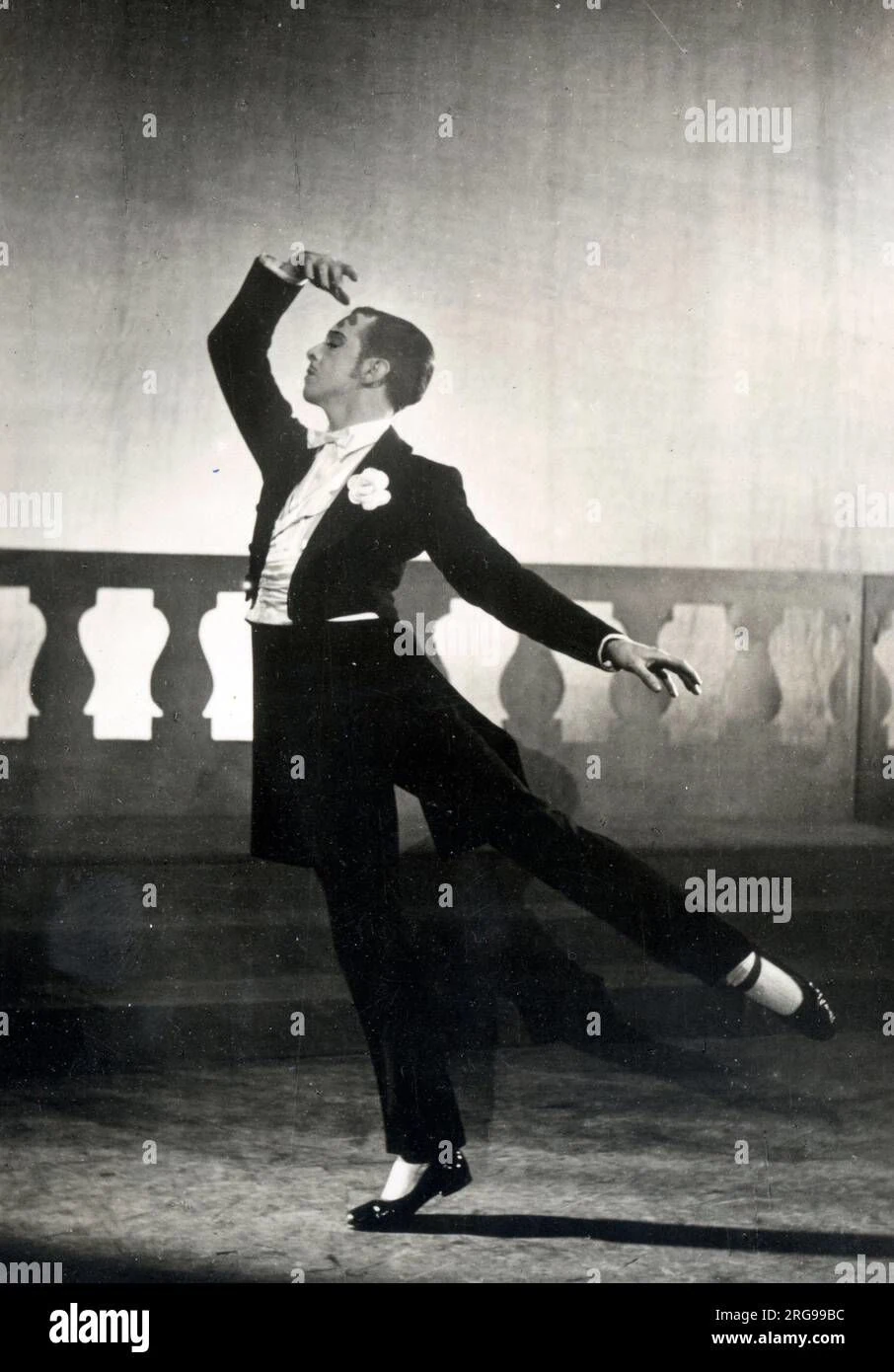
Robert Helpmann made his name in British ballet as a dancer who could turn a role into a piece of theatre. He arrived in Britain from Australia in 1932, joined Ninette de Valois’s Vic-Wells Ballet and became one of its leading men. His career never fitted neatly within ballet: he acted at the Old Vic and in the West End, choreographed for the company during the Second World War, and later directed plays, opera and musicals. That range was not a departure from his dancing so much as an extension of its dramatic instinct.
From South Australia to the Vic-Wells Ballet
Born Robert Murray Helpman in Mount Gambier, South Australia, on 9 April 1909, he grew up in a family drawn to performance. His mother, Mary, encouraged her children’s interest in theatre; his younger brother Max and sister Sheila also went on to work on stage, television and screen. Helpmann was not an enthusiastic schoolboy, but dance offered a clearer direction. In 1926, while Anna Pavlova was touring Australia, she took him on as a student apprentice. He trained with her leading male dancer, Alexis Dolinoff, then joined the theatrical producers J. C. Williamson Ltd as a principal dancer in musicals, revues and pantomimes.
Helpmann’s early work included Frasquita, The Merry Widow and The New Moon. The English actress Margaret Rawlings, touring Australia, encouraged him to seek a career in Britain and introduced him to de Valois, director of the Vic-Wells Ballet. He left Australia in 1932 and joined her company. In the mid-1930s, he added a second “n” to his surname. The company, which later became the Sadler’s Wells Ballet and then The Royal Ballet, gave him a home in which his gifts as both dancer and actor could develop.
In 1934 he and Alicia Markova led de Valois’s new ballet The Haunted Ballroom. He danced in Swan Lake and in operas, and appeared at the Open Air Theatre in Regent’s Park. In 1936, Frederick Ashton cast him opposite the young Margot Fonteyn in Apparitions. Helpmann and Fonteyn became a notable partnership, including in The Sleeping Beauty. He was equally at ease with comedy and character roles: in de Valois’s Checkmate, he played the Red King, a role he returned to in the final year of his life.
Dance, drama and wartime choreography
Helpmann’s acting drew attention before he left ballet behind. In Tyrone Guthrie’s production of A Midsummer Night’s Dream at the Old Vic, he played Oberon opposite Vivien Leigh’s Titania. Critics praised the way his dancing and delivery of Shakespeare’s verse worked together. In May 1940, while touring with the Sadler’s Wells Ballet, he and the company were caught in the Netherlands by the German invasion. They escaped on the last British boat to leave as the Dutch surrendered.
Back in Britain, the company kept performing through the war, combining London seasons with provincial tours. When Ashton was called up in 1941, Helpmann took on choreography as well as his demanding schedule as a principal dancer. His wartime works included Comus and The Birds in 1942, and Miracle in the Gorbals in 1944. His ballet Hamlet, created in 1942 to music by Tchaikovsky, brought Shakespeare into the repertory in a form shaped by dance and theatrical storytelling.
He also pursued Shakespeare as an actor, playing the title role in the Old Vic’s 1944 Hamlet. Responses to the performance varied, a reminder that his work was not beyond criticism. His film career began during the war with One of Our Aircraft Is Missing (1942), followed by the Bishop of Ely in Laurence Olivier’s Henry V (1944). When the Royal Opera House reopened after the war, Helpmann and Fonteyn led the ballet company in the opening gala performance of The Sleeping Beauty. In 1946, he choreographed and danced in Adam Zero, a new work for the reopened house.
A career across British stages and screens
In the years after the war, Helpmann moved readily between dance and drama. He co-directed the Duchess Theatre in London with Michael Benthall, his long-time professional and personal partner. At Stratford-upon-Avon in 1948, he played King John and Shylock, among other roles. He later directed opera at Covent Garden, including Madama Butterfly in 1950, and worked on productions of plays, musicals and Shakespeare. In 1951, he appeared in the Powell and Pressburger film The Tales of Hoffmann, playing its four villains.
Helpmann continued to return to ballet, directing and choreographing as well as dancing. His 1963 work Elektra, made for the Royal Ballet, received a critical reception that did not match his earlier successes. He also supervised a new production of Swan Lake. In London, he directed the first British production of the musical Camelot in 1964. Although reviews of the show were lukewarm, his staging was praised for its visual spectacle and the production ran for more than a year.
His best-known film role came in 1968, when he played the Child Catcher in Chitty Chitty Bang Bang. The part showed how effectively he could make physical presence and gesture carry a character. It brought a wide screen audience to an artist whose working life had also included classical ballet, Shakespeare, opera and musical theatre. The film was one of many screen appearances; Helpmann acted in fifteen films between 1942 and 1984.
Leadership and a return to the ballet stage
Helpmann’s connection to Australia remained important even during his long years in Britain. In 1964, the Australian Ballet premiered his The Display, a work inspired by the lyrebird and made with designer Sidney Nolan and composer Malcolm Williamson. Its reception helped lead to his appointment as co-director of the company in 1965. He created further works for it, including Yugen and Sun Music, and became sole director in 1975.
The role ended in disagreement. Helpmann opposed reductions to the company’s budget, arguing that cuts would damage its artistic and technical standards. The board dismissed him in 1976. The following year, he returned to British ballet audiences with the Sadler’s Wells Royal Ballet, dancing the Red King in Checkmate and Dr Coppélius in Coppélia. Critics welcomed his performances. In 1981 he revived Hamlet with Anthony Dowell, first at Covent Garden and later in New York. His final stage appearances were as the Red King, with the Australian Ballet, in 1986.
Final years and remembrance
Helpmann died in Sydney on 28 September 1986, aged 77, after a long illness with emphysema. His state funeral at St Andrew’s Cathedral reflected his stature in Australian public life, while a memorial service at St Paul’s, Covent Garden, brought together people from British ballet and theatre. His honours included appointment as a Commander of the Order of the British Empire in 1964 and a knighthood in 1968.
His working life crossed national and artistic boundaries, but the British chapter was central: it began with his arrival at the Vic-Wells Ballet and encompassed decades of performances and creative work in London and elsewhere in Britain. His later leadership in Australia was another substantial part of his career, rather than an epilogue to it. The two strands help explain why his legacy belongs both to British ballet and to the wider history of performing arts in Australia.
Why Robert Helpmann deserves a place in British Legacy
Helpmann’s place in British Legacy rests on a specific contribution: he helped make ballet a more overtly theatrical art in Britain, not only through the roles he danced but through the way he moved between performance, choreography and drama. At the Vic-Wells Ballet, later The Royal Ballet, he became a leading dancer, partnered Alicia Markova and Margot Fonteyn, and brought distinctive character work to ballets such as Checkmate. When Ashton was called up during the Second World War, Helpmann assumed the additional responsibility of choreographing for the company. Works including Hamlet and Miracle in the Gorbals show the scale of that contribution during a difficult period for British performance.
His influence was not confined to the ballet stage. Helpmann’s Oberon at the Old Vic demonstrated how dance and Shakespearean acting could reinforce one another; later work as an actor and director carried that understanding into theatre, opera and film. He helped reopen the Royal Opera House’s ballet programme after the war, and returned to British audiences in the 1970s and 1980s with performances that showed the lasting force of his dramatic character roles. His career also offers a useful picture of cultural exchange: an Australian artist made his name in British institutions, then applied his experience to the development of Australian ballet. Remembering him in British Legacy recognises both his concrete work within British ballet and the broader, cross-continental course of his career.
Sources
Robert Helpmann — revision 1377853176
Adapted in part from Robert Helpmann by Wikipedia contributors, under CC BY-SA 4.0. Text has been edited and combined with the existing article; this adapted text is shared under the same licence. Contributor history.