In the 1930s, Britain faced a problem of time. Enemy aircraft might cross the Channel and reach their targets before fighters could climb to intercept them. Robert Watson-Watt helped develop a way to detect aircraft by radio, then helped turn that discovery into a working air-defence system. His contribution was not simply a piece of equipment: it was part of a national network that made warning useful by connecting signals, trained operators and the people directing the response.
Watson-Watt’s route to radar began with a different kind of danger. Working for the Meteorological Office, he investigated how radio signals from lightning could help locate thunderstorms and warn pilots. The scientific and engineering problems he tackled there—detecting brief signals, finding their direction and making them readable—fed into his later work. His career shows how research undertaken for one practical purpose can open the way to another, especially when institutions are able to recognise and apply its value.
Learning to read the invisible
Robert Alexander Watson-Watt was born in Brechin, Angus, on 13 April 1892. He attended school there before entering University College, Dundee, then part of the University of St Andrews. He graduated in engineering in 1912 and stayed at the college as an assistant to Professor William Peddie, who encouraged his interest in radio, then generally called wireless telegraphy. Peddie introduced him to the physics of radio-frequency oscillators and wave propagation: how waves travelled, and how their behaviour could be measured.
When the First World War began, Watson-Watt was working in the college’s Engineering Department. In 1916 he joined the Meteorological Office, which was interested in his ideas about using radio to detect thunderstorms. Lightning produces radio signals; the challenge was to capture them and work out where a storm lay so that pilots could be warned. The signals could be detected over very long distances, but individual lightning strikes were fleeting. An operator turning an aerial could not reliably point towards one in time. Repeated readings, and methods for displaying the signals, made it possible to estimate a storm’s direction.
At first Watson-Watt worked at the Air Ministry Meteorological Office wireless station in Aldershot. In 1924, when the site was needed for other purposes, he moved to Ditton Park near Slough. There, equipment developed for other research helped him address two related difficulties: determining the direction of a signal and displaying it clearly. An Adcock antenna arrangement made it possible to compare signals arriving from different directions. A cathode-ray oscilloscope, using horizontal and vertical channels, could turn a brief electrical event into a visible mark. These methods helped make transient radio signals something an operator could interpret rather than merely hear.
The work widened beyond storm detection. Watson-Watt and other researchers investigated radio interference and signals reflected from the upper atmosphere. Their findings provided practical evidence for the existence of the Heaviside layer, proposed earlier but not widely accepted by engineers. Work on displaying and timing signals also led to a fast time-base method for the oscilloscope. That development mattered because a fleeting event could be represented as a trace and assessed. These were not yet aircraft-detection systems, but they built knowledge and techniques that would prove useful when Britain began considering how radio might reveal what was in the sky.
From a supposed death ray to aircraft detection
In 1934, the Air Ministry established the Committee for the Scientific Survey of Air Defence, chaired by Sir Henry Tizard. The committee was looking for ways to improve Britain’s defences as aircraft became a more serious threat. In January 1935, reports that Germany might possess a radio-based “death ray” prompted a request for Watson-Watt’s view. He and his colleague Arnold Wilkins concluded that such a weapon was impractical. Wilkins, however, had suggested another use for radio: detecting aircraft from a distance by the reflections of radio waves.
Watson-Watt took that possibility to the Air Ministry. On 12 February 1935 he submitted a memorandum proposing the detection and location of aircraft by radio methods. The proposal still needed proof. On 26 February, Watson-Watt and Wilkins tested a receiver near Daventry, using signals from a BBC short-wave transmitter and a Handley Page Heyford bomber flying nearby. Reflected signals from the aircraft produced a clear return on the receiver. The experiment demonstrated that radio could detect an aircraft, though it was not yet a complete radar system or an operational defence network.
The test relied on adapted research equipment. Its importance lay not in presenting a finished device, but in showing that the principle worked well enough to justify further development. The Air Ministry received evidence that aircraft detection by radio was feasible; the next task was to increase range, improve the equipment and determine how the information could be used. In April 1935, Watson-Watt received a patent for a radio device for detecting and locating an aircraft. The breakthrough was collaborative: Wilkins’s suggestion, Watson-Watt’s assessment and leadership, and the practical work of colleagues all contributed to moving the idea forward.
Further experiments began at Orford Ness, an isolated site on the Suffolk coast. By June 1935, the researchers were detecting aircraft at a range of 16 miles; by the end of the year, the range had reached 60 miles. Those results encouraged plans for a series of stations covering the approaches to London. Bawdsey Manor became the principal centre for radar research. Rather than delaying for ideal equipment, the team adapted available components and pressed ahead with workable designs. The priority was to build something that could function and be improved through use.
Building a network, not just a machine
By 1937, the first three stations were ready for testing. The results encouraged the government to commission more, and the expanding chain of fixed radar stations became known as Chain Home. Nineteen stations were ready by the beginning of the Second World War, and further stations were built during the conflict. The network along Britain’s east and south coasts gave the country an early-warning capability that had not existed before.
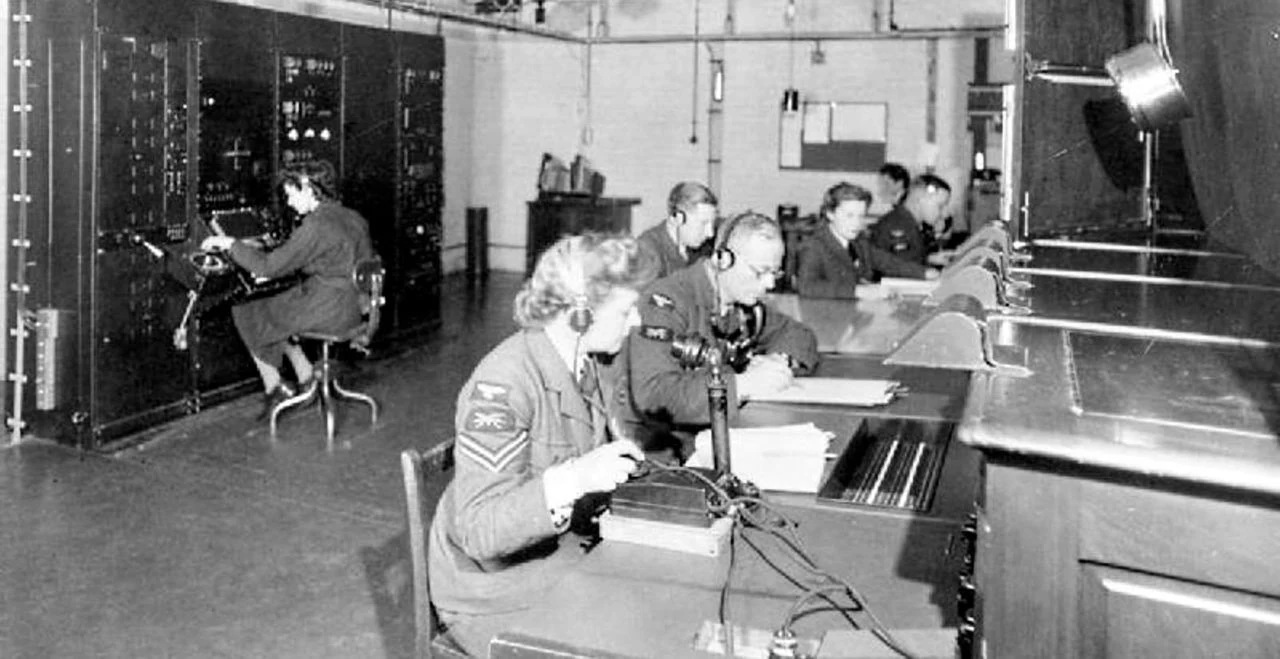
Radar stations transmitted radio signals and received echoes reflected from aircraft. The time between transmission and return provided a measure of distance; comparing signals from different aerials helped determine direction, while further calculations could estimate height. Chain Home’s equipment displayed signals on cathode-ray tubes. Operators and controllers then had to interpret the information and turn it into reports that could guide action. The system’s value depended on more than detecting an aircraft: it depended on making the information timely and useful.
Early trials made that distinction clear. A test of the developing system failed to guide fighters effectively, not simply because of the radar equipment but because reports travelled too slowly through the chain of observers and decision-makers. The problem required a reporting and command structure as well as engineering. Henry Tizard, Patrick Blackett and Hugh Dowding worked on a system that gathered, filtered and plotted information before sending instructions to fighters. This organisation became known as the Dowding System. Radar, communications, plotting and trained people had to work together.
During the Battle of Britain, early warning helped the Royal Air Force direct fighters towards incoming raids instead of maintaining costly, exhausting patrols in the air. It allowed available aircraft and pilots to be used with greater purpose. Watson-Watt’s work formed part of this achievement, but it was never a solitary effort. Arnold Wilkins, Edward Bowen, Henry Tizard, Hugh Dowding, the Observer Corps and the women and men who operated and interpreted the system all had roles in a wider enterprise. Recognising Watson-Watt’s importance need not mean assigning him sole credit for radar or for Britain’s wartime defence.
Radar’s wartime development and wider influence
The demand for effective air defence did not end with daylight. From 1936, researchers considered the threat of night bombing and the need to guide aircraft close enough to intercept bombers in darkness. Edward Bowen led much of the work on airborne radar, which had to meet difficult limits on weight, size and power. Airborne Interception radar became operational in 1940. Watson-Watt’s contribution belonged to a larger programme in which researchers developed different forms of radar for changing military needs.
Watson-Watt’s wartime responsibilities continued as the work expanded. In 1938 he left Bawdsey Manor to become Director of Communications Development at the Royal Aircraft Establishment. In 1939 he became Scientific Adviser on Telecommunications to the Ministry of Aircraft Production. After the attack on Pearl Harbor, he travelled to the United States in 1941 to advise on air defence. The journey reflected the growing importance of British radar research, and the urgency with which other countries sought to strengthen their own defences.
He was elected a Fellow of the Royal Society in 1941 and knighted in 1942. The United States awarded him the Medal for Merit in 1946. Ten years after his knighthood, the British government awarded him £50,000 for his contribution to radar’s development. These honours recognised his work, but they should not obscure the collective nature of the research and organisation that made radar effective.
After the war, Watson-Watt established himself as a consulting engineer. He spent periods in Canada and the United States before returning to Scotland. Radar itself continued to develop, with uses extending beyond military warning. The same broad principle of transmitting a signal and interpreting its return became important in weather observation; radar also became part of the changing world of aviation and navigation. Watson-Watt did not create every later application. His contribution was to help establish methods, technology and practical confidence that others could adapt.
Later years and remembrance
Watson-Watt died in Inverness on 5 December 1973, aged 81. His career is preserved not only in accounts of radar but in collections of his papers. The National Library of Scotland holds a collection of his correspondence and papers, and the University of Dundee also holds related material. Such records offer a way to examine the research, decisions and working relationships behind an achievement often compressed into a single word: radar.
His story also belongs to a history of scientific work carried out through public institutions. The Meteorological Office and research organisations gave him settings in which to investigate radio signals and develop practical methods. When the air-defence problem became urgent, earlier work on lightning, direction-finding and displays could be put to new use. That progression—from atmospheric research to aircraft detection, and from a successful experiment to a national network—helps explain the scale of his influence.
Watson-Watt’s importance is clearest when the story keeps both the individual and the system in view. His radio expertise and leadership helped make aircraft detection by radio a practical programme. But radar’s wartime value depended on engineers and researchers, station operators, observers, controllers and fighter crews, as well as the reporting system that connected them. The history is more compelling, not less, when it recognises the people and institutions that turned an idea into an effective defence.
Why Robert Watson-Watt deserves a place in British Legacy
Robert Watson-Watt deserves a place in British Legacy because he helped turn difficult radio science into a practical form of protection. His work began with a specific problem: detecting thunderstorms so that pilots could be warned. The methods developed through that research—finding the direction of signals and making brief events visible—became relevant to a different national need when Britain faced the danger of aerial attack. Watson-Watt helped move aircraft detection from proposal to demonstration and from demonstration towards a network of early-warning stations.
That achievement matters not as a story of one inventor working alone, but as an example of what applied science can do when expertise, public institutions and operational planning meet. Chain Home gave Britain warning; the Dowding System helped ensure that information could reach those able to act on it. Together, radar and its reporting structure helped the RAF direct limited resources more effectively during the Battle of Britain. Watson-Watt was a central figure in that work, alongside colleagues and the people who operated the network.
His legacy also reaches beyond the emergency that brought radar to prominence. Research into radio signals and their interpretation contributed to a body of knowledge that later generations could extend, including in weather observation and other peacetime applications. The enduring lesson is not that one person can claim every later use of a technology, but that careful research can equip others to solve new problems. Watson-Watt’s Scottish education, public-service career and practical leadership make that lesson distinctly grounded in Britain’s history of scientific work. His place in British Legacy rests on the lasting benefit of making invisible signals useful: first as warning, then as knowledge that could be carried forward.
Sources
Robert Watson-Watt — Wikipedia, revision 1372831974 · Robert Watson-Watt — Wikipedia
Adapted in part from Robert Watson-Watt by Wikipedia contributors, under CC BY-SA 4.0. Text has been edited and combined with the existing article; this adapted text is shared under the same licence. Contributor history.