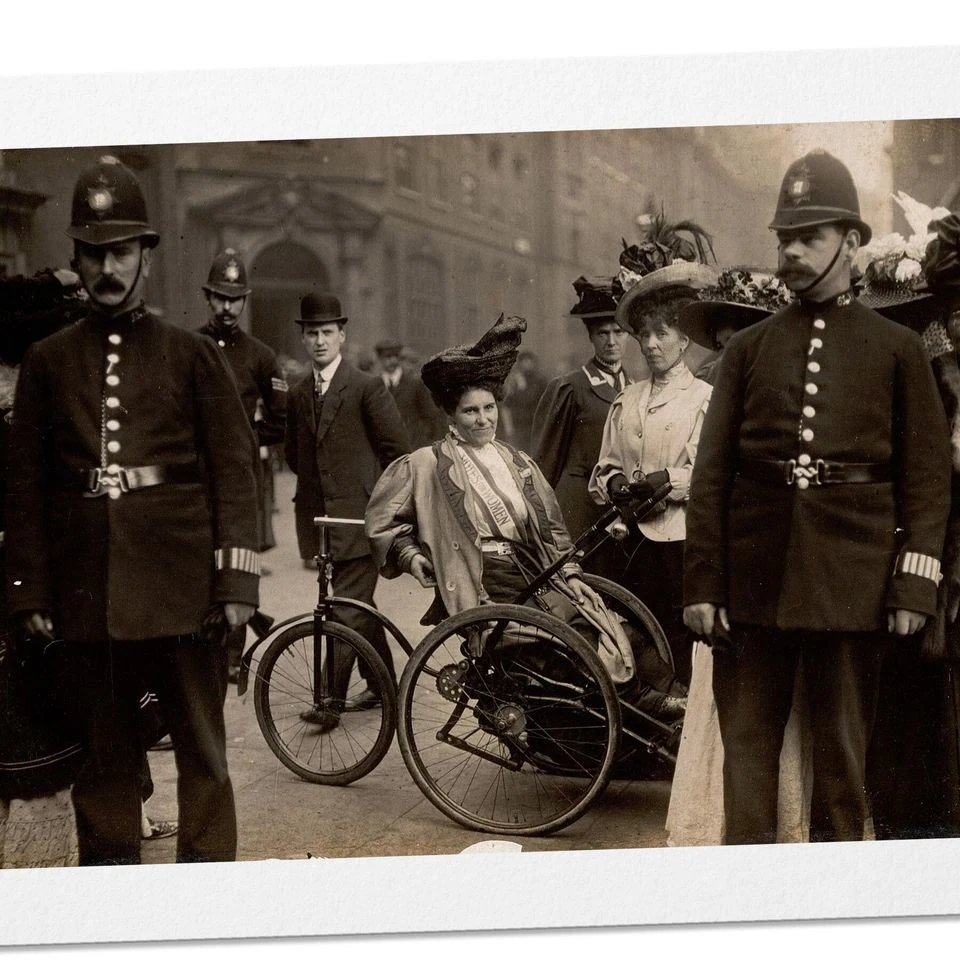
Rosa May Billinghurst took her campaign for women’s votes into the streets of London on an adapted tricycle. After surviving polio as a child, she could not walk and used leg-irons, crutches or a modified tricycle. As a member and organiser of the Women’s Social and Political Union, she joined demonstrations, faced arrest and continued campaigning despite the particular risks created by her disability. Her story connects the struggle for suffrage with the practical barriers women with disabilities faced in public life.
Early life and social work
Billinghurst was born in Lewisham on 31 May 1875, the second of nine children of Rosa Ann Brinsmead and Henry Farncombe Billinghurst. Her mother came from a family of piano manufacturers; her father was a banker. Polio left Billinghurst unable to walk. She used leg-irons and relied on crutches or a modified tricycle for mobility.
Before joining the best-known militant suffrage organisation, she was active in local and charitable life. She worked in social care at a Greenwich workhouse, taught in a Sunday School and joined the temperance Band of Hope. She was also involved in a Women’s Liberal Association. These activities preceded her move into the WSPU, founded by Emmeline Pankhurst, in 1907.
Billinghurst’s political work was not confined to attending demonstrations. She took part in the WSPU march to the Royal Albert Hall in June 1908 and helped organise the union’s response to the Haggerston by-election the following month. Two years later, she founded the Greenwich branch of the WSPU and became its first secretary. In this role she helped build local organisation as well as taking part in actions that attracted public attention.
A tricycle on the front line
Billinghurst’s adapted tricycle enabled her to participate in demonstrations and became closely associated with her public identity as a suffragette. At the November 1910 Black Friday demonstration, police capsized her from it and arrested her. She knew she would be vulnerable if tipped out, but was prepared to accept the publicity her treatment might bring to the cause. On another occasion, police let down her tyres and removed the valves, leaving her in a side street.
Her willingness to confront opposition did not mean that she was immune to it. The obstacles were physical as well as political: an overturned tricycle or disabled tyres could leave her stranded. Yet she returned to campaigning. When police saw her approaching the House of Commons in 1911 with a “Votes for Women” banner, they decided against attacking the tricycle in the rush. Billinghurst is also thought to have joined suffragettes who evaded that year’s census as part of a boycott.
She was arrested several more times. During the window-smashing campaign of March 1912, she apparently worked with Glasgow suffragette Janie Allan and hid stones under the rug covering her knees. Billinghurst’s first term in Holloway Prison followed the breaking of a window in Henrietta Street. She was sentenced to a month’s hard labour, although prison authorities did not give her additional work. Fellow prisoners included Dr Alice Stewart Ker, for whose daughter Billinghurst smuggled a letter after her release.
Prison, protest and political change
On 8 January 1913, Billinghurst was tried at the Old Bailey and sentenced to eight months in Holloway for damaging letters in a postbox. She represented herself and used her defence to argue for women’s suffrage. The speech, titled “The Guilt Lies on the Shoulders of the Government”, was published in The Suffragette. In prison she went on hunger strike and was force-fed. She became so ill that she was released two weeks after the force-feeding began. She was later awarded a Hunger Strike Medal “for Valour”.
Her campaigning continued outside prison. She spoke at a public meeting in West Hampstead in March 1913 and chained herself to the gates of Buckingham Palace that May. In June she rode in the funeral procession for Emily Wilding Davison, dressed in white. Davison had been killed after reaching for the King’s horse at the Epsom Derby. In May 1914, Billinghurst joined a mass deputation of suffragettes seeking to petition King George V; although she was not arrested, two policemen tipped her from her tricycle.
When the Pankhursts gave priority to the war over the campaign for women’s rights, Billinghurst supported their decision and helped Christabel Pankhurst’s 1918 election campaign in Smethwick. She had also joined the Women’s Freedom League and became part of the Suffragette Fellowship. In 1918, the Parliament (Qualification of Women) Act gave some women the vote, and Billinghurst stopped her suffrage activity. The Representation of the People Act that year extended the parliamentary franchise to women who met age and property conditions; equal voting terms for women and men followed under the Equal Franchise Act of 1928.
Life beyond the demonstrations
Billinghurst’s commitment to political causes continued in different forms. She supported Jill Craigie’s Equal Pay Film Fund and attended the funeral of Emmeline Pankhurst and the unveiling of Pankhurst’s statue in 1930. Her life also included family relationships largely outside the public record of her campaigning. She lived in the garden house of her property, Minikoi, in Sunbury, with her adopted daughter, Beth; her brother Alfred John Billinghurst, an artist, lived with her after 1914.
Billinghurst died at a hospital in Twickenham on 29 July 1953, aged 78, and left her body to science. Her later recognition includes a place among the women commemorated on the plinth of the Millicent Fawcett statue in Parliament Square, unveiled in 2018. Her name and image appear there alongside those of 58 other supporters of women’s suffrage.
Why Rosa May Billinghurst deserves a place in British Legacy
Rosa May Billinghurst deserves a place in British Legacy because her contribution to the campaign for women’s votes was both organisational and visible. She founded the Greenwich branch of the WSPU, served as its first secretary and helped with election campaigning. She also joined demonstrations in which arrests, imprisonment and force-feeding were real consequences. Her account makes clear that the history of suffrage was not only shaped by prominent leaders or by speeches in political institutions: it depended on local organisers and people who repeatedly put themselves in public view.
Her use of an adapted tricycle gives this history a further significance. Billinghurst’s mobility aid helped her take part in protest, but it also made her especially exposed when police overturned her or disabled its tyres. Her experience brings the physical conditions of political participation into view without reducing her to a symbol of disability. The campaign for votes was part of a wider transformation in British political rights, culminating in equal voting terms for women and men in 1928. Remembering Billinghurst preserves the specific part she played in that long struggle, and recognises a woman who combined local service, political organisation and direct action.
Sources
Rosa May Billinghurst — revision 1366100826 · Rosa May Billinghurst
Adapted in part from Rosa May Billinghurst by Wikipedia contributors, under CC BY-SA 4.0. Text has been edited and combined with the existing article; this adapted text is shared under the same licence. Contributor history.