Rosencrantz calls heads; the coin lands heads again. After 92 wins in a row, his friend Guildenstern tries to explain what the run of tosses means. It is an improbable opening to a play in which two courtiers repeatedly try to make sense of a world that seems to have decided their ending for them. Tom Stoppard’s Rosencrantz and Guildenstern Are Dead takes two minor characters from Shakespeare’s Hamlet and makes their confusion, verbal games and uncertain grasp of events its subject.
From an early sketch to the Edinburgh Fringe
The play grew from Stoppard’s 1964 one-act work, Rosencrantz and Guildenstern Meet King Lear. The expanded play under its familiar title was first staged by the Oxford Theatre Group at the Edinburgh Festival Fringe on 24 August 1966. It opened in London at the Old Vic on 11 April 1967, directed by Derek Goldby, with designs by Desmond Heeley and a score by Marc Wilkinson.
The Old Vic cast included John Stride as Rosencrantz, Edward Petherbridge as Guildenstern, Graham Crowden as the Player and John McEnery as Hamlet. This was not the National Theatre production: the play’s London debut took place at the Old Vic, while the National Theatre presented a later revival. The distinction matters because the early London production helped carry the work from the Fringe into a larger theatrical setting.
Living at the edge of Hamlet
Rosencrantz and Guildenstern are childhood friends of Prince Hamlet, summoned to the Danish court by King Claudius and Queen Gertrude. Shakespeare’s tragedy gives them a supporting part in the prince’s story. Stoppard changes the viewpoint: the courtiers remain central while Hamlet’s plot unfolds around them, much of it out of their sight. They encounter familiar figures and fragments of familiar scenes, but lack the knowledge an audience brings from Shakespeare’s play.
That arrangement turns the gaps around Hamlet into dramatic space. The two men are asked to discover the cause of Hamlet’s behaviour, yet their attempts to practise questioning him bring them little understanding. They are caught between orders from the court and events whose larger shape they cannot grasp. When their mission carries them towards England, even the letter they are meant to deliver becomes a source of danger. The play follows the consequences of Shakespeare’s plot from the courtiers’ limited perspective rather than supplying a separate history for them.
The opening coin game introduces the play’s interest in chance and explanation. Guildenstern reaches for theories when Rosencrantz’s 92 consecutive heads defy ordinary expectation, but reasoning does not give him control. Elsewhere, the pair pass time with questions, imitation and argument. Comparisons have been drawn with Samuel Beckett’s Waiting for Godot, particularly in the exchanges between two central characters who seem to act as complements to one another. Stoppard’s pair, however, are also Shakespearean characters, caught inside a pre-existing story.
When acting and reality meet
The travelling Tragedians, led by the Player, make theatre part of the action rather than a backdrop to it. Their performances expose the difference between a staged event and what the courtiers take to be real. In a rehearsal, the actors play out a sea journey and deaths that anticipate Rosencrantz and Guildenstern’s fate. Later, Guildenstern draws what he believes to be a real dagger and thinks he has killed the Player; the weapon is revealed as a theatrical prop, and the Tragedians resume their performance.
These episodes give the play its metatheatrical structure: it reflects on performance while borrowing characters and scenes from another play. Shakespeare’s drama appears in fragments, and Stoppard’s characters occupy a world shaped by scenes they do not fully understand. The humour comes in part from their attempts to impose order on that world; the unease comes from the possibility that their choices cannot alter its course.
In the final movement, the courtiers discover that the letter they are carrying now orders their own deaths. Rosencrantz hesitates, while Guildenstern considers whether they could have stopped the sequence of events. The pair disappear, and the play ends with the English Ambassador’s announcement from Hamlet: “Rosencrantz and Guildenstern are dead.” The title, already a statement of the outcome, gains its force from watching the characters approach it without knowing how the story will close.
London, Broadway and later revivals
After its London opening, the production reached Broadway on 9 October 1967. The year-long run began at the Alvin Theatre and transferred to the Eugene O’Neill Theatre on 8 January 1968, closing on 19 October. It totalled eight previews and 420 performances. Brian Murray played Rosencrantz, John Wood played Guildenstern and Paul Hecht was the Player. The production received eight Tony Award nominations and won four, including Best Play and awards for scenic design, costume design and producer. It also won the New York Drama Critics’ Circle award for Best Play in 1968.
The National Theatre revival opened on 14 December 1995, with Adrian Scarborough as Rosencrantz and Simon Russell Beale as Guildenstern. The production later toured to Belfast, Cork, Bath, Newcastle, Sheffield and Bradford. In 2011, Sir Trevor Nunn directed a revival that opened at Chichester Festival Theatre and transferred to the Theatre Royal Haymarket in London’s West End. Samuel Barnett and Jamie Parker played the title roles; Tim Curry, initially scheduled as the Player, withdrew during the Chichester previews because of ill health and was replaced by Chris Andrew Mellon.
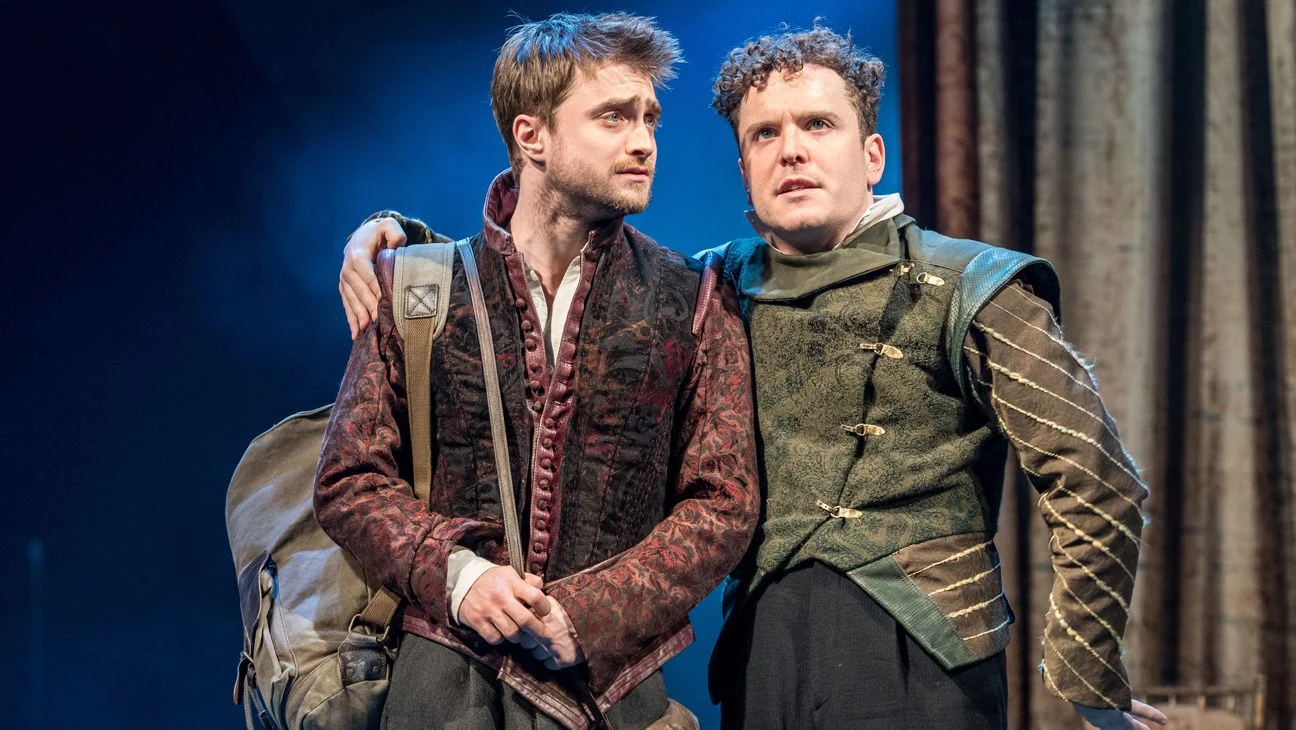
For the play’s fiftieth anniversary, David Leveaux directed a 2017 Old Vic production starring Daniel Radcliffe as Rosencrantz, Joshua McGuire as Guildenstern and David Haig as the Player. An excerpt was also performed at the National Theatre in 2013 by Benedict Cumberbatch and Kobna Holdbrook-Smith, marking the National’s fiftieth anniversary. These productions brought the work back to British stages in different settings while retaining its central pairing and its collision of comic exchange with foreknown tragedy.
Film and radio
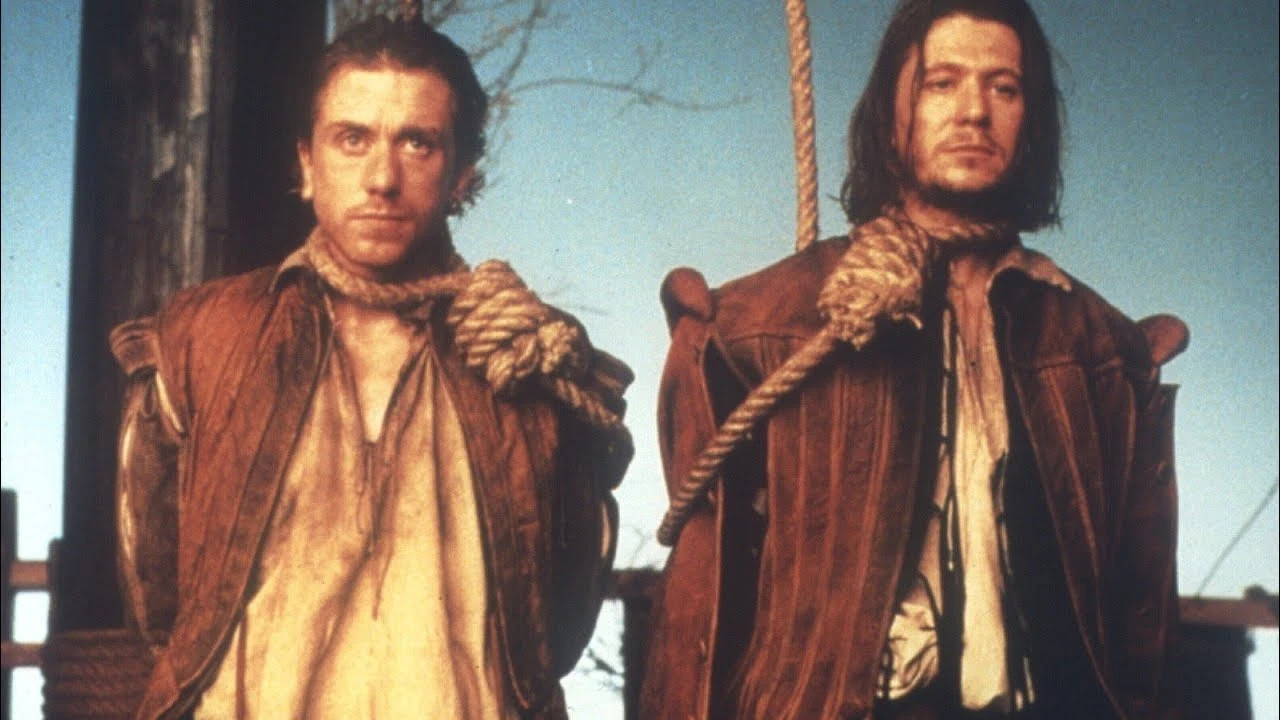
Stoppard adapted and directed the film version, released in February 1990. Gary Oldman played Rosencrantz, Tim Roth played Guildenstern and Richard Dreyfuss was the Player. The screen adaptation carried the play’s premise beyond the theatre while keeping its attention on the courtiers and their relationship to the larger events of Hamlet.
Radio offered another setting for its dialogue and sound. The BBC broadcast an adaptation directed by John Tydeman on 24 December 1978, adapted by Stoppard himself. A further version, directed by Peter Kavanagh, was broadcast in 2007 as part of a celebration of Stoppard’s seventieth birthday. BBC Radio 4 broadcast a two-part production directed by Emma Harding on 30 and 31 March 2019, with Mathew Baynton as Rosencrantz, Andrew Buchan as Guildenstern and Toby Jones as the Player. Together, the film and radio productions show the work moving across media without losing its focus on the two men’s uncertain point of view.
Why Rosencrantz and Guildenstern Are Dead deserves a place in British Legacy
Rosencrantz and Guildenstern Are Dead deserves a place in British Legacy because it makes an inventive theatrical work from a precise change of perspective. Stoppard takes two characters on the margins of Hamlet and gives their uncertainty the centre of the stage. The result joins verbal comedy to questions about chance, identity, knowledge and fate. The coin tosses, rehearsed conversations and encounters with the Tragedians are not ornamental diversions: each tests how much the characters can understand, and how much control they possess, within a story whose ending is already known.
The play’s British connection is grounded in its performance history. It began at the Edinburgh Festival Fringe, opened in London at the Old Vic and returned to the National Theatre, Chichester Festival Theatre, the Theatre Royal Haymarket and the Old Vic. Its National Theatre tour reached audiences in Belfast, Cork, Bath, Newcastle, Sheffield and Bradford. The Broadway production’s awards and year-long run document a further reach beyond Britain, while the film and BBC radio adaptations brought the play to audiences outside the theatre. Its achievement is not simply that it revisits Shakespeare: it uses the resources of theatre—character, dialogue, staging and performance—to make a new drama from the spaces around a familiar tragedy. That combination of British stage history, formal playfulness and accessible comic unease is a lasting contribution to modern theatre.
Sources
Rosencrantz and Guildenstern Are Dead (revision 1378713796)
Adapted in part from Rosencrantz and Guildenstern Are Dead by Wikipedia contributors, under CC BY-SA 4.0. Text has been edited and combined with the existing article; this adapted text is shared under the same licence. Contributor history.