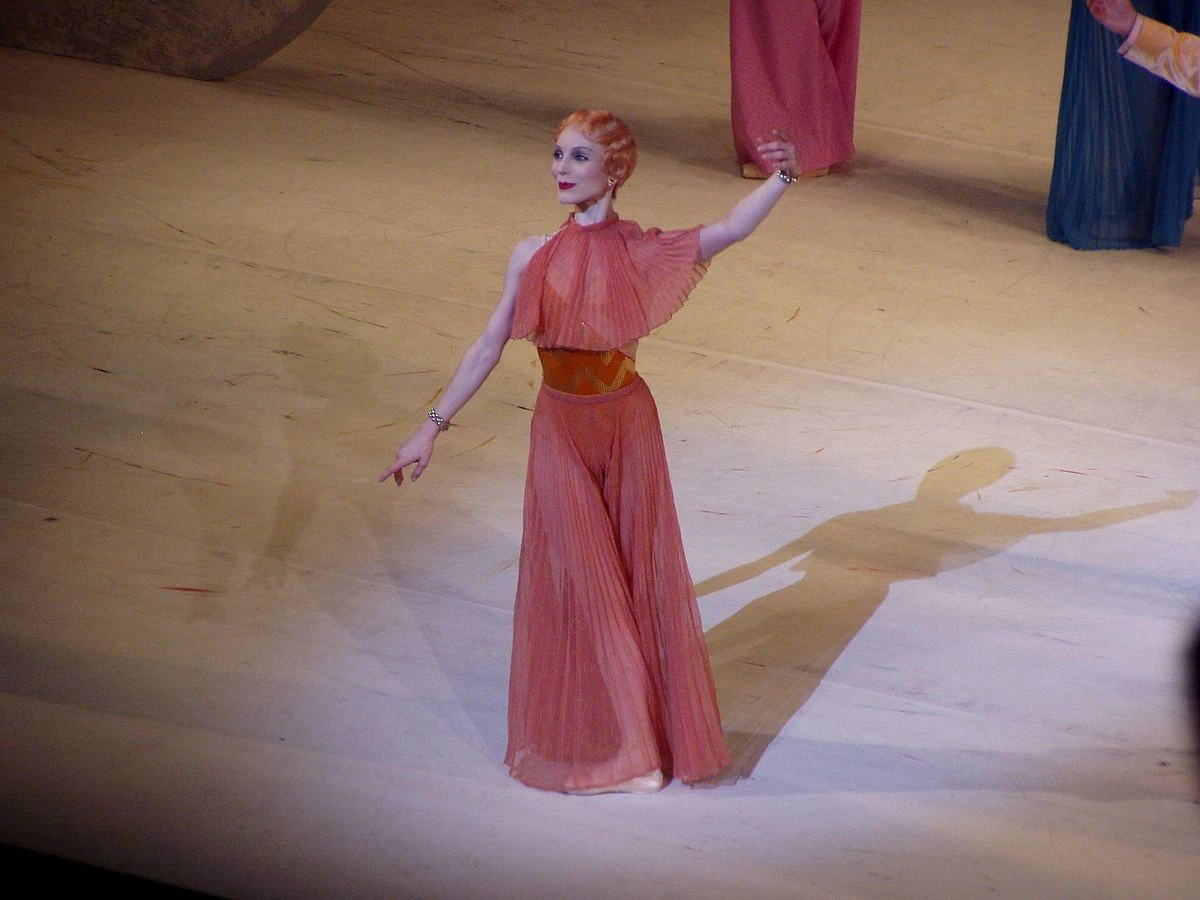
Sarah Lamb’s career has crossed the Atlantic, from her early training and first professional appointments in Boston to the Royal Ballet in London. She joined the company in 2004 as a first soloist and was promoted to principal dancer two years later. Her repertory encompasses classical roles such as Aurora in The Sleeping Beauty and contemporary works including Christopher Wheeldon’s The Winter’s Tale.
Training in Boston
Lamb was born in Boston, Massachusetts, on 17 October 1980. She began with tap and then modern dance, before starting ballet at the Boston Ballet School at the age of six. As a child, she was selected to dance Clara in a Boston Ballet performance marking the company’s centenary. At 13, she began training with Madame Tatiana Legat, continuing with her for four years and receiving further coaching for a year after joining the Boston Ballet’s second company.
In 1998, Lamb was named a Presidential Scholar in the Arts and received a gold medal from US President Bill Clinton. She also won silver medals at three international ballet competitions: in Nagoya in 1999, at the Sixth New York International Ballet Competition in 2000, and at the USA International Ballet Competition in 2002. These awards mark the early competitive strand of a career that would develop through company work and an increasingly varied repertory.
From Boston Ballet to London
Lamb joined Boston Ballet in 1999 as a member of its corps de ballet. She became a soloist in 2001 and a principal dancer in 2003. Her roles there included Odette and Odile in Swan Lake, Juliet in Rudi van Dantzig’s Romeo and Juliet, Lise in La fille mal gardée and Gamzatti in La Bayadère. She also danced Olga in Eugene Onegin, roles in Giselle and Don Quixote, and the Sugar Plum Fairy, Dew Drop Fairy and Snow Queen in The Nutcracker.
In August 2004, she moved to London to join the Royal Ballet as a first soloist. The company promoted her to principal in 2006. Her move was not simply a change of location: it placed a dancer with established experience in Boston’s company repertory within a different ensemble and an expanded range of roles. She continued to take on classical parts, including Aurora and Princess Florine in The Sleeping Beauty, while also performing works by contemporary choreographers.
A repertory spanning classical and contemporary ballet
The Royal Ballet repertory recorded for Lamb includes both leading roles and parts in works that make very different demands on a dancer. Alongside The Sleeping Beauty, she has danced the Sylph in La Sylphide, Marie Larisch in Mayerling, Tatiana and Olga in Onegin, and Manon in L’histoire de Manon. Her roles also include Alice in Alice’s Adventures in Wonderland and Princess Belle Rose in The Prince of the Pagodas.
Her repertory reaches beyond narrative classics. It includes works such as Polyphonia, Voluntaries, Chroma, Infra and The Grey Area, as well as Afternoon of a Faun, Human Seasons and Stop Time Rag. The range matters: Lamb’s career cannot be described through a single famous role or one style of ballet. She has performed in story-led works, classical repertory and pieces whose place in a programme is not dependent on a traditional narrative.
Two parts singled out in accounts of her work are Aurora in The Sleeping Beauty and Hermione in Wheeldon’s The Winter’s Tale, his ballet adaptation of Shakespeare’s play. The former belongs to the classical repertory; the latter brings a Shakespearean story to the ballet stage. Taken together with her other recorded roles, they illustrate the breadth of the company repertory through which Lamb has built her career.
Family connections and life in London
Lamb is the second of three daughters of Kathleen and John Lamb. Her father, who is English, moved to the United States as a child in 1950, after his father died. That family background forms part of her connection to Britain, alongside her professional life with the Royal Ballet in London.
In 2005, Lamb married fellow dancer Patrick Thornberry, who was born in California. They live in London. Her family also has a connection to Camp Jabberwocky, a summer camp for disabled children founded by her grandmother, Helen Lamb. Her parents ran the camp for many summers after Helen retired, and Lamb and her sisters worked there as counsellors. In 2009, Lamb performed a ballet with three of the campers for the camp’s end-of-summer play.
Why Sarah Lamb deserves a place in British Legacy
Sarah Lamb’s place in British Legacy rests on a specific, sustained contribution to British ballet: her work as a principal dancer with the Royal Ballet. She joined the London company in 2004 after progressing through Boston Ballet from the corps de ballet to principal. At the Royal Ballet she took on a wide range of roles, from Aurora in The Sleeping Beauty to Hermione in The Winter’s Tale, as well as parts in works including Chroma, Infra and Alice’s Adventures in Wonderland. That repertory shows how a major British company brings classical ballet and newer work before audiences, and how a dancer’s contribution is built through many performances rather than a single celebrated part.
Her story also gives British ballet a clear international dimension without obscuring the evidence of her work here. Lamb was born and trained in Boston, then made her professional career in two companies, reaching principal rank at Boston Ballet before joining the Royal Ballet. Her father’s English background provides a further family connection, but her strongest British association is her long professional role in London. The combination is a reminder that the cultural life of a British institution can be shaped by artists whose training began elsewhere. Lamb’s career contributes to that life through the roles she has danced, the breadth of the repertory she has undertaken and her participation in a performance with young people at Camp Jabberwocky.
Sources
Sarah Lamb (dancer), revision 1374725789
Adapted in part from Sarah Lamb (dancer) by Wikipedia contributors, under CC BY-SA 4.0. Text has been edited and combined with the existing article; this adapted text is shared under the same licence. Contributor history.