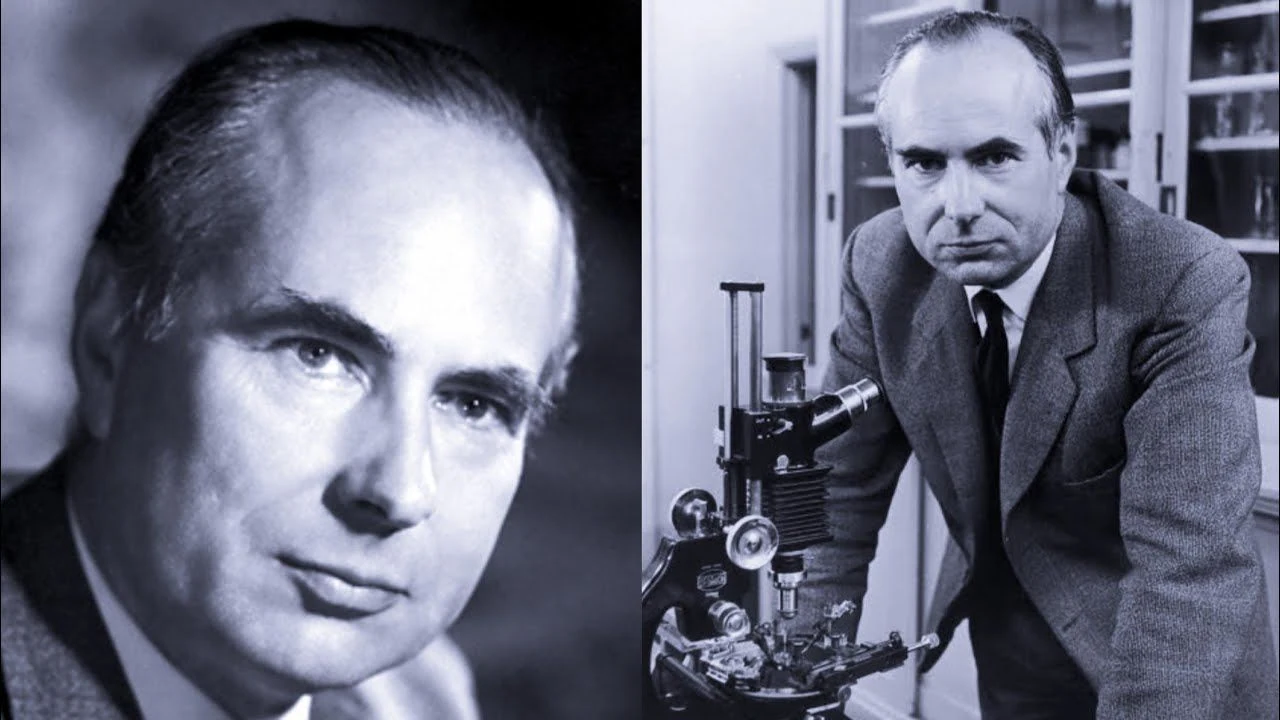
How does a nerve send a signal? Andrew Fielding Huxley helped turn that deceptively simple question into a problem that could be measured, modelled and answered. Working with Alan Hodgkin, he showed how movements of sodium and potassium ions across a cell membrane generate the electrical pulse known as an action potential. Their experiments and equations gave physiology a precise account of nerve signalling. Huxley then brought similar experimental ingenuity to the mechanics of muscle, helping explain how its fibres shorten.
His career ranged from building laboratory apparatus to leading major British scientific institutions. The same habits recur throughout it: close observation, practical skill and a willingness to make a theory answer to evidence. His work on nerves and muscles became fundamental to physiology, while his service at University College London, the Royal Society and Trinity College, Cambridge, connected discovery with the institutions that sustain research and teaching.
A practical mind takes shape
Huxley was born in Hampstead, London, on 22 November 1917, into the Huxley family. As a boy he became interested in microscopy and learned to work with a lathe. Making things and looking closely at them were not separate pursuits: both demanded attention to the behaviour of materials and to the limits of the tools being used. That practical familiarity would prove valuable in a career where scientific progress often depended on designing or adapting equipment as well as asking the right question.
He attended University College School and Westminster School, then won a scholarship to Trinity College, Cambridge. He initially considered engineering before turning to physiology. In 1939 he became one of Hodgkin’s postgraduate students. The choice brought his mechanical interests into a field concerned with living systems, and began a collaboration that would reshape the understanding of nerve impulses. His early grounding in engineering did not disappear when he changed disciplines: it informed the practical approach he took to experimental problems.
The Second World War interrupted his early research. Huxley served with British Anti-Aircraft Command and later transferred to the Admiralty, working on radar control and naval gunnery. These were technical wartime duties, and they formed part of a period in which scientific and engineering knowledge was applied to practical problems. The interruption was substantial, but it did not end his research career. When the war ended, he returned to Cambridge and resumed the work with Hodgkin.
Making the nerve impulse measurable
The central obstacle for Huxley and Hodgkin was not simply a lack of theory. Nerve impulses are brief electrical events, and the cells in which they occur are small. Recording the changes as they happened required a specimen that could be reached by instruments and apparatus capable of keeping pace with the signal. They worked with the giant axon of a squid at the Marine Biological Association laboratory in Plymouth. Its unusually large diameter made it possible to investigate electrical activity in a way ordinary nerve fibres did not.
The choice of specimen answered one difficulty, but did not make the work straightforward. An electrical pulse lasts only milliseconds; measurements had to capture a fast-changing event in a very small biological structure. The scale of the axon made access possible, while the demands of the experiment still required exact, responsive equipment. The laboratory problem and the scientific question were inseparable: without a method capable of recording the changes, the mechanism could not be established by observation.
Huxley’s practical ability helped make the experiments possible. He built or adapted much of the equipment they needed. With Hodgkin, he used voltage-clamp methods to control electrical conditions across the nerve membrane and measure ionic currents. Instead of treating the impulse as an unexplained spark travelling through a nerve, they could investigate changes in the membrane itself. Holding electrical conditions under control made it possible to observe currents that would otherwise be difficult to distinguish during the rapidly changing signal.
The measurements showed a sequence: sodium ions move inwards as the electrical pulse rises, followed by potassium ions moving outwards as it subsides. This movement of ions across the membrane produces and propagates the action potential. The work replaced a broad description of nerve activity with an account in terms of measurable physical events. It also demonstrated what carefully controlled experiments could establish when the specimen, instruments and method were suited to the question.
Equations that explained a living process
In 1952, Huxley and Hodgkin published the theory now known by their names. Its differential equations described how action potentials are generated and propagated, relating changing electrical conditions at the membrane to the nerve impulse’s course. Mathematics was not an ornament added to an already complete explanation. It was part of the explanation: a means of showing how the measured changes could account for the pulse as a whole. The model connected experimental observations to a description of the nerve’s changing electrical state.
A model of this kind gives other researchers something they can test and refine. The Hodgkin–Huxley framework became foundational in neurobiology and electrophysiology, and helped shape later thinking about excitable membranes, ion channels and electrical signalling in cells. Its influence lay not only in the particular results but also in the method it exemplified: careful measurement, a defined mechanism and a mathematical description usable beyond the original experiment. The equations made it possible to consider the impulse as a process with components and a course, rather than an indivisible event.
In 1963, Huxley shared the Nobel Prize in Physiology or Medicine with Hodgkin and John Eccles. The award recognised discoveries concerning the ionic mechanisms involved in nerve-cell excitation and inhibition. Huxley and Hodgkin’s work elucidated the action potential; Eccles’s work concerned synaptic transmission. The distinction matters: the prize honoured complementary contributions to understanding how the nervous system operates, rather than attributing all of its recognised findings to one pair of researchers.
From nerve signals to muscle force
Huxley’s scientific work did not stop with the nerve impulse. He turned to another fundamental physiological problem: how a muscle contracts. As with his earlier research, he improved the means of observation as part of the investigation, working on interference microscopy to examine muscle fibres with greater precision. The aim was not simply to produce a clearer image, but to make it possible to test explanations of how muscle changes length. Better observation could distinguish between competing accounts of the structures within a contracting muscle.
In the early 1950s, Huxley worked with the physiologist Rolf Niedergerke on what became known as the sliding-filament theory of muscle contraction. At about the same time, Hugh Huxley and Jean Hanson reached closely related conclusions. Their papers appeared together in Nature in May 1954. The theory proposed that muscle shortens as actin and myosin filaments slide past one another, rather than because the filaments themselves crumple. The account gave contraction a structural mechanism: the filaments move relative to one another within an organised arrangement.
Huxley later developed equations describing how cross-bridges generate force during this sliding process. By 1966, his team had provided strong evidence for the theory. This body of work makes clear that his importance was not confined to one celebrated discovery. He helped explain both how electrical signals travel along nerves and how muscles produce force, bringing observation, instrumentation and mathematical reasoning to two different problems in physiology. His move from nerves to muscles was not a departure from his earlier method, but a new application of it.
Academic leadership and public service
Huxley held academic posts in Cambridge until 1960. He then became head of the Department of Physiology at University College London, where he later served as a Royal Society Research Professor. UCL records him as holder of the Jodrell Chair from 1960 to 1969. These appointments placed him within the work of a major British university department: research and teaching, alongside the responsibilities of leadership. His scientific career therefore included not only investigation but also a sustained role in an academic institution.
His institutional service extended beyond UCL. Elected a Fellow of the Royal Society in 1955, he received its Copley Medal in 1973 and served as its president from 1980 to 1985. He was knighted in 1974 and appointed to the Order of Merit in 1983. In 1984 he succeeded Hodgkin as Master of Trinity College, Cambridge, remaining in the post until 1990. Together, these roles show a career in which experimental research sat alongside responsibility for scientific and academic communities. The honours mark recognition, but the posts also represent practical service to British science and higher education.
Huxley died on 30 May 2012. The theories and methods he helped establish had by then become part of the working framework of physiology. A scientific idea can have a particularly lasting effect when it ceases to be merely a striking result and becomes a starting point for further work. His nerve and muscle research achieved that kind of endurance: later researchers could take its measurements, mechanisms and models as tools for further investigation.
Why Sir Andrew Huxley deserves a place in British Legacy
Andrew Huxley deserves a place in British Legacy because his achievements changed how physiology could explain two basic processes: the transmission of a nerve impulse and the generation of force in muscle. With Hodgkin, he used the giant squid axon, carefully controlled measurements and mathematical modelling to show how ionic movements across a membrane produce an action potential. That explanation gave later researchers a framework they could test and develop. In his separate work on muscle contraction, he helped establish the sliding-filament account and went on to describe force generation through cross-bridges. These are specific contributions to understanding how living bodies function, not simply a record of honours or reputation.
His British legacy is also institutional and practical. He studied and worked at Cambridge, conducted research at Plymouth, led physiology at UCL and served the Royal Society as president before returning to Trinity as Master. Across those settings, his example joined technical resourcefulness to intellectual precision: apparatus had to work, observations had to be exact, and explanations had to account for the evidence. His career benefited science not only through results but through service to places where research and teaching take place. Remembering Huxley therefore means recognising both what his work made possible for physiology and the British institutions through which he contributed to scientific life.