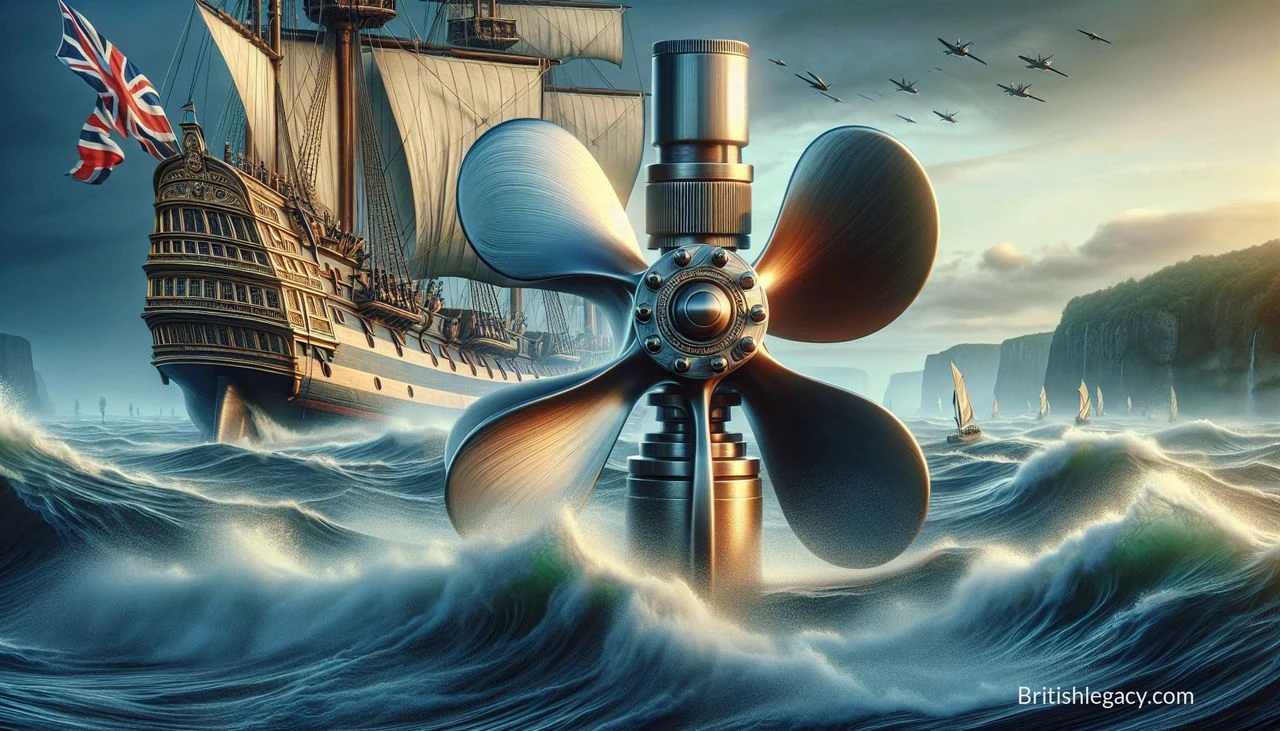
The screw propeller is easy to overlook: fitted beneath a ship’s stern, it does its work out of sight. In the early nineteenth century, however, it offered a different way to move vessels through the water. Francis Pettit Smith helped make that possibility practical in Britain. His importance lies not in being the only person to work on screw propulsion, but in helping demonstrate that it could operate at a serious scale and persuade shipbuilders and the Admiralty to take it seriously.
Smith’s experiments helped change the design of SS Great Britain and contributed to the Royal Navy’s adoption of screw propulsion. His story is not a solitary inventor’s triumph: it involves prototypes, financial backing, shipbuilders, naval trials and the willingness to learn from an accident. It shows how a working demonstration can carry an idea from experiment towards everyday use.
A farmer with an interest in model boats
Francis Pettit Smith was born at Hythe, Kent, on 9 February 1808. His father was the town’s postmaster. Smith attended a private school in Ashford and went on to work as a grazing farmer on Romney Marsh. He later moved to Hendon in Middlesex, where he continued farming for decades. His route into marine engineering was not through a naval dockyard or a formal engineering office. The account of his early work instead centres on a practical interest in model boats and how they moved.
In Smith’s youth, steam navigation relied heavily on paddle wheels. The wheels were exposed at the sides of a ship, took up space and could be less effective in rough conditions. A propeller working beneath the water at the stern offered a different arrangement. It could leave the sides of a vessel clear and avoid some of the constraints imposed by large paddle boxes. These were practical design considerations, not simply questions of novelty.
Later accounts describe Smith as a skilled maker of model boats from boyhood. By 1834, he had made a model on a reservoir near his farm, using a spring to drive a wooden screw. He continued to develop the idea. In 1835 he built an improved model for further trials. Such small experiments could not by themselves establish how a propulsion system would work on a larger vessel, but they gave Smith a means to test the basic principle and refine his approach.
A broken screw changes the design
In 1836, Smith patented a method of propelling vessels with a screw revolving beneath the water at the stern. The work involved others: the engineer Thomas Pilgrim provided technical assistance, while Wright’s Bank supplied financial backing. The patent marked an important stage, but it did not settle the engineering questions. Those required practical trials.
During tests in 1837 of a small boat named Francis Smith, a wooden screw made of two complete turns accidentally broke. The damaged screw performed better, leaving Smith with a useful observation: a shorter working surface could be more effective than the long, corkscrew-like form he had been testing. The accident did not originate screw propulsion. It helped Smith refine a design by showing that the initial assumption about the screw’s length was not necessarily right.
The episode captures an important part of the story. A patent can describe an idea, but a vessel in motion provides a different kind of evidence. Smith’s work depended on watching how the model behaved and changing it in response. The practical value of the experiment was not that every early design was successful; it was that testing could reveal what to alter.
Smith was not alone in exploring screw propulsion. John Ericsson was developing a rival system, and the wider progress of marine engineering involved investors, shipbuilders and naval officers as well as inventors. Recognising that context makes Smith’s contribution clearer. His distinction was not exclusive ownership of the idea, but his role in demonstrating and promoting its practical potential in Britain.
Archimedes takes the idea to sea
A larger demonstration followed. Smith helped organise the Propeller Steamship Company, which built Archimedes in 1839. The vessel, described as a 237-ton ship, is widely recognised as the world’s first successful screw-propelled steamship. The qualification matters: experimental craft and competing designs came before and alongside it. What Archimedes offered was persuasive evidence that a screw could propel a ship on a substantial scale.
The change was about more than speed. A stern-mounted propeller left the ship’s sides free of paddle wheels and their boxes, and kept the mechanism beneath the waterline. That arrangement created different possibilities for a vessel’s layout. It made screw propulsion a proposition for working ships, rather than only an ingenious mechanism on a model.
Smith and his backers took Archimedes around the British coast to publicise the system. The ship visited Bristol in May 1840. There, Isambard Kingdom Brunel and his colleagues could examine the screw and consider its use on a much larger vessel. The demonstration helped turn an abstract engineering possibility into a practical choice for people involved in ship design.
Brunel, the Admiralty and a public trial
Brunel had originally planned SS Great Britain with paddle wheels. Following trials associated with Archimedes, he persuaded the directors of the Great Western Steam Ship Company to adopt screw propulsion instead. Smith did not design Great Britain; his importance to the decision was the practical evidence his work helped provide. Brunel’s change of plan shows how a tested idea could influence a much larger engineering project.
Launched in 1843, Great Britain was celebrated as the world’s largest and longest passenger ship and the first iron-hulled, screw-propelled ship of her kind. The ship’s place in the story should not obscure the different contributions involved. Brunel and his colleagues were responsible for their vessel; Smith’s experiments helped establish the case for the means of propulsion they chose.
The Royal Navy was also considering screw propulsion. Smith helped persuade the Admiralty to adopt it, and the screw-driven HMS Rattler later took part in a well-known comparison with the paddle steamer Alecto. On 3 April 1845, in the North Sea, the two vessels were tested stern to stern. Rattler towed Alecto backwards. The trial made for a striking demonstration of the competing systems and helped show the public and naval observers what screw propulsion could do.
The consequences of such a shift reached beyond one celebrated contest. Screw propulsion offered ship designers a way to arrange vessels without large paddle boxes at their sides, while placing the working mechanism below the waterline. The account of Smith’s contribution links his experiments to changes in naval, passenger and commercial shipping. It was a gradual transition involving many people and decisions, not a change accomplished by one inventor in isolation.
Recognition and a later role in preserving invention
By 1852, Smith could travel on the kind of vessel whose propulsion his experiments had helped advance. In May that year he went between Liverpool and New York aboard SS Great Britain. The voyage came after the argument had shifted from whether screw propulsion could work to how the technology might be developed and used.
Smith received a civil-list pension in 1855. In 1860 he was appointed to lead the Patent Museum at South Kensington. The position placed him in an institution concerned with the preservation and interpretation of invention. It also followed a career that had depended on more than an initial idea: making models, testing them, securing backing, demonstrating a design and persuading others to adopt it.
Smith was knighted in 1871. From 1864 to 1870 he lived at Fountain House, 17 Sydenham Hill. A blue plaque there identifies him as a “Pioneer of the Screw Propeller”. He died in London on 12 February 1874 and was buried at Hythe, the Kent town where he had been born.
The marine propeller has since changed in form, materials and engineering. Smith’s early designs are not the same as modern propellers, but the broader significance of his work remains in the adoption of screw propulsion. His achievement was to help persuade a technically and commercially important industry that a different way of moving ships was worth testing and using.
Why Sir Francis Pettit Smith deserves a place in British Legacy
Francis Pettit Smith deserves a place in British Legacy because his work helped alter the machinery of a country deeply connected to shipping. His experiments contributed to a practical alternative to the paddle wheel, and his role in demonstrating screw propulsion helped move it towards acceptance in British shipbuilding and naval use. That connection is specific: his work influenced Brunel’s decision to change the propulsion planned for SS Great Britain, and the Admiralty’s adoption of the screw formed part of a wider shift in naval engineering.
Smith’s contribution also offers a useful account of how engineering change happens. He worked with technical assistance and financial backing, built models, tested them and adjusted a design after an accidental break produced an unexpected result. The later success of Archimedes depended on demonstrating the system to people who could assess, build and adopt it. Remembering that process gives a fuller account than naming a single inventor and treating the technology as an isolated stroke of genius.
The benefits of screw propulsion reached beyond the experiment itself. A propeller beneath the stern allowed different arrangements from those required by side-mounted paddle wheels, influencing ships used for naval, passenger and commercial purposes. Smith did not single-handedly create every later development, and he was one of several people working on the technology. But he helped make the case for its use in Britain. His story belongs in a British legacy of practical invention: ideas tested against real demands, carried forward through collaboration, and adopted when their usefulness could be demonstrated.