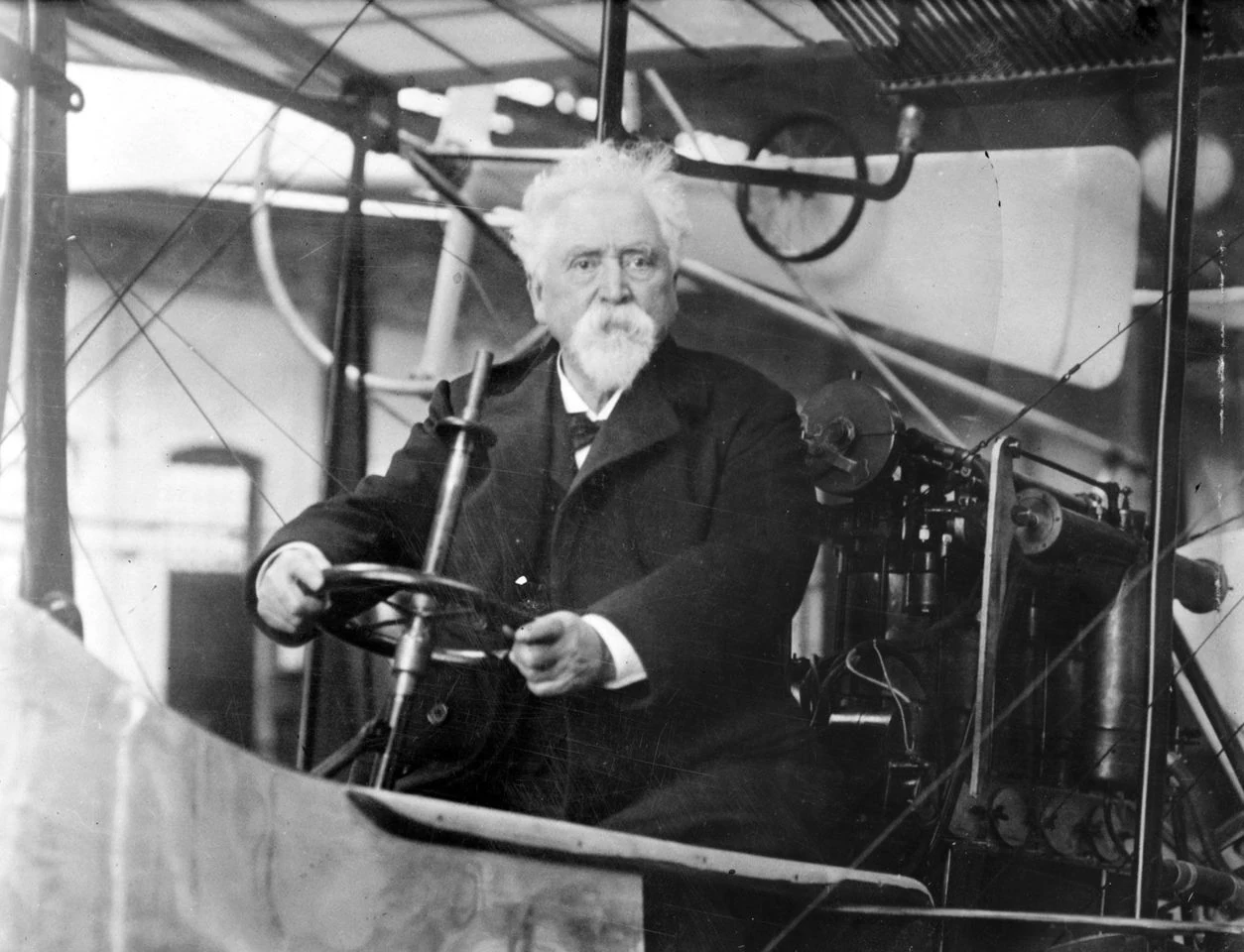
Hiram Maxim’s most consequential invention made the energy of one shot prepare a gun to fire the next. By using recoil to reload and repeat the firing cycle, he produced a practical automatic weapon that transformed firearms engineering. The consequences were lethal: sustained fire altered the balance between attack and defence on battlefields. But Maxim’s British story extends beyond armaments. He came to Britain for work in electric lighting, built an industrial enterprise here, explored powered flight and devised an amusement ride that remains associated with Blackpool.
A working inventor crosses the Atlantic
Maxim was born in Maine in 1840. His early working life began with an apprenticeship as a coachbuilder at fourteen; he later worked as an instrument maker and draughtsman. Those trades placed him close to the practical demands of making things: materials, dimensions, moving parts and the repeated adjustments needed to make a mechanism work. They provide a useful context for his later career, which ranged across machines and devices, although they should not be treated as a simple explanation for every invention that followed.
Before he became known for an automatic gun, Maxim worked with steam, gas and electrical machinery. His interests included electric lamps and the manufacture of filaments, and he helped install electric lighting in a major New York building. His work also touched steam pumps, electrical apparatus, inhalers for respiratory trouble and fire-sprinkler technology. The supplied accounts describe a varied body of patents and projects, some commercially important, others more speculative, and some associated with disputes over priority. The range matters: his career was not confined to weapons, even if the gun came to dominate his reputation.
Maxim moved to Britain in 1881 to work in electric lighting. Here he developed the automatic gun and became involved in manufacturing. His move therefore marks more than a change of residence: Britain became the setting for the work that established his international reputation and for the business that helped turn his mechanism into a product. He became a naturalised British citizen on 16 September 1899 and was knighted in 1901. His life connects American birth with a substantial British working and inventive career.
The imported article dates the creation of the Maxim gun to 1884, while the current feature emphasises its development in Britain without giving a precise year. That date is not necessary to explain the sequence of events and is not repeated here as a separately established detail. What the supplied material makes clear is the broader chronology: Maxim arrived in Britain in 1881, pursued electrical work and developed the weapon that became his defining invention.
How recoil made a gun automatic
Rapid fire was not itself a new idea. Hand-cranked weapons such as the Gatling gun could fire repeatedly, but an operator had to keep turning the mechanism. Maxim’s central contribution was to make the firing cycle drive itself. Recoil from a shot operated the mechanism: it opened the breech, ejected the spent cartridge case, brought a fresh round into position and prepared the gun to fire again. Once started, the cycle could continue while ammunition remained.
The important distinction is between a weapon that fires rapidly with continuous manual effort and one in which the mechanism uses each discharge to prepare the next. Maxim’s design put the energy of firing to work as part of the reloading process. His patent language, as presented in the supplied feature, described a gun “entirely automatic in its action”. That mechanical principle—not a single headline figure for rounds per minute—is the clearest way to understand the innovation.
The design also had to prove usable beyond the inventor’s bench. A mechanism that is ingenious but unreliable will not be a practical weapon. The supplied feature describes Maxim’s as the first practical fully automatic machine gun, robust enough to be manufactured, tested, sold and used at scale. Later versions employed features including water cooling around the barrel to sustain fire. The Maxim system was adopted in numerous forms, through derivatives and copies, and Maxim-pattern guns were widespread by the First World War.
That practical success gave the mechanism consequences on a scale that its compact description can obscure. In imperial warfare, industrial firearms could intensify the imbalance between armies equipped with them and opponents without comparable firepower. In later conflicts, machine guns strengthened defensive positions and made frontal attacks more dangerous. The imported article says that the British Army first used the gun in colonial conflicts; the supplied research does not independently establish that specific first-use claim, so it is not presented here as settled chronology. The wider, supported account is still stark: automatic fire increased the destructive capacity available to armies and helped change battlefield conditions.
The significance of Maxim’s work is therefore double. It was a major mechanical advance, founded on a clear way of converting recoil into repeated action. It was also a technology whose military use carried grave human costs. A feature about his engineering should not obscure those costs, or imply that technical achievement and humanitarian benefit are the same thing. The weapon’s influence forms part of the history of modern firearms precisely because it was both mechanically effective and devastating in application.
From an invention to an industrial lineage
In Britain, the Maxim gun became an industrial enterprise rather than remaining an experiment. The supplied feature says that Maxim developed the weapon in South London and founded an arms company with financial backing from Edward Vickers at Crayford in Kent. That business later merged with Nordenfelt, and from this lineage emerged Vickers, Son & Maxim. The account places the making of the gun within a wider process: an inventor’s mechanism needed finance, workshops and production before it could be manufactured and distributed on a much larger scale.
This industrial history is an important part of Maxim’s British connection. His work did not stop at the patent or the prototype. The company and its later development helped carry the design into manufacture, while subsequent engineers and makers adapted it. The resulting weapons were not all identical to Maxim’s original gun, and it would be misleading to treat every later model as his invention without qualification.
The Vickers machine gun used by British forces was an improved descendant of Maxim’s work, not simply the original gun under a new name. British engineers and manufacturers refined, standardised and adapted the system after Maxim had established its central operating principle. That distinction gives a more accurate account of how engineering advances develop: an inventor can establish a mechanism, while the products that follow are altered through further design and manufacture.
His other projects underline the breadth of his practical interests, but the available material does not support treating every patent as an equally successful innovation. Steam pumps, lighting and electrical apparatus, inhalers and sprinklers represent different kinds of work and different prospects. Some projects were commercially significant; others were speculative or linked to priority disputes. Taken together, they show a career in applied mechanics rather than a single-minded progression towards the machine gun.
Experiments in flight, then a ride in Blackpool
Maxim’s interest in powered flight brought him to another difficult mechanical problem. He investigated aerofoils, propellers and the relationship between power and weight. In 1894, at Baldwyn’s Park in Kent, he tested a large steam-powered flying machine running on rails. It did not become a practical aircraft. The supplied feature describes the trials as serious engineering work, involving questions of lift, control, structural strength and whether a sufficiently light power source could be provided.
The test rig was part of an effort to understand flight, but it also led to an unexpected second use. Maxim devised the Captive Flying Machine in 1902 as a development of his flight apparatus; it was first exhibited in 1904. Rather than becoming an aircraft, the device offered a controlled public experience of motion and height. In this change of purpose, an experiment in aviation became a form of entertainment.
The ride opened at Blackpool Pleasure Beach on 1 August 1904. The supplied feature identifies it as Grade II listed and describes it as the oldest static amusement ride in Britain, the only example of its type in the world and the oldest fairground ride in continuous use in Europe. These distinctions are reported in the supplied material and have not been independently checked for this edition. The same feature says that the Pleasure Beach continues to list Flying Machines among its rides.
Blackpool gives Maxim’s work a physical afterlife quite different from a patent or a company history. His rail-mounted flying machine did not solve the practical problem of building an aircraft, but the development led to a ride that brought a managed imitation of flight to a seaside audience. It is a reminder that inventions can change direction: a piece of experimental apparatus can find a new purpose, and that purpose can outlast the original investigation. In Maxim’s case, the ride connects his interest in flight with British public leisure.
Why Sir Hiram Maxim deserves a place in British Legacy
Sir Hiram Maxim deserves a place in British Legacy because Britain was central to the development and industrial history of his most consequential invention. He arrived in 1881 to work in electric lighting, developed his automatic gun here and built an arms business with backing at Crayford. His naturalisation and knighthood are part of that British life, but the connection is not merely biographical. The country’s workshops and manufacturers became the setting in which his recoil-operated mechanism was developed and carried into production. Its descendants were refined by others, including the engineers behind the later Vickers machine gun.
That legacy needs to be told without disguising the weapon’s human cost. The mechanism was a remarkable engineering solution, but its military effectiveness helped make warfare more destructive. Maxim’s wider career also included electrical work, other mechanical projects and serious experiments in powered flight; these details broaden the story without cancelling the consequences of his gun. The Captive Flying Machine offers a particularly tangible counterpoint. Developed from his flight experiments and opened at Blackpool in 1904, it connected engineering with public entertainment and, according to the supplied account, remains part of the resort’s ride offering. Maxim’s place in British history is therefore specific and complicated: it joins invention, manufacture, warfare and leisure, and asks us to remember both the ingenuity and the cost.