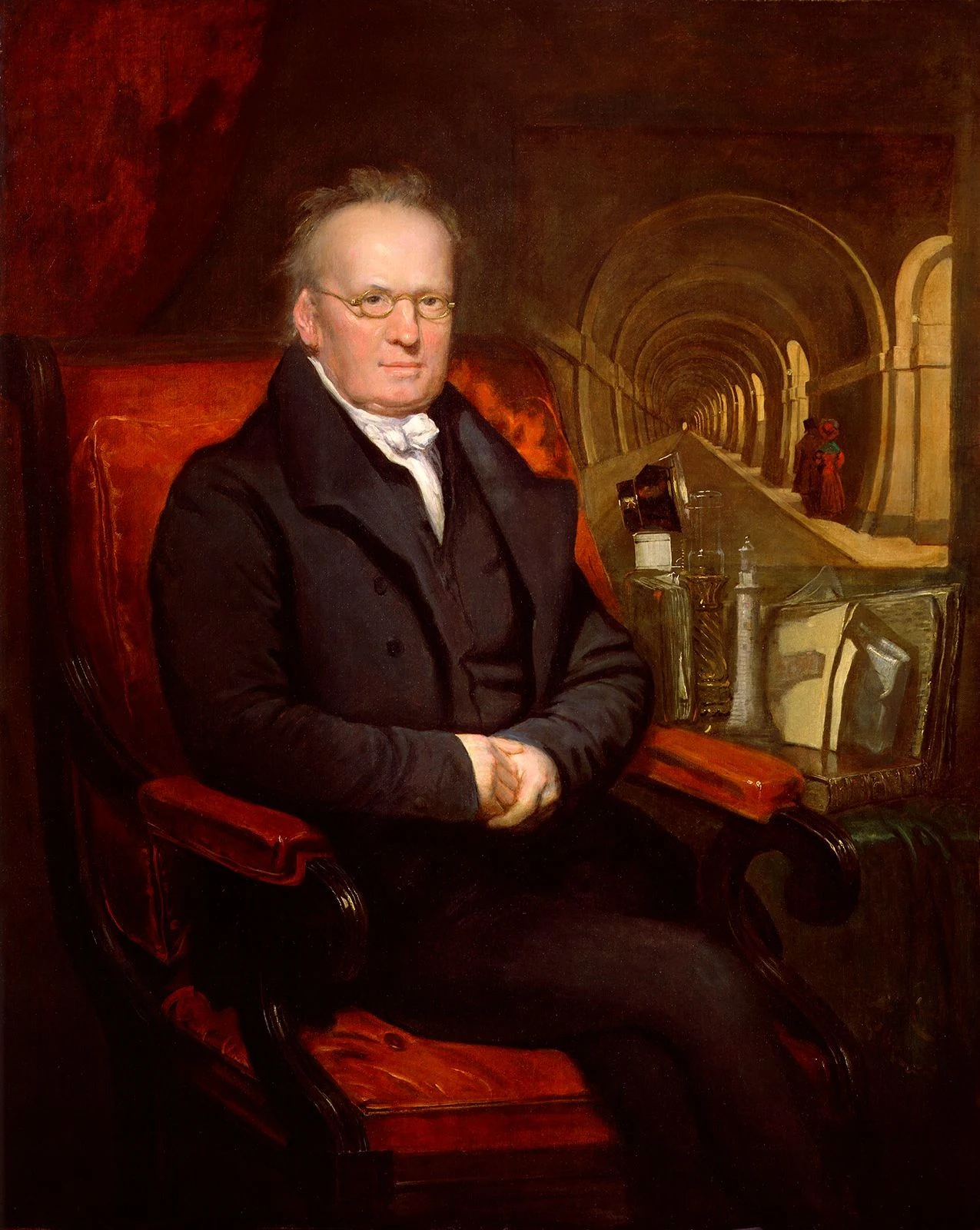
Before London’s underground trains could carry passengers beneath the Thames, Marc Isambard Brunel had to solve a more basic problem: how to keep workers safe while they excavated soft, waterlogged ground under a working river. His answer was a tunnelling shield that enclosed the men at the tunnel face and allowed work to advance in protected stages. The Thames Tunnel opened in 1843; trains began using it in 1869. Its later life as transport infrastructure gives a measure of Brunel’s achievement: an audacious experiment became part of the city’s everyday movement.
The tunnel was not his only contribution to Britain. At Portsmouth, Brunel developed machinery for making pulley blocks for the Royal Navy, helping replace slow hand production with a coordinated industrial process. Born in France and shaped by time in the United States, he settled in Britain in 1799. Here, his work served the navy, advanced manufacturing and changed what engineers thought possible beneath the capital.
From Normandy to London
Brunel was born in Hacqueville, Normandy, on 25 April 1769. His family intended him for the priesthood, but his interests lay in drawing, mathematics and practical work. Training in the French navy gave him experience of ships, timber, mechanics and measurement. The French Revolution brought political danger as well as upheaval. A royalist, he left France in 1793 and travelled to the United States.
In America he joined engineering schemes and travelled in upstate New York. By 1796 he had been appointed chief engineer of New York City, and he submitted a design for the new Capitol in Washington. These experiences introduced him to engineering on a civic scale. A conversation about the Royal Navy’s need for pulley blocks would soon give his work a British focus: Brunel devised a mechanised approach to their production, then crossed the Atlantic in 1799 to bring the proposal to Britain.
London also reunited him with Sophia Kingdom, whom he had met in France before fleeing the Revolution. After years apart, they married at St Andrew, Holborn, on 1 November 1799. They had three children, including Isambard Kingdom Brunel. Marc’s achievements deserve to be considered in their own right, rather than treated mainly as a prelude to his son’s career. The household in which the younger Brunel grew up had already been shaped by his father’s engineering work and experience.
Brunel’s route to Britain was more than a change of address. His experience in France, the navy and the United States formed part of the background to a career that would be put to work in British institutions. The move also reunited a family separated by the upheaval of the Revolution. In London, the work that followed ranged from the manufacture of a small but essential naval component to an immense construction project below the Thames.
Production for the Royal Navy
A pulley block is a component used in a ship’s rigging. The Royal Navy needed large numbers, made reliably and to standard sizes. Producing them by hand was slow and required skilled labour. Brunel’s response was not a single machine but a system of specialised machines, developed with the engineer Henry Maudslay. Following official approval in 1802, the machinery was introduced at Portsmouth Block Mills.
The scale of production was striking. By 1806, forty-five machines and ten men were producing 140,000 blocks a year; the capital costs had been recovered within three years. The Block Mills are described as the earliest application of steam-powered machine tools for mass production. The figures convey more than speed. They show a change in how a complex manufacturing task could be organised: into repeatable stages, with machinery designed to improve consistency as well as output.
The machines addressed different parts of the work of making blocks, turning what had been a slow, skilled process into a system capable of producing standard components in quantity. The importance lay in the organisation as well as the individual devices. The machinery had to operate as a connected production method, and the number of blocks made each year shows what that method could achieve. Brunel’s contribution was therefore not confined to invention at the drawing board; it involved applying machinery to the practical demands of a large-scale manufacturing operation.
That mattered to the navy as well as to manufacturing. Naval strength depended on dependable supplies and on the many components that made ships work, not only on ships and their crews. Brunel’s system addressed a practical bottleneck in that supply chain. It also demonstrates the breadth of his engineering. The Thames Tunnel made him famous for a major civil-engineering project, but at Portsmouth he applied his abilities to industrial processes: designing a system in which machinery, labour and production were coordinated to meet a large institution’s needs.
A new method beneath the Thames
Brunel’s tunnelling idea took shape against a background of failed attempts to work beneath the river. In 1818 he patented a shield for excavating at the tunnel face. The iron structure was divided into cells. Workers could dig small sections from within the cells while the frame supported the surrounding ground. When enough earth had been removed, jacks pushed the shield forwards and a lining could be built behind it.
The essential innovation was the sequence. Rather than leaving workers exposed as they cut into unstable ground, the shield brought protection, excavation, forward movement and lining into a controlled process. It could reduce the danger of collapse, although it could not remove the risks of working below a river. The principle became important to later tunnelling methods, which developed machinery and scale but retained the idea of supporting the ground as excavation progressed.
The shield was a response to the conditions at the tunnel face, where workers had to excavate in soft ground under a river. Dividing the structure into cells meant that excavation could proceed in sections while the surrounding earth was supported. The shield could then be advanced with jacks, with the tunnel lining built behind it. This practical order of operations mattered: progress depended on protecting the workers and the ground while creating a permanent passage, rather than simply digging forwards and hoping the tunnel would remain stable.
Brunel later associated his idea with the shipworm, which bores through timber while protected by a hard shell at its head. The image offers a way to understand how he thought: observing a physical process and considering how its protective arrangement might inform engineering. It should not be treated as a complete account of how the shield was conceived, but it illustrates the connection between observation and practical design in his work. The shield’s importance, in any event, lay in the method it made possible and its application to the particular dangers of the Thames project.
Floods, money and perseverance
The Thames Tunnel received Royal Assent in 1824, and work began in 1825. The scheme was intended to carry freight serving the nearby London Docks as well as pedestrians. Approaches suitable for horse-drawn traffic were planned, but the ramps were never completed. A shaft was sunk at Rotherhithe, the shield assembled below ground, and excavation began through the river mud. Brunel’s son Isambard worked on the project and later became its resident engineer.
The intended use helps explain the scale of the ambition. This was not conceived only as a passage for curious visitors: it was to connect places on either side of the river and serve freight as well as pedestrians. The planned approaches for horse-drawn traffic were never completed, however, and the finished tunnel’s use would not match every original expectation. The construction itself demanded a separate achievement: getting a protected passage through difficult ground beneath a navigable river.
Progress was repeatedly interrupted by danger and lack of money. Flooding struck in 1827 and again in 1828. The second flood killed six men and badly injured Isambard. Workers faced foul air, polluted water entering the tunnel and methane underground. In August 1828, after funds ran out, the tunnel was bricked up. Marc Brunel had already suffered a stroke. Behind the eventual opening lay years of physical risk, financial difficulty and uncertainty, not a steady or inevitable advance.
The stoppage was not a minor pause in an otherwise smooth project. Work had to confront flooding, dangerous conditions and a shortfall in funds; after the 1828 inundation, the tunnel was closed off. The human cost included the deaths of six men and serious injury to Isambard. These setbacks make clear that the shield did not make the work safe in any absolute sense. It was a means of managing unstable ground, not a guarantee against flooding, injury or the other hazards of working underground.
Brunel had also faced serious financial trouble before the tunnel’s suspension. Commercial setbacks led to his imprisonment for debt in 1821. Government intervention prevented him from leaving for Russia. The tunnel later resumed with renewed support, including a Treasury loan, a new shield and further work. The state and private backers had reason to persist with an ambitious scheme, but its revival did not make the earlier failures disappear; it made completion possible after a prolonged interruption.
Brunel was knighted in 1841, as the tunnel neared completion. It was paved and fitted out for pedestrians, then officially opened on 25 March 1843, connecting Rotherhithe and Wapping beneath the Thames. The opening drew large crowds. People could visit not only to cross the river but to see a remarkable piece of engineering at work. The tunnel was a practical route, but also a public demonstration that a protected passage could be driven under a navigable river.
From pedestrian passage to railway
The tunnel’s original transport ambitions were only partly realised. The planned access for carriages was never completed, and ferries competed with it as a pedestrian crossing. Yet the structure remained useful. It was sold for railway use in 1865, and trains began running through it in 1869. The tunnel has continued to serve rail traffic, giving Brunel’s work a practical afterlife well beyond its first purpose.
Its changing role also explains why the tunnel should not be judged only by the success of its original business plan. The intended carriage traffic did not arrive, and the pedestrian route faced competition from ferries. But the structure could be adapted for trains. Its later use did not fulfil every original ambition; it gave the tunnel a durable new purpose and ensured that Brunel’s work became part of London’s transport system.
That change of use is central to the tunnel’s story. Brunel had not simply built a spectacle for Victorian visitors. He created a structure that could be adapted to a different transport need and incorporated into London’s rail network. A project that began as an attempt to carry people and freight beneath the river became part of the city’s underground transport infrastructure. Its continuing use makes the durability of the original engineering tangible.
Brunel died in London on 12 December 1849. He did not live to see the tunnel become a railway route. By the time of his death, however, his work had already broadened the possibilities of engineering in Britain: in one setting through mechanised production for the navy, and in another through a method for protecting workers as they excavated beneath a river.
Why Sir Marc Isambard Brunel deserves a place in British Legacy
Marc Isambard Brunel deserves a place in British Legacy for achievements that changed what British institutions and engineers could do. At Portsmouth, he applied machinery and organised production to the Royal Navy’s need for pulley blocks. The scale of the Block Mills—forty-five machines and ten men producing 140,000 blocks a year by 1806—shows why this was more than an ingenious device. It was a new way to deliver a vital component in quantity, with implications for manufacturing and the dependable supply on which a navy relied. Brunel’s work joined practical engineering to an institutional need: producing the rigging components that a major naval service required, at a rate and consistency hand-making could not readily match.
The Thames Tunnel gives his legacy a second, distinct dimension. Its construction demanded a method for working through unstable ground below a navigable river. Brunel’s shield made that work a sequence of protected excavation and support, and the tunnel endured beyond its original pedestrian purpose to carry trains from 1869. These are benefits with a continuing physical presence in London: a structure first opened to public wonder became transport infrastructure. Brunel’s own path also matters. Born in France, shaped by experience in America and established in Britain, he demonstrates how a country’s engineering history can be made by people whose lives cross borders. His British legacy lies not in birthplace but in the work he carried out here: industrial systems for public service, a new tunnelling method and infrastructure that continued to serve the capital after his death. Together, the Block Mills and the tunnel show two different forms of engineering achievement: making production more systematic and making construction possible in conditions that had resisted it.