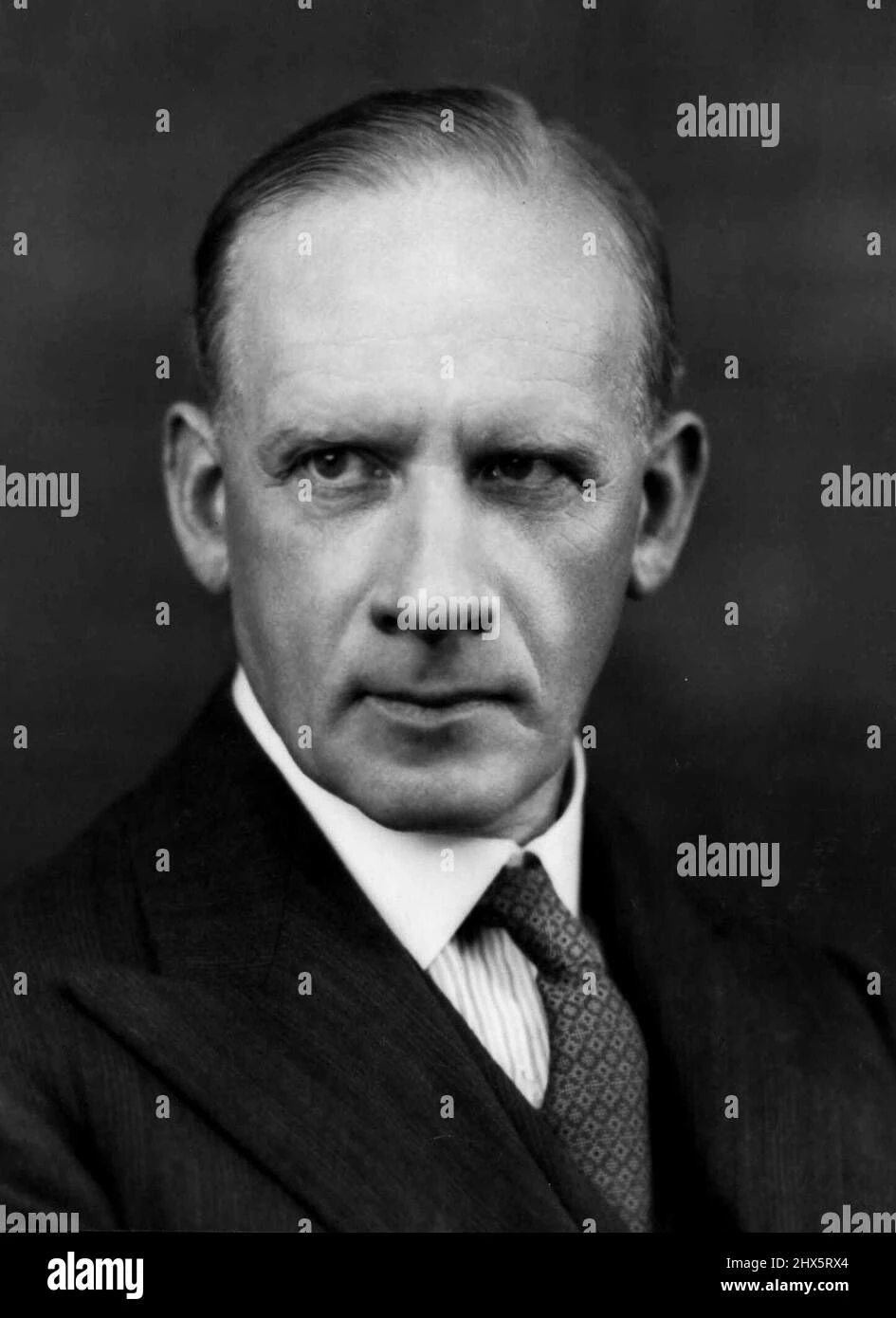
Organic chemistry deals in structures too small to see and reactions that can seem difficult to predict. Sir Robert Robinson helped make that hidden world more intelligible. His research on alkaloids, naturally occurring compounds with significant biological effects, advanced understanding of complex molecules; his work on reaction theory also helped chemists reason about how molecules change. These were different kinds of contribution, joined by a common aim: to make the behaviour of organic substances open to systematic explanation.
Born in Chesterfield on 13 September 1886, Robinson built a career across several British universities, from Manchester and Liverpool to St Andrews, University College London and Oxford. He became Waynflete Professor of Chemistry at Oxford in 1928, was knighted in 1939 and received the Nobel Prize in Chemistry in 1947. The Nobel citation recognised his investigations on plant products of biological importance, especially the alkaloids. The honours marked a career whose significance lay not simply in individual discoveries, but in the research and ways of thinking he helped establish.
Education and a career across Britain
Robinson attended Fulneck School in Pudsey, Yorkshire, before studying chemistry at the University of Manchester, where he took his degree. He went on to academic appointments at the University of Liverpool, the University of St Andrews and University College London. The sequence placed him in several of Britain's important centres of higher education before Oxford became the setting for a particularly prominent chapter of his career.
A university career is built through more than a list of posts. Teaching, laboratories, students and colleagues all contribute to the development of a subject. Robinson’s movement between institutions brought his work into different academic settings and helped establish his standing in organic chemistry. By the time he was appointed Waynflete Professor of Chemistry at Oxford in 1928, his research had already made a significant contribution to the field.
The range of problems he addressed helps explain that standing. Robinson studied the structures of complex organic compounds, considered how chemical reactions could be understood and pursued questions connected with substances of biological importance. Those strands belong together: to explain what a molecule is, chemists need to understand both the arrangement of its parts and the ways it can react. His career gave him the opportunity to pursue such questions in university departments, where research and teaching could inform one another.
Robinson’s advancement through British institutions also matters to the story of his influence. His work did not take place apart from the academic world: it developed within universities that trained chemists and sustained research. The supplied record gives the principal appointments but little detail about particular students, laboratories or collaborations, so the scale of those individual influences should not be guessed at. What can be said is that his work and appointments brought him into a position to contribute to the development of organic chemistry in Britain.
Making sense of alkaloids
Alkaloids are naturally occurring compounds, often found in plants, that can have powerful biological effects. Their complexity presented a demanding challenge. Identifying a substance was only a starting point; chemists also needed to establish its molecular structure: how its component parts were arranged and how that arrangement related to its behaviour. Robinson’s work on these compounds helped advance that structural understanding.
Clarifying a structure changes what can be done with a natural substance. It can be described more precisely, compared with related molecules and investigated systematically. Researchers can then ask how its properties relate to its arrangement, and consider the chemistry through which it might be synthesised or modified. These steps do not mean that structural research alone delivers a medicine. They do mean that a complex substance becomes a more tractable object of scientific study.
The original account connects Robinson’s alkaloid research with medicinal compounds including morphine and cocaine. That connection illustrates the potential importance of studying plant products, but it should not be mistaken for a claim that Robinson alone discovered or produced those compounds. His contribution, as presented in the supplied material, was to the scientific understanding of complex natural substances and to the broader development of knowledge that could support synthetic and pharmaceutical chemistry.
In 1947 the Nobel Prize in Chemistry recognised Robinson “for his investigations on plant products of biological importance, especially the alkaloids”. The wording identifies the central subject of the award: research into chemical substances produced by plants and significant for biological study. It also captures the meeting point between chemistry and living systems that made this work consequential. The prize acknowledged a body of investigation, not a single isolated result.
Explaining how molecules react
Robinson’s influence extended beyond the study of alkaloids. The supplied account credits him with developing the concept of “electron-pushing”, a way of representing and reasoning about the movement of electrons during organic reactions. Chemists use this kind of representation to show a sequence of changes within molecules, rather than treating a reaction simply as something that happens between starting materials and products.
A shared method for describing a reaction mechanism gives researchers a language for explaining why a transformation occurs and for considering how a related molecule might behave. It also gives students a framework for working through chemical change instead of memorising isolated outcomes. The point is not that a diagram removes uncertainty from research; rather, it makes the reasoning visible, so that explanations can be discussed and tested.
The supplied article describes electron-pushing as a cornerstone of modern organic chemistry education and practice. Its enduring value, in that account, lies not in one result but in a habit of thought: breaking a complicated transformation into a reasoned sequence. A framework that can be taught and used across many problems contributes to the organisation of a discipline as well as to the solution of particular research questions.
This contribution complements Robinson’s work on molecular structure. Structural research addresses what a molecule is; reaction theory helps explain what it can do. Together, the two approaches give chemists ways to describe both the arrangement of matter and its transformation. Robinson’s reputation therefore rests on more than research into particular compounds: it also includes a conceptual tool that the supplied material says influenced teaching and practice.
Penicillin, honours and recognition
Robinson’s career also included work on penicillin during the Second World War. The supplied account describes him as instrumental in its synthesis and links his efforts to the Sir Henry Howarth Memorial Prize from the Royal College of Surgeons. Penicillin became associated with a transformation in medical treatment; Robinson’s involvement, as described in the source material, is a reminder that chemical expertise could be brought to urgent practical problems as well as to longer-term questions about molecular structure.
The available account does not set out the precise scope of Robinson’s role in penicillin work. It would therefore be misleading to add detail about particular processes, collaborators or results. His reported efforts in this field should be kept distinct from the more clearly specified basis of his Nobel Prize: investigations on plant products of biological importance, especially alkaloids. That distinction allows both aspects of his career to be included without merging them into a single achievement.
Robinson was knighted in 1939. The Sir Henry Howarth Memorial Prize from the Royal College of Surgeons is associated in the supplied account with his penicillin work. Eight years after his knighthood, the Nobel Prize acknowledged his research on biologically important plant products. The honours reflect different parts of his record; the Nobel citation in particular identifies the research for which he received that international award.
Robinson died on 8 February 1975. The supplied material says that his influence continued after his retirement and passing, particularly through the approaches and teaching shaped by his work. It does not provide a detailed account of his later years, so the clearest way to describe the afterlife of his contribution is through its stated scientific and educational reach: the study of alkaloids and the continued use of reaction reasoning in organic chemistry.
A legacy in research and learning
Robinson’s significance can be understood through two connected contributions. His research on alkaloids and molecular structure advanced knowledge of complex natural compounds. His work on reaction theory helped provide chemists with a way to explain and reason through molecular change. The first contribution concerned what chemists could establish about particular substances; the second concerned how they could organise and communicate their understanding.
These contributions matter in different ways. Structural knowledge enables more precise description and comparison, and can inform further work in synthesis and pharmaceutical chemistry. A method for analysing reactions, meanwhile, can be taught and applied across many problems. The supplied account says Robinson’s theoretical approach influenced academic curricula around the world. That influence suggests a reach carried not only by individual research findings but through the training of later generations of chemists.
It is not necessary to claim that one person created a modern industry to recognise the value of such work. Robinson’s record shows a chemist whose research helped expand what could be analysed and whose ideas offered a framework for explaining chemical transformations. The supplied material links his work to synthetic chemistry and pharmaceutical development, but does not quantify those effects or attribute the development of an industry to him alone. Keeping the claim proportionate makes the nature of his contribution clearer.
His career was rooted in British education and research: he studied at Manchester, held appointments at Liverpool, St Andrews and University College London, and occupied the Waynflete chair at Oxford. These institutions are not incidental details. They locate his scientific work within the universities where he trained and pursued his career. The questions he addressed, and the recognition his work received, were international in scope, but his professional life was closely tied to the development of British chemistry.
Why Sir Robert Robinson deserves a place in British Legacy
Sir Robert Robinson deserves a place in British Legacy because his work joined demanding scientific research to durable ways of understanding chemistry. His investigations into alkaloids helped bring complex, biologically important plant products into sharper focus. Establishing molecular structure makes it possible to describe and compare substances more precisely and to investigate their chemistry systematically. The Nobel Prize recognised this area of work in 1947, specifically citing plant products of biological importance, especially the alkaloids. His achievement was not simply to study unusual substances, but to help make them accessible to rigorous chemical explanation.
His work on reaction theory gives that legacy a second dimension. Electron-pushing offered chemists a systematic way to represent how molecules change, supporting the explanation of reaction mechanisms and, according to the supplied account, contributing to modern teaching and practice. A method of reasoning can travel beyond its originator: it can be taught, used to frame research questions and applied to problems that were not part of the original work. The account also credits Robinson’s theoretical approach with influencing curricula internationally, extending his reach beyond the institutions in which he worked.
Robinson’s British connection is specific: he was born in Chesterfield, studied chemistry at Manchester and held academic posts at Liverpool, St Andrews and University College London before becoming Waynflete Professor at Oxford. Across that career, he contributed to a scientific culture grounded in research and university teaching, while addressing questions with relevance beyond Britain. His story belongs in British Legacy because it shows how work pursued through British institutions could deepen international knowledge, improve the scientific understanding of medicinally important compounds and leave tools useful to later chemists. The public benefit lies in that lasting capacity: clearer ways to investigate substances and explain the transformations on which chemical research depends.