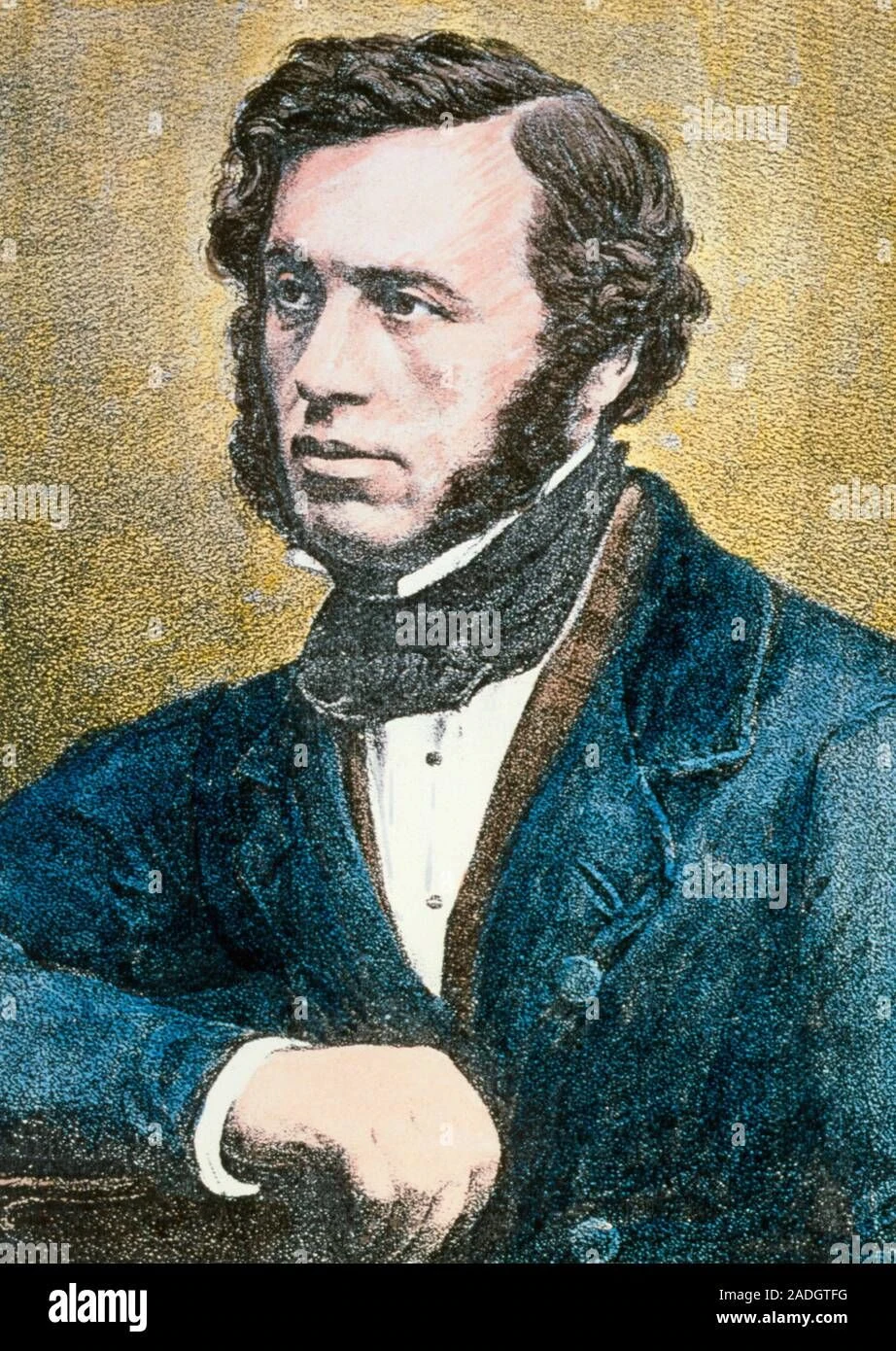
In the early 1840s, a Welsh barrister demonstrated a striking reversal: instead of using electricity to split water into hydrogen and oxygen, he brought the gases together and produced an electric current. Sir William Robert Grove’s gas voltaic battery, later recognised as the first fuel cell, established a principle whose applications would take generations to develop. He did not create a ready-made power source for Victorian homes. He showed what chemistry could do, and connected that experiment to a larger argument about the relationships between heat, electricity, motion and other natural processes.
Grove’s work ranged well beyond one device. Born in Swansea, he moved between Welsh civic institutions, London’s scientific societies and the English courts. He improved batteries, explored light and gases, lectured to public audiences and wrote about the correlation of physical forces. His career joined experimental practice to public explanation and the law: a distinctive contribution to Britain’s nineteenth-century scientific life.
A Welsh education and a scientific vocation
Grove was born in Swansea on 11 July 1811, the only child of John Grove and Anne Bevan. After private education, he went to Brasenose College, Oxford, where he studied classics rather than law. His legal training followed at Lincoln’s Inn, which called him to the bar in 1835. That sequence matters. Grove was not a university chemist following a settled scientific career; he entered the legal profession while pursuing experiments with considerable seriousness.
In 1835 he joined the Royal Institution and became involved in founding Swansea’s Literary and Philosophical Society, later part of the Royal Institution of South Wales. His scientific life therefore took shape both in London and in the civic culture of his home town. Swansea’s local society was one setting in which science could be discussed and demonstrated outside the capital’s institutions. Grove’s participation linked his scientific interests to the Welsh city where he had grown up, as well as to the metropolitan networks he would later join.
Grove married Emma Maria Powles in 1837. A continental tour that followed provided an opportunity for scientific work, and he published early papers on improved electric cells. In 1841 he became professor of experimental philosophy at the London Institution. The title reflects a period when a scientific practitioner might combine experiment, explanation and public lecturing. Grove’s authority did not rest on a single narrow discipline: he investigated electrical, chemical and thermal phenomena as related parts of the natural world.
That breadth helps explain why his scientific career cannot be reduced to the story of one invention. Experiments with batteries brought chemical action and electrical current into the same apparatus. Lectures and writing gave him opportunities to consider what such experiments implied more generally. At the same time, he retained a legal profession, which would take him into public service and eventually the judiciary. His career developed across these fields rather than leaving one behind for another.
Two batteries, and a new way to generate current
In 1839 Grove developed the battery known as the Grove cell. It was a wet-cell design, using zinc and platinum electrodes in different acids separated by a porous ceramic pot. Platinum made it expensive, and the arrangement was not convenient by modern standards, but the cell provided a strong current for its time. It gave experimenters a more vigorous source of electricity than earlier cells could provide.
The Grove cell and the gas voltaic battery are distinct achievements. By 1842, Grove had turned to a question that reversed a process already familiar to investigators. Electricity could split water into hydrogen and oxygen; might the gases, brought together under suitable conditions, generate electricity instead? His experiment tested that possibility directly. The separate devices should not be confused: the Grove cell was a battery developed in 1839, while the later gas voltaic battery demonstrated the fuel-cell principle.
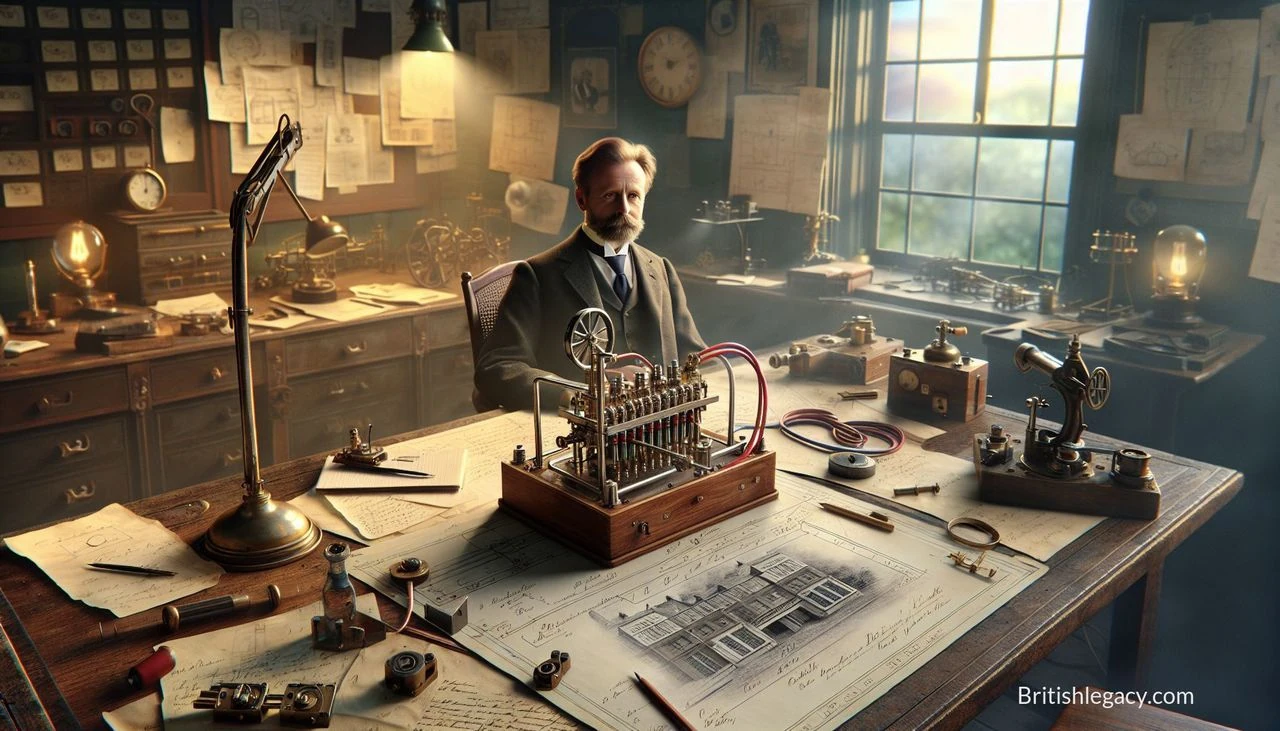
Grove’s gas voltaic battery used platinum electrodes dipped in acid, with hydrogen and oxygen supplied separately. As current flowed, the water levels in the tubes changed, showing that the gases were being consumed. Grove called the apparatus a gas voltaic battery; it was later recognised as the first fuel cell. The experiment demonstrated that chemical combination could yield electricity directly, rather than first producing flame, steam and mechanical motion. Its force lay in what it made observable: the gases were consumed as electrical energy was produced.
The apparatus was not a practical power source ready for widespread use. Its materials were costly, electrochemistry remained incompletely understood, and Victorian engineering offered no straightforward route from the experiment to a mass-produced technology. Grove proved a principle, not launched an industry. That distinction prevents hindsight from turning the experiment into a modern machine in miniature, while also making clear why it mattered to scientific history.
Later fuel-cell systems differ substantially in scale, materials and construction. Their relevance to Grove’s work is the underlying electrochemical possibility: fuel and oxidant can be combined to produce electrical power directly. The delay between his demonstration and later applications does not make the experiment less original. It shows how a scientific principle may be established long before other materials, designs or needs make it broadly useful. Grove made the possibility testable at a time when steam power was central to engineering ambition.
Thinking across the physical sciences
Grove’s interests extended from apparatus to the ideas experiments could support. In lectures at the London Institution and in his 1846 book On the Correlation of Physical Forces, he argued that heat, light, electricity, magnetism, motion and chemical affinity were related and could be converted from one form to another. His account was an early qualitative treatment of a connected natural order. It was not the finished mathematical statement of the first law of thermodynamics later associated with other scientists.
For Grove, a battery converting chemical action into current was more than a useful contrivance. It helped show that divisions between nature’s apparent “forces” were not absolute. Experiments involving ignition, the decomposition of water by heat and electrical discharges all formed part of his wider interest in transformation and exchange. His argument encouraged readers to look for relationships between phenomena rather than treating each as an isolated wonder.
The idea was expansive and required later refinement. Its importance lies in how Grove brought broad claims into contact with practical experiment. A working battery could demonstrate one kind of conversion; other experiments could prompt questions about heat, light and electricity. The apparatus and the argument belonged together: the experiment made an abstract relationship easier to examine, while the larger account helped place individual results within a connected picture of nature.
Grove’s book did not settle the later science of energy conservation, and his account should not be presented as its sole or final formulation. It contributed an early, influential way of discussing the relationship between physical processes. The subject was a matter of active debate in Victorian natural philosophy, where competing systems sought to explain invisible forces. Grove’s emphasis on transformation, exchange and connection offered one framework for thinking about what experiments revealed.
This combination of experiment and explanation was characteristic of his work. He was not merely a mechanic producing a clever device; he sought to understand what a device could show about the natural world. The concept of correlation was broad enough to invite argument and needed later tightening, but it encouraged a habit of thought: examine connections as well as separate effects. Grove helped make that approach part of scientific discussion before the terminology of energy had fully settled into place.
Science, institutions and the courts
Grove became a Fellow of the Royal Society in 1840, received its Royal Medal in 1847 and later served several times as a vice-president. He also took part in arguments about the Society’s governance, criticising cronyism and supporting efforts to modernise its charter and strengthen the public standing of science. This was institutional work rather than an experiment, but it mattered to the organisation through which scientific contributions were recognised and standards maintained.
His legal career advanced alongside his scientific one. Grove became Queen’s Counsel in 1853, served on a Royal Commission on patent law and sat on the Metropolitan Commission of Sewers. In 1871 he was appointed a judge of the Court of Common Pleas; in 1880 he moved to the Queen’s Bench. These roles placed him in legal and public institutions while he remained known for his scientific work.
Patent law brought technical invention into contact with questions of evidence, priority and practical use. Grove’s experience as an experimenter gave him direct familiarity with the kinds of technical questions that could arise when an invention was assessed in law. His career therefore joined two fields that are often treated separately: the making and testing of scientific ideas, and the legal processes through which claims about invention can be judged.
Grove’s work was not confined to batteries or legal questions. In the 1840s he investigated photography and recognised its potential importance to science, history and law as a means of preserving fleeting actions. He also devised an early incandescent electric light in 1840. Neither project displaced the fuel cell or his writing on physical forces as his principal claims to scientific distinction. They nevertheless show how widely he followed experimental developments, and how readily he considered their significance beyond the laboratory.
His career culminated in honours as well as appointments. Grove was knighted in 1872 and made a Privy Councillor in 1887. He died in London on 1 August 1896 and was buried at Kensal Green. His life connected a Swansea upbringing and Welsh civic science with London’s scientific institutions and the English judiciary. That combination was not incidental to his story: he pursued scientific work while participating in legal and public institutions across several decades.
Why Sir William Robert Grove deserves a place in British Legacy
Grove deserves a place in British Legacy for a specific scientific achievement: he demonstrated that hydrogen and oxygen could generate electricity through chemical action. His gas voltaic battery did not provide a ready-to-use energy system for his contemporaries, and it should not be mistaken for a modern fuel cell. But it established an electrochemical principle that later fuel-cell technologies could develop. Grove’s work made a new route to electrical generation demonstrable at a time when steam and mechanical power defined much of the engineering landscape.
His legacy also lies in how he joined different kinds of work. Grove combined experiment with public lectures and a broad account of physical forces; he worked in scientific institutions and participated in their reform; he brought technical knowledge into a legal career that included service on patent law. Those contributions show how scientific ideas acquire meaning through explanation, institutions and law as well as through engineering. His thinking about connected physical processes was an early contribution, not the final word on energy conservation, and his fuel-cell apparatus was a proof of principle rather than a commercial technology. Keeping those distinctions clear gives his achievements their proper scale.
Born in Swansea, Grove took part in local Welsh scientific life before his career brought him into London institutions and the English courts. That connection matters to a British account of science: his story includes civic societies beyond the capital, national scientific bodies and public service. He is remembered not for delivering a finished solution to later energy needs, but for making an important possibility visible and testable. His example shows the value of experimental work that opens a path other people may follow, and of a scientific career that connected local activity with national institutions and practical questions of law.