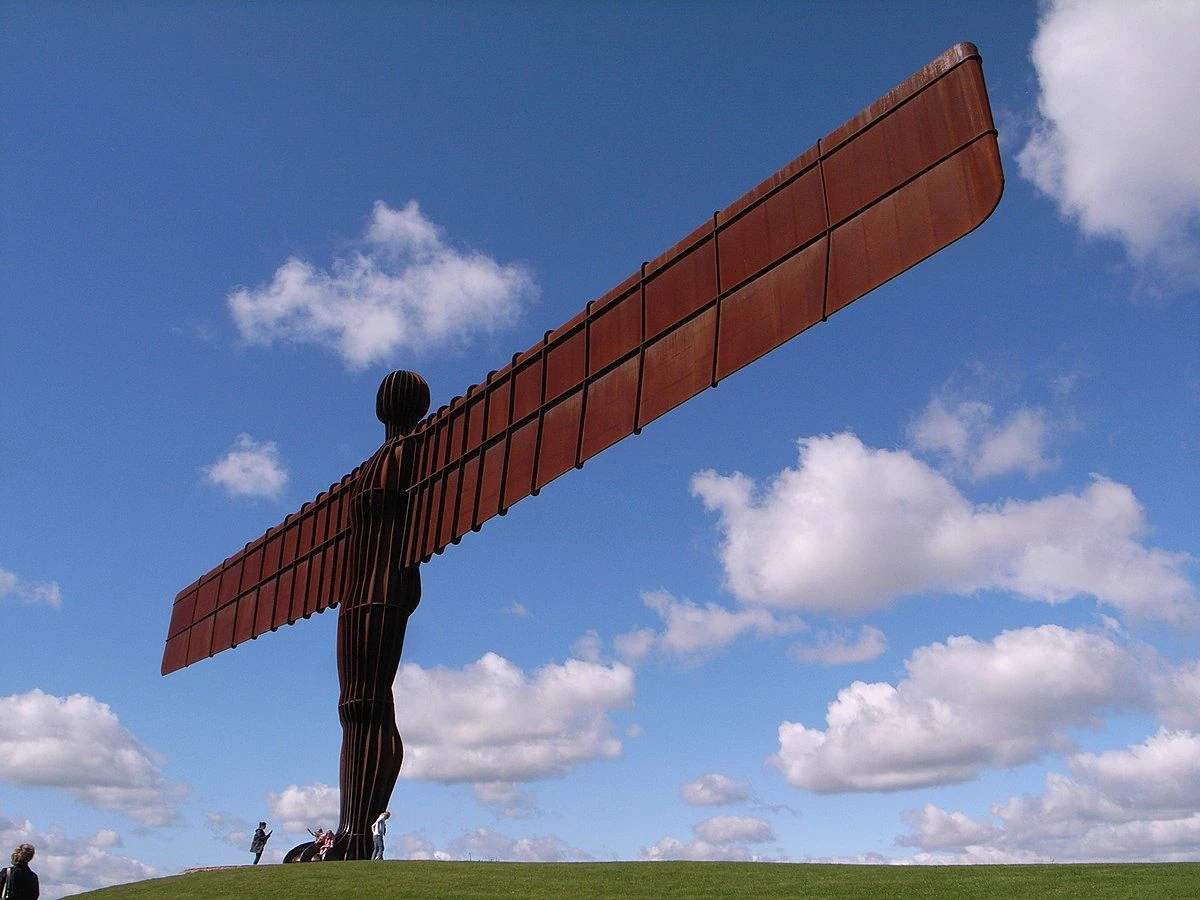
On the southern edge of Gateshead, beside the A1 and A167, a steel figure spreads its wings across the landscape. The Angel of the North, designed by Antony Gormley, stands 20 metres tall, with a wingspan of 54 metres. Installed in February 1998, it occupies a former colliery site. Its scale makes it a conspicuous presence; its location ties that presence to the industrial history of the North East.
A figure made for its setting
The Angel is made of weathering steel, which develops a protective rust-like coating. Its wings angle slightly forwards. The shape may suggest an embrace or flight, but the sculpture does not depend on a single interpretation. Gormley described it as a focus for “our hopes and fears”. The material and form give the work a strong visual identity, while its position places it in a particular landscape rather than presenting it as an object apart from its surroundings.
The site’s history as a colliery provides a direct connection to the region’s industrial past. Steel also recalls the material associated with heavy industry and the making of ships, bridges and buildings. The Angel does not depict a specific industrial process; instead, its substance and setting make that inheritance part of how it is encountered. Its dimensions reinforce the relationship: a 20-metre figure and wings extending 54 metres are difficult to separate from the open landscape around Gateshead.
The sculpture also carries a forward-looking quality. Its title and winged form invite associations with flight and aspiration, while its monumental presence gives the former industrial site a new point of reference. These readings can coexist with the work’s more unsettled note: Gormley’s phrase, “our hopes and fears”, leaves room for uncertainty as well as optimism.
From scepticism to a landmark
The project was not universally welcomed at the outset. Some local people and public figures objected to its modern appearance and questioned whether it suited the landscape. Its cost and artistic merit were also disputed. Over time, the Angel came to be embraced as a landmark. That change in reception is part of its history: its place in local identity was not automatic, but developed after the sculpture was installed.
Its position beside major roads makes the figure visible in the wider surroundings, and its distinctive outline has made it a subject for photography. The work has also been described as inspiring poetry, visual art, music and film. Those cultural associations suggest a reach beyond sculpture, though the Angel’s significance does not need to rest on claims about visitor numbers or tourism. Its scale, setting and recognisable form offer a more grounded account of how it entered public life.
The combination of a former colliery site and a contemporary steel sculpture brings local history into view without turning the work into a simple monument to the past. Its meaning is open enough to accommodate differing reactions, from the early objections to later affection. The Angel’s story therefore includes both its physical presence and the changing ways people have responded to it.
Why the Angel of the North deserves a place in British Legacy
The Angel of the North deserves a place in British Legacy because it joins public art to a specific regional history. Its position on a former colliery site makes the North East’s industrial past part of the sculpture’s setting, while its steel construction gives that connection a material presence. Gormley’s work does not simply record what came before: its height and outstretched wings establish a new landmark in the landscape around Gateshead. The result is a work of contemporary art whose context is inseparable from the place where it stands.
Its reception adds another dimension to that achievement. The Angel faced criticism over its cost, appearance and suitability for the landscape, yet came to be regarded as a local landmark. This shift shows how a public work can acquire meaning through its continuing presence and through the responses it draws, rather than arriving with universal approval. Its particular contribution is to make the industrial inheritance of the North East and a striking contemporary form visible together. That connection between place, material and changing public feeling is a substantial British legacy: rooted in a local landscape, but expressed through a work of public art that has become widely recognisable.