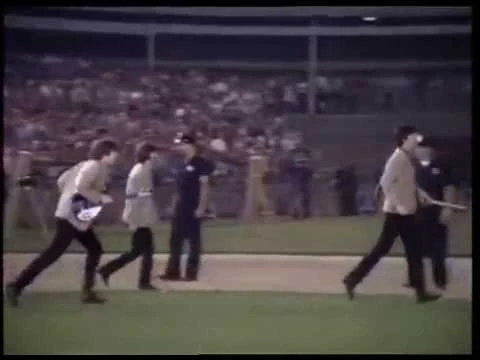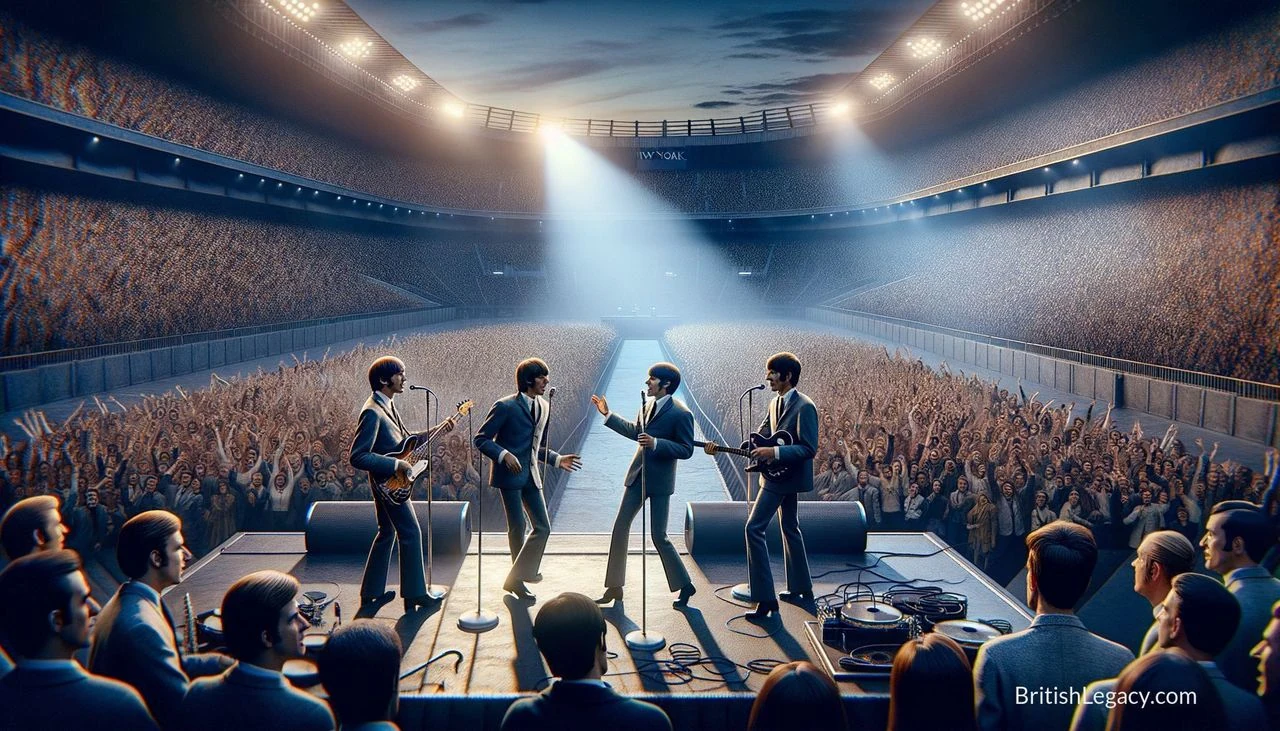
On 15 August 1965, the Beatles took the stage at Shea Stadium in New York before a crowd of more than 55,000. The size of the audience was central to the event: a band associated with the intense enthusiasm of Beatlemania was playing not in a club or theatre, but in a major sports stadium. The concert became a striking example of how far popular music’s live audience could extend.
Beatlemania in a stadium
John Lennon, Paul McCartney, George Harrison and Ringo Starr were already internationally famous by the time they performed at Shea. At the stadium, the crowd’s scale and enthusiasm became part of the spectacle. The event is often described as one of the first major stadium concerts in rock history; its significance lies not just in attendance, but in the attempt to present a rock band to an audience on a scale that challenged the usual concert setting.
A stadium brought practical demands that smaller venues did not. The concert’s sound system was limited by the standards of later performances, while the noise of the crowd made listening difficult. Those conditions exposed a problem that would accompany large concerts: performing for tens of thousands of people required more than a popular act and a large venue. Sound and the organisation of the event mattered too.
The performance and its limitations
The Beatles played songs including “Twist and Shout”, “She’s a Woman” and “Help!”. The set brought familiar material to a vast audience, but the performance took place amid the clamour of the crowd and the technical constraints of the time. The contrast between the scale of the gathering and the limits of the sound is part of what makes the concert notable: it showed both the draw of the band and the difficulty of making a live performance work across a stadium.
The event helped demonstrate the commercial and organisational possibilities of staging rock concerts in large venues. It is too simple to say that one show alone created the modern stadium concert, but Shea offered a vivid, widely remembered instance of a major rock act meeting an audience of this size. Its importance rests in that combination: a mass gathering driven by Beatlemania, and a performance that brought the logistical and technical challenges of stadium-scale music into view.
From New York to a British musical legacy
The concert took place in the United States, but its central performers were a British band whose popularity had travelled across the Atlantic. Shea therefore provides a clear example of British popular music reaching a large international audience. Its place in the Beatles’ story comes not simply from the size of the crowd, but from the way the performance made their worldwide appeal tangible in a single event.
The concert was later documented in The Beatles at Shea Stadium. The surviving public memory of the event brings together the band, the crowd and the unusual scale of the occasion. It is remembered as a marker in the development of large rock performances, though claims that it single-handedly set standards for concert production or served as a blueprint for countless later acts go beyond what can be established here.
Why The Beatles at Shea Stadium deserves a place in British Legacy
The Shea Stadium concert merits a place in British Legacy because it records a British group meeting an audience on an exceptional international scale. Lennon, McCartney, Harrison and Starr performed in New York at a moment when Beatlemania was drawing huge crowds. The event makes that reach concrete: more than 55,000 people gathered to see a band whose identity and music had travelled well beyond Britain.
It also captures a significant challenge in the history of live popular music. A stadium offered room for an audience far larger than a theatre could hold, but the crowd’s noise and the limitations of the sound system made the performance difficult to hear. Remembering both the achievement and the constraints gives the concert more value than treating it as an uncomplicated triumph. It stands as evidence of British popular culture crossing borders, and of the practical questions that arose when rock music moved to a much larger stage.