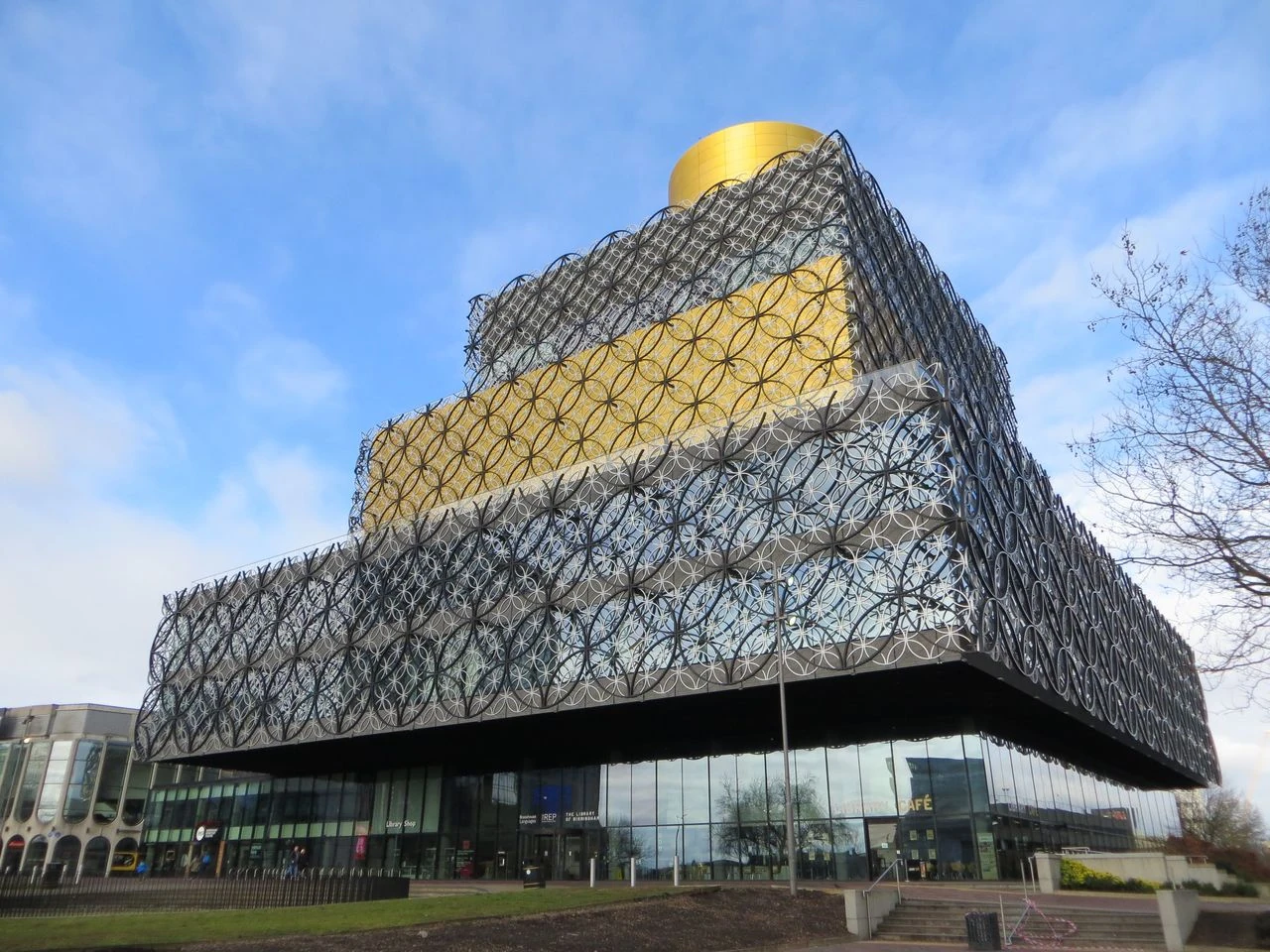
Opened in 2013, the Birmingham Library brought together books, archives, digital resources and public facilities in a modern building designed by the Dutch architectural practice Mecanoo. Its role, as described in the existing account, reaches beyond lending books: the library is also a place for children to read, researchers to consult historical material and members of the public to attend events and workshops.
A new building for a longstanding library tradition
The library’s contemporary design gives it a distinct place in Birmingham’s civic landscape. The existing account describes a latticework exterior and connects its design to the city’s industrial heritage. That architectural character sits alongside a broader history of public library provision in Birmingham: the account dates the opening of the city’s first public library to 1866.
The present library was described as having ten levels and more than a million books, journals and digital resources. Those figures convey the scale of its intended offer, while the range of facilities points to a library designed for different kinds of use. Readers can come for books; children have a dedicated library space; and people working with local history can consult archival collections. The building also includes computer facilities, e-books and Wi-Fi, extending access to information beyond printed collections.
Collections, archives and access
Among the collections identified in the account is material associated with Matthew Boulton, James Watt and William Murdoch, figures connected with the Industrial Revolution. It describes historical manuscripts and early scientific journals within this collection. Their presence gives the library a role in preserving and making available records of technological and industrial history, as well as serving everyday reading and information needs.
The account also refers to more than 6,000 volumes of historical archives relating to Birmingham. Such collections can support research into the city’s past, while a children’s library offers younger visitors a dedicated setting for reading and learning. The building’s digital facilities form another part of this offer: computer stations, e-books and wireless internet access sit alongside physical books and archival holdings. Taken together, these are distinct services, rather than a choice between traditional collections and digital access.
Events and community use
Public activity is another strand of the library’s work. The existing article lists author talks, workshops, exhibitions and film screenings among its events. It also describes educational programmes and workshops organised in partnership with schools, universities and other educational organisations. These activities give the building a function as a venue for learning and cultural participation as well as a place to consult collections.
The account presents free access and community-oriented services as part of the library’s approach to inclusion. It also identifies business seminars, start-up support and job fairs as activities hosted there. Those examples suggest a broad civic purpose: the library’s spaces and services are intended for reading and research, but can also be used for public events, education and work-related activities. The account’s wider claims about economic impact and global influence are less firmly evidenced, so the significance of the building is best understood through the specific facilities and activities described.
Why The Birmingham Library deserves a place in British Legacy
The Birmingham Library merits a place in British Legacy as a public institution that brings together several practical forms of access to knowledge. Its described collections include books, journals, digital resources and historical archives, including material associated with Boulton, Watt and Murdoch. Its children’s facilities, computers and e-books extend that offer to different users and needs. The building’s design by Mecanoo and its opening in 2013 also make it a notable example of a modern library conceived as more than a repository for books.
Its civic value lies in the combination of collections and shared activity. Author talks, workshops, exhibitions and film screenings give people reasons to gather; educational partnerships connect the library with schools and universities; and business events and job fairs broaden the kinds of public use described. These details provide a grounded British connection: the library is part of Birmingham’s civic and cultural life, preserving local historical material while offering facilities for present-day learning. That combination—not unsupported claims of worldwide influence—is the strongest reason to remember it.