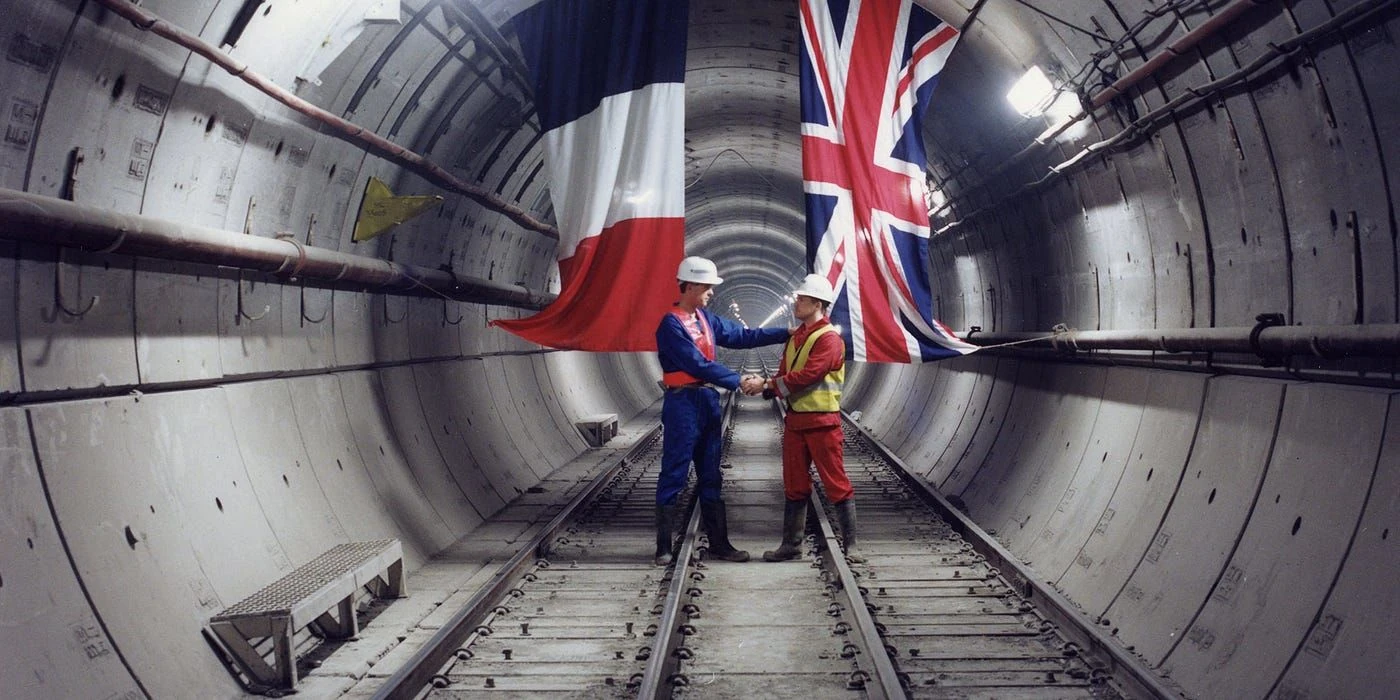
The Channel Tunnel is a railway route beneath the English Channel, linking the United Kingdom and France. Opened on 6 May 1994, it transformed a long-discussed idea into a permanent connection across the seabed. Built by British and French companies working together, the project joined engineering ambition to a practical purpose: carrying passengers and freight between Britain and continental Europe by rail.
A tunnel imagined, then built
The idea of crossing beneath the Channel predates the modern tunnel by nearly two centuries. In 1802, French engineer Albert Mathieu-Favier proposed a tunnel lit by oil lamps and used by horse-drawn carriages. The proposal did not become a working route, but the underlying ambition eventually returned. In the 1980s, political support and engineering capability came together, and construction began in 1988.
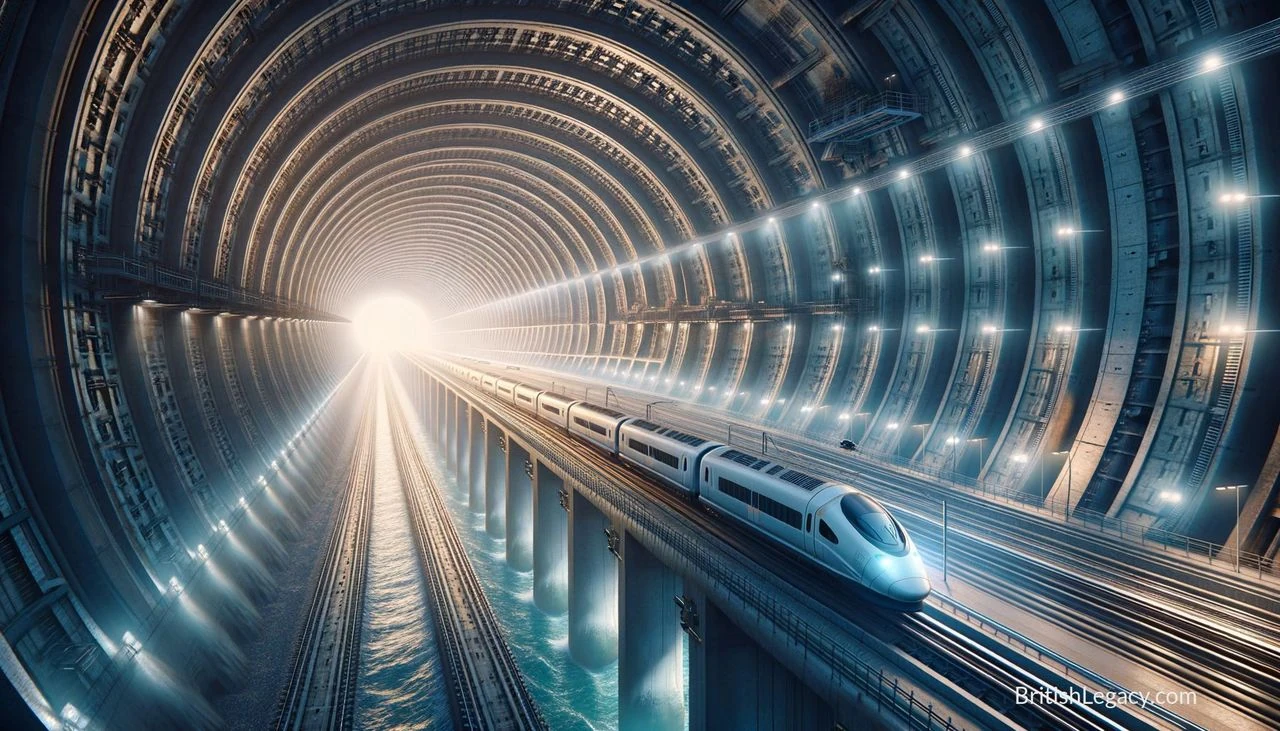
The undertaking was a joint effort by British and French companies under the Eurotunnel consortium. Rather than a single passage, the finished railway comprises two rail tunnels and a service tunnel beneath the seabed. The source account gives each as approximately 31.4 miles (50.45 kilometres) long and says the deepest point lies 75 metres below the seabed. These dimensions convey the scale of the work: the route had to be excavated and equipped not only for trains, but also with a separate service tunnel and systems for ventilation and safety.
Excavation and infrastructure
Eleven tunnel-boring machines were used to cut through chalk marl beneath the seabed. Their work brought the cross-Channel plan into physical form, while the completed structure incorporated ventilation, safety systems and a railway network. The project’s cost is given in the existing account as around £9.5 billion. That figure reflects the scale of the undertaking, although the source does not specify a price basis or accounting measure.
The tunnel opened on 6 May 1994. Its construction required a coordinated effort on both sides of the Channel, from the excavation itself to the systems needed to operate a railway underground. It was therefore more than a feat of digging: the result was an integrated transport link, designed to carry both passenger trains and freight through a shared cross-Channel route.
Travel and trade across the Channel
Eurostar services made high-speed passenger travel between London and Paris possible through the tunnel. The existing account gives a journey time of around two hours and 15 minutes, and contrasts it with the longer ferry-and-rail journey that had preceded the direct rail option. The tunnel also carries freight, giving goods a rail route between Britain and the continent. Its contribution is clearest in this practical change: passengers and freight could cross the Channel without making the sea crossing by ferry.
The source describes the tunnel as encouraging cross-border business and travel. Those broad economic and social effects are difficult to quantify from the available detail, but the change in transport infrastructure is concrete. The route made rail travel between the UK and France more direct and provided a continuing channel for goods as well as passengers.
Why the Channel Tunnel deserves a place in British Legacy
The Channel Tunnel belongs in British Legacy because it is a major British public work whose purpose and construction were international. British companies took part in a joint project with French partners; the tunnel’s significance is not a story of national achievement in isolation. Its three-tunnel design, excavation through chalk marl and associated ventilation and safety systems show the range of engineering and infrastructure involved in creating a railway beneath the sea.
Its legacy is also measured in what it enables. The tunnel opened a direct rail route for passengers travelling between Britain and France and carries freight across the same connection. That link changed the practical options for cross-Channel journeys, making high-speed rail travel between London and Paris possible and providing an alternative to ferry-and-rail travel. The project connects British engineering and transport history to a shared European undertaking: a once-imagined crossing made usable through sustained cooperation and construction.