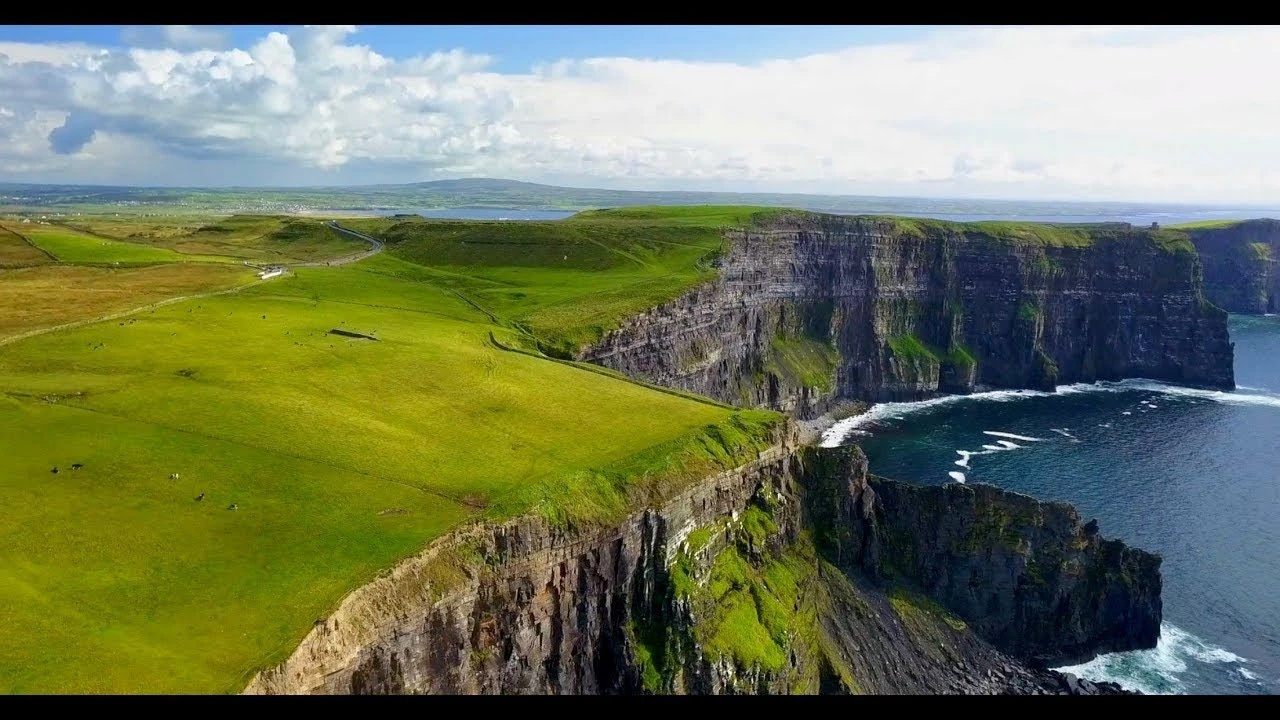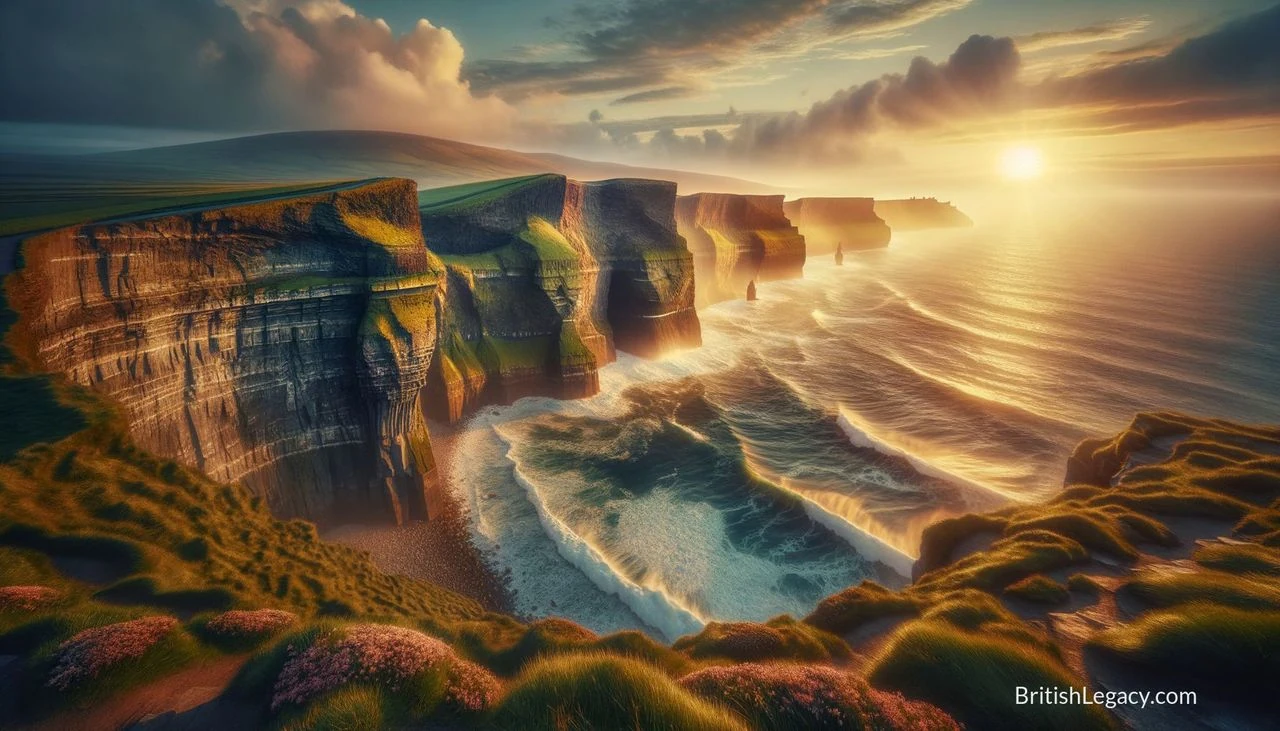
On Ireland’s Atlantic coast, the Cliffs of Moher rise above the sea in a long, steep line of rock. Their scale and exposed setting have made them a destination for visitors from around the world, including from the UK. They are an Irish landmark, not a British one; their place in a British Legacy feature rests on that documented connection with visitors from Britain, rather than on a claim of shared ownership or national identity.
A coastline shaped by rock and sea
The cliffs extend for more than 14 kilometres along the Atlantic and reach heights of up to 214 metres. Their layers of Namurian shale and sandstone record geological change over a long span of time. From the cliff edge, the steep face meets the open sea, creating the dramatic coastal views for which the site is known.
The landscape is also a habitat for cliff-nesting seabirds. The original account names puffins, razorbills and guillemots among the species found there, and describes the cliffs as one of Ireland’s major seabird-colony sites. It also identifies the area as a Special Protection Area under the EU Birds Directive, reflecting the importance of its birdlife.
Place, story and screen
The cliffs’ name is associated in local folklore with an ancient fort called Mothar, said to have stood at Hag’s Head, the southernmost point of the cliffs. The account also suggests that the site served as a lookout for ancient communities, though it gives no further detail about the evidence for that interpretation.
In modern popular culture, the landscape is associated with Harry Potter and the Half-Blood Prince: the cliffs feature as the setting for the Horcrux cave. The rugged coast and its striking views have also attracted artistic attention, although the source account does not identify particular artists or works beyond that film connection.
Conservation and visitors
The Cliffs of Moher Visitor Experience Centre opened in 2007. Its environmentally sensitive design was intended to help visitors experience the landscape while limiting the impact of tourism. That balance matters at a site where the steep coastal terrain, wildlife and large numbers of visitors meet.
The original account says the cliffs attract more than a million visitors a year, but does not specify a year for that figure. It describes British tourists as part of the international audience, while offering no figures for their numbers or share of visits. The cliffs’ location in Ireland and their appeal to visitors from the UK provide a clear cross-water connection without making them a British landmark.
Why the Cliffs of Moher deserve a place in British Legacy
The Cliffs of Moher deserve a place in British Legacy as a landmark in Ireland that is also visited by people from Britain. That distinction matters: their setting, geology and wildlife belong to the Irish coast, and the connection to a British audience should not be stretched into a claim that the cliffs are part of the United Kingdom. The documented visitor link is enough to give the site relevance to readers interested in places that draw people across the Irish Sea.
The cliffs also offer a way to consider how a celebrated landscape can serve several purposes at once. They are a destination for visitors, a setting recognised from film, and a habitat for seabirds within a designated conservation area. The visitor centre, opened in 2007, represents an effort to present the site while protecting it. Taken together, these features make the cliffs significant beyond their dramatic appearance: they connect Irish coastal heritage with British visitors, while underlining the importance of conserving the natural places that attract them.