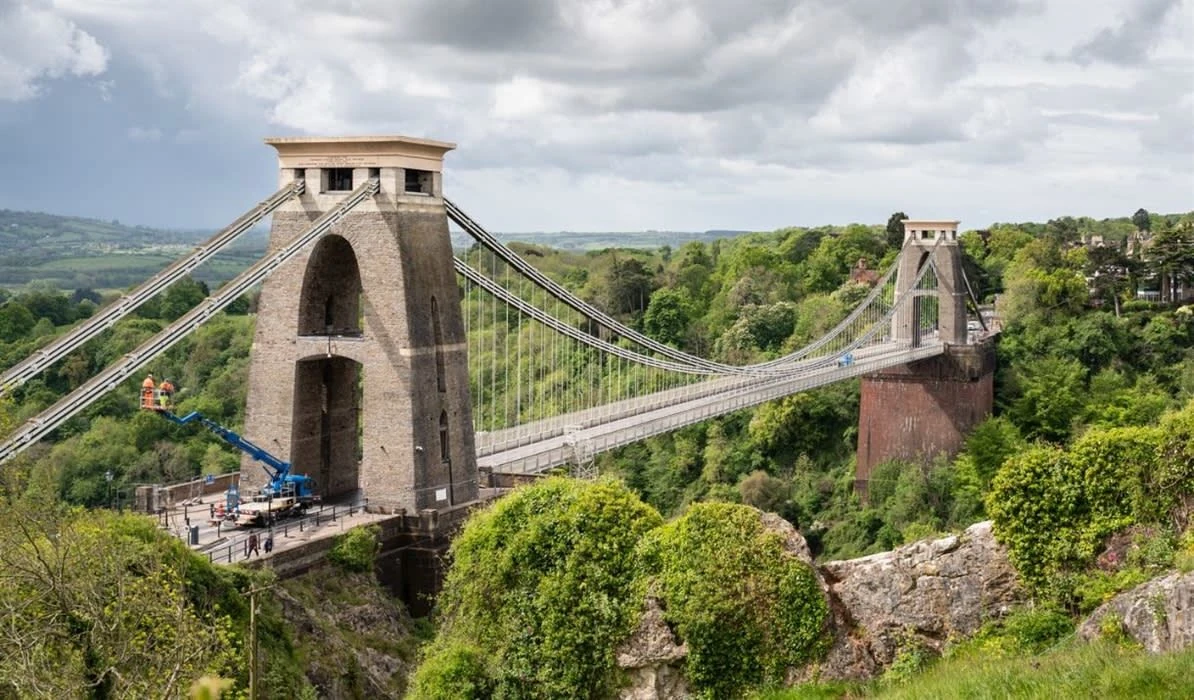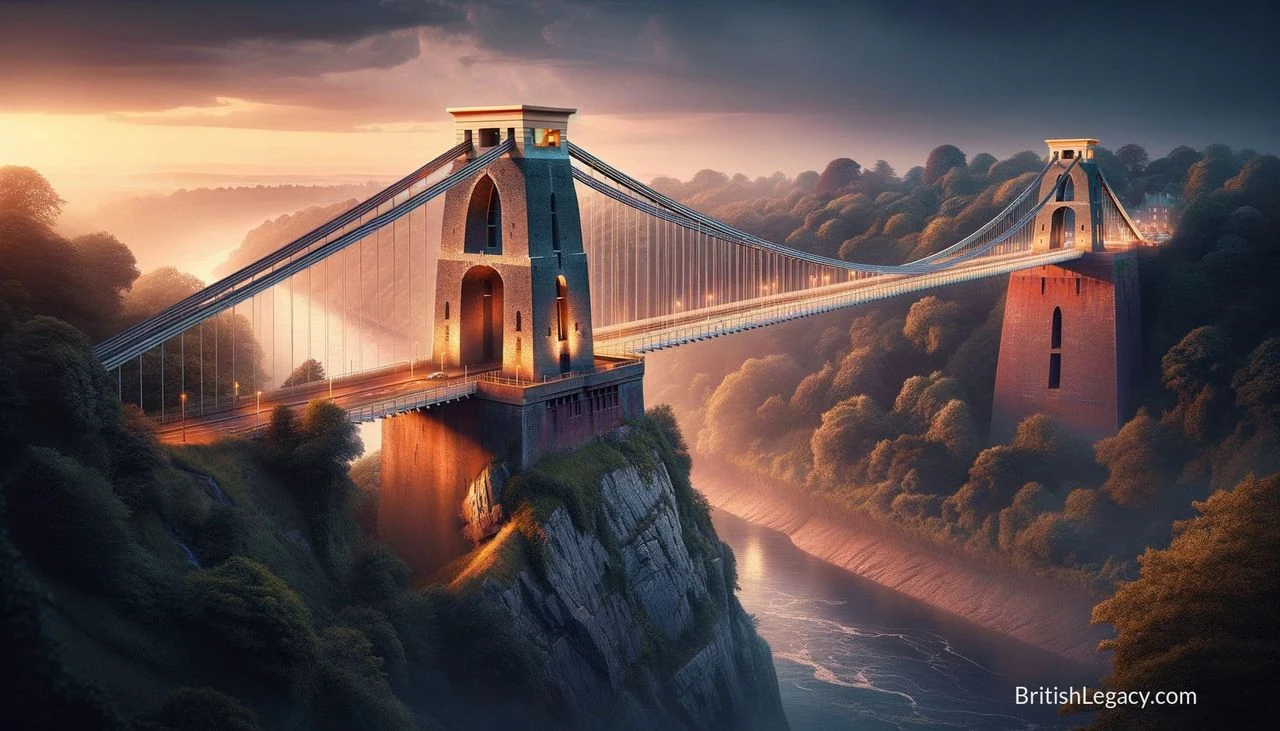
In Bristol, the Clifton Suspension Bridge turns the Avon Gorge from a natural divide into a working crossing. Its design was chosen in 1830, but the bridge was not completed until 1864, five years after Isambard Kingdom Brunel’s death. The result is at once a piece of infrastructure and a prominent feature of the landscape: a 214-metre span between tower piers, with the roadway 75 metres above the high-water level below.
A design realised after Brunel’s death
Brunel’s proposal won a competition to bridge the gorge in 1830. The long interval between that decision and completion gives the bridge its distinctive chronology. Brunel died in 1859, before the crossing was finished; the structure that opened in 1864 therefore carried his design into reality posthumously. It remains closely associated with him, while its completion belongs to a later period.
The gorge was the central physical challenge and the defining setting. The bridge had to span a natural divide in Bristol, and its towers and suspended roadway are visible against the sides of the gorge. The supplied dimensions convey the scale: 214 metres between the tower piers and a height of 75 metres above the river’s high-water level. Those measurements describe not simply an impressive object, but a route held above a deep landscape.
Chains, scale and setting
Wrought-iron chains are a key feature of the bridge’s construction. The existing account describes the design as accommodating temperature changes and stress, though it gives no further engineering explanation. The chains, long span and elevated roadway together define the structure: materials and form are presented in service of carrying a crossing over the gorge.
The bridge’s appearance is bound up with its position. Its towers and suspended roadway give it a recognisable outline against the gorge, making the crossing a landmark as well as a practical route. It is described as a symbol of Bristol and a point of local pride. The account also notes its appeal to artists, photographers and writers, without identifying particular works; its visual presence can be recognised without claiming a specific artistic influence.
A working bridge in Bristol
The Clifton Suspension Bridge remains operational and carries traffic across the Avon Gorge. Its present-day function sits alongside its heritage status: it is a historic structure that continues to serve as a crossing. The Clifton Suspension Bridge Trust maintains it, linking the bridge’s continued use with the responsibility of caring for a lasting public work.
That combination makes the bridge’s local role tangible. It connects across the gorge while remaining a defining feature of the Bristol landscape. Its significance here rests on the documented design, construction materials, setting and continued operation, rather than on broad claims about influence for which the account offers no examples. It is an engineering landmark whose history can be followed from Brunel’s 1830 competition-winning design to its completion in 1864 and its ongoing use.
Why Clifton Suspension Bridge deserves a place in British Legacy
The bridge deserves a place in British Legacy because its story brings a specific engineering design into close relation with a British city and its geography. Brunel’s proposal won the competition to cross the Avon Gorge in 1830; the bridge was completed in 1864, after his death. Its 214-metre span, wrought-iron chains and position above the gorge give substance to its engineering identity. These particulars make its legacy more than a general emblem of ingenuity: they describe a designed crossing shaped by the demands and setting of a real place.
Its continuing operation is equally important. The bridge still carries traffic across the gorge and is maintained by the Clifton Suspension Bridge Trust. It therefore joins historical design to present function, while remaining a recognisable part of Bristol’s landscape. The posthumous completion is not a footnote but part of its history: Brunel’s selected design became a lasting public work that continues to connect the city across a natural divide. That combination of engineering, civic presence and ongoing use is the bridge’s enduring contribution.