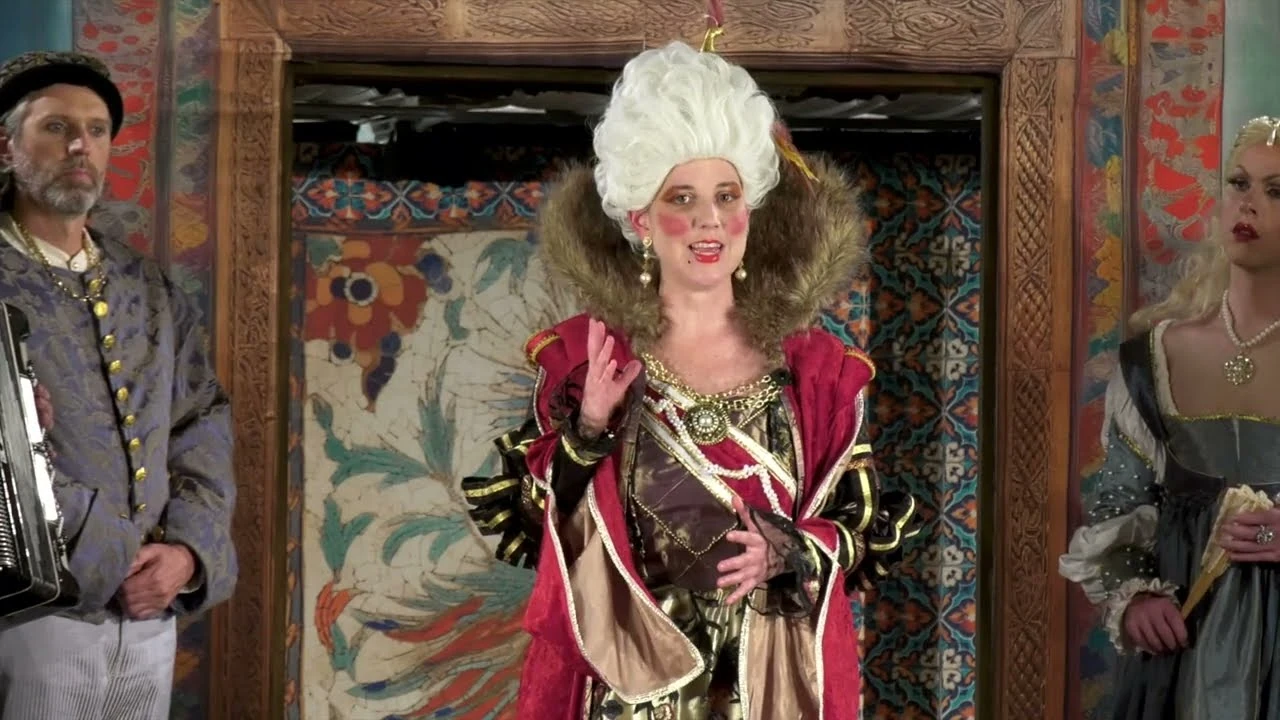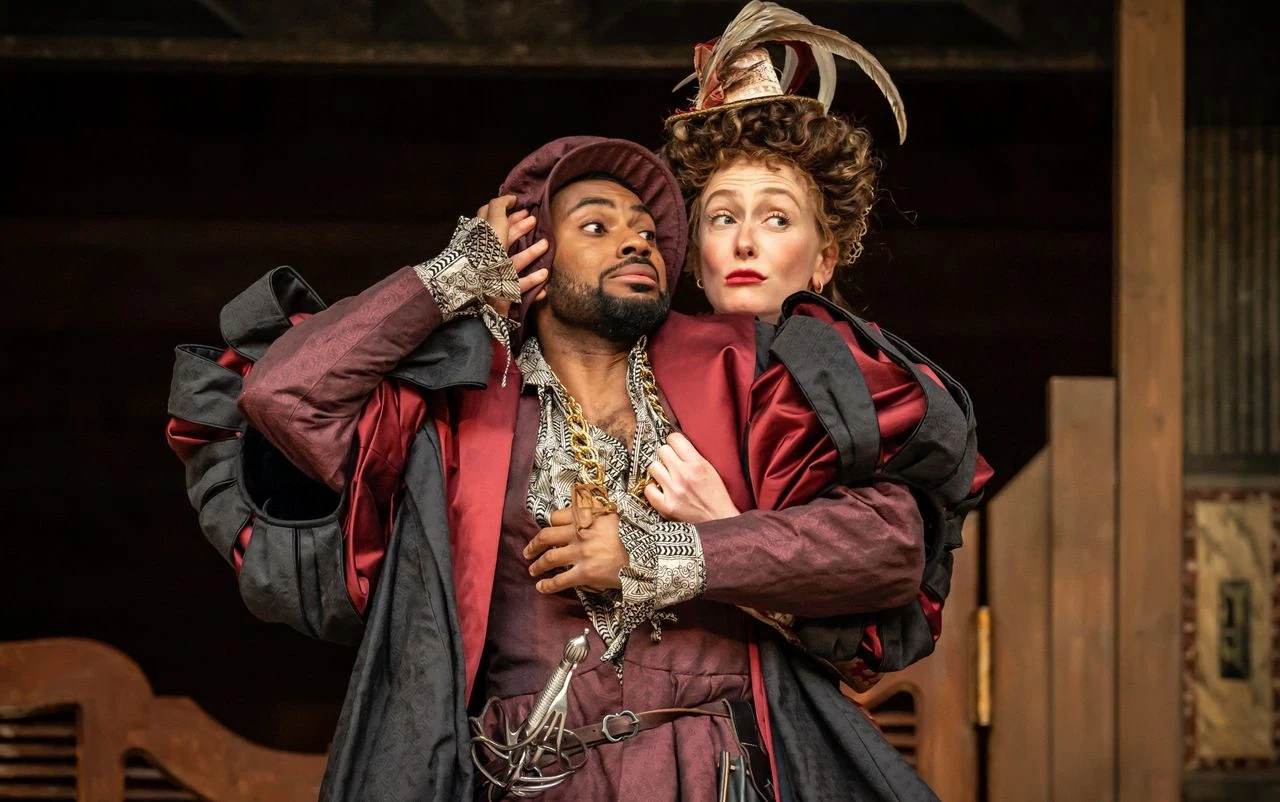
In The Comedy of Errors, one man is arrested for a chain he never received, another is mistaken for a husband who has locked his wife out, and two servants are repeatedly blamed for each other’s actions. Shakespeare builds the confusion around two pairs of identical twins, separated in a shipwreck and brought together again in Ephesus. Mistaken identity drives the action; slapstick, puns and wordplay propel it towards recognition and reunion.
A plot built on doubling
The action begins with Aegeon, a merchant from Syracuse, facing execution in Ephesus because a law forbids merchants from his city to enter. He tells the Duke of Ephesus how a tempest separated his family. Aegeon and his wife, Emilia, escaped in different boats, each taking one of their infant twin sons and one of a second pair of twins bought to serve the boys. Years later, Aegeon’s son Antipholus of Syracuse set out with his servant, Dromio of Syracuse, to find the brothers they had lost. Aegeon followed in search of them.
On the day the play unfolds, the Syracusan Antipholus and Dromio arrive in Ephesus, where their twins live. Neither pair recognises the other. Dromio of Ephesus mistakes Antipholus of Syracuse for his master and asks him home to dinner; Antipholus thinks the man is playing a joke. Adriana, the wife of Antipholus of Ephesus, then encounters the Syracusan twin and takes him for her husband. Each meeting compounds the error.
The consequences become more serious as well as more absurd. Antipholus of Ephesus is shut out of his home and arrested over a gold chain delivered to his twin. Adriana calls on Doctor Pinch, a conjuring schoolmaster, to deal with what she takes to be madness and demonic possession. Meanwhile, the Syracusan pair suspect witchcraft and try to leave. The confusion ends at a priory, where the twins are recognised. The Abbess reveals that she is Emilia, Aegeon’s long-lost wife; the Duke pardons Aegeon, and the family is reunited.
From Plautus to the Elizabethan stage
Shakespeare adapted the mistaken-twin premise of Plautus’ Roman comedy Menaechmi. His version increases the confusion by giving the twin Antipholuses a second pair of twin servants, the Dromios. Identity becomes a source of theatrical uncertainty: characters trust the names and relationships they know, but other people repeatedly see someone else.
The date of composition is uncertain. A topical reference in the play has been taken to place it between 1589 and 1595; one scholarly argument favours the latter part of 1594. The earliest recorded performance took place at Gray’s Inn Hall on 28 December 1594, during the inn’s revels. A second recorded performance followed at court on 28 December 1604. These are performance dates, not proof of when Shakespeare wrote the play. It was not published until the First Folio of 1623.
Among Shakespeare’s earliest works, the play is also his shortest. Its humour depends on the physical consequences of confusion as much as on verbal wit: servants are beaten, a husband is denied entry to his house, and mistaken identities prompt accusations of theft, infidelity and madness. Ephesus is the setting for these events, not a portrait of Shakespeare’s contemporary Britain. The play’s British cultural history lies in its authorship, language and continuing place in performance.
Centuries of adaptation
The play’s stage history includes extensive rewriting, particularly from the eighteenth century onwards. Thomas Hull’s The Twins, produced at Covent Garden in 1739, was more faithful to Shakespeare than some adaptations. Hull later revised it, adding songs, enlarging the love interest and expanding the recognition scene. John Philip Kemble’s 1780 adaptation caused controversy by casting the Dromios as black-a-moors. The history of adaptation includes choices that invite scrutiny as well as theatrical reinvention.
Other artists carried the story into opera. Stephen Storace’s Gli equivoci, with a libretto by Lorenzo da Ponte, premiered in Vienna in 1786. An operatic version with music by Henry Bishop was staged at Covent Garden in 1819 and revived at Drury Lane in 1824. In 1855, Samuel Phelps revived Shakespeare’s original at Sadler’s Wells. The play’s chain of encounters and recognition could be reshaped for different stages and audiences.
Twentieth-century versions reached musical theatre, film and television. Richard Rodgers and Lorenz Hart’s musical The Boys from Syracuse premiered on Broadway in 1938, later had a West End run, and was adapted as a film in 1940. The Royal Shakespeare Company’s musical, with book and lyrics by Trevor Nunn and music by Guy Woolfenden, was produced in 1976 and transferred to the West End in 1977, where it won the Laurence Olivier Award for best musical. In 1983, Roger Daltrey played both Dromios in a BBC adaptation directed by James Cellan Jones. The film Big Business (1988) reworked the twin premise with female characters played by Bette Midler and Lily Tomlin.
The story’s afterlife extends beyond Britain. Shakespeare’s play has inspired operas, musicals, films and stage versions worldwide. In India, Ishwar Chandra Vidyasagar retold it in the Bengali novel Bhranti Bilash (1869), and Indian films have also drawn on the plot. These works differ in language, form and setting, but share a dramatic structure built on mistaken identity, recognition and reunion.
Why The Comedy of Errors deserves a place in British Legacy
The Comedy of Errors belongs in British Legacy because it is an early work by William Shakespeare, written in Early Modern English and sustained through centuries of British theatre. Its recorded performance at Gray’s Inn in 1594 places it within the documented theatrical life of Elizabethan England. Later British productions and adaptations—from Covent Garden and Drury Lane to Sadler’s Wells and the Royal Shakespeare Company—show successive theatre-makers returning to the play and reshaping it while retaining its central comic device.
Its wider contribution is equally specific. Shakespeare’s doubling of the twins in Plautus’ plot lets one mistaken identity trigger another until the characters’ whole social world seems unstable. That design has proved adaptable across stage comedy, opera, musical theatre, film and television, and has travelled into different languages and cultures, including Bengali literature and Indian cinema. The play’s afterlife demonstrates how a work rooted in English theatrical history can provide material for reinvention elsewhere. Its physical comedy, verbal wit and final family reunion offer a durable example of how tightly organised plotting can engage audiences while leaving room for each production to make the story its own.
Sources
Adapted in part from The Comedy of Errors by Wikipedia contributors, under CC BY-SA 4.0. Text has been edited and combined with the existing article; this adapted text is shared under the same licence. Contributor history.