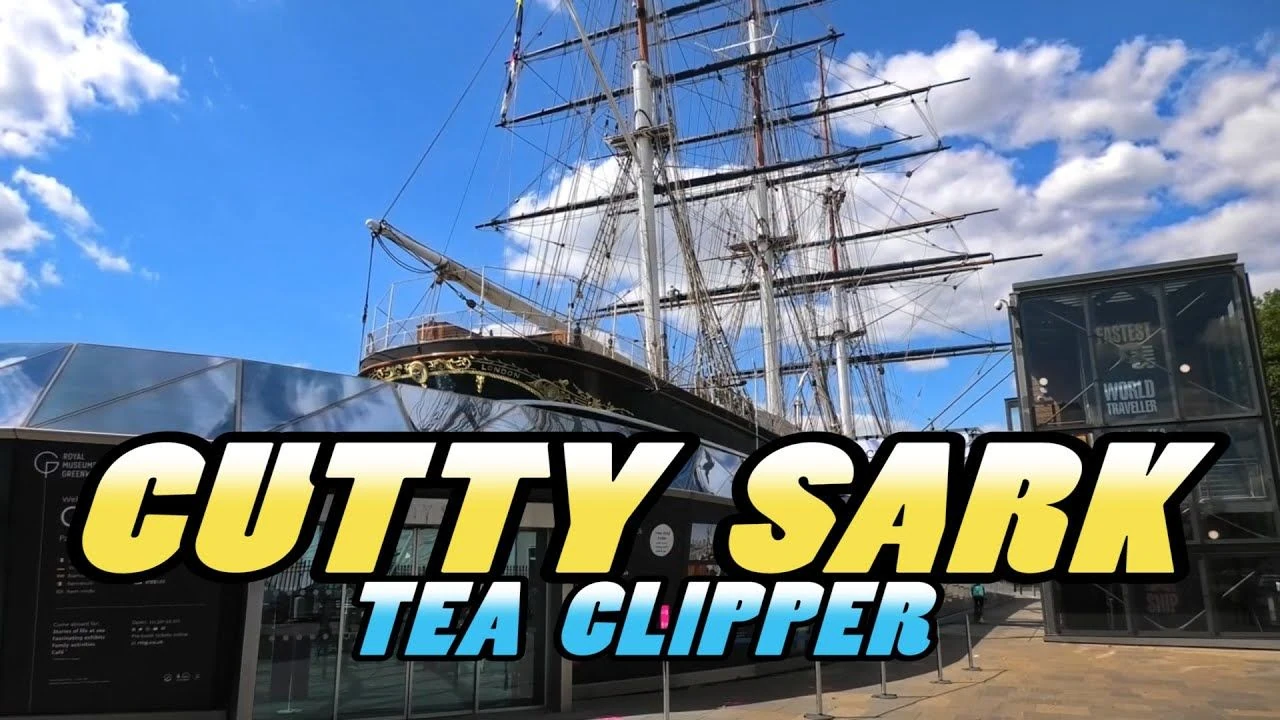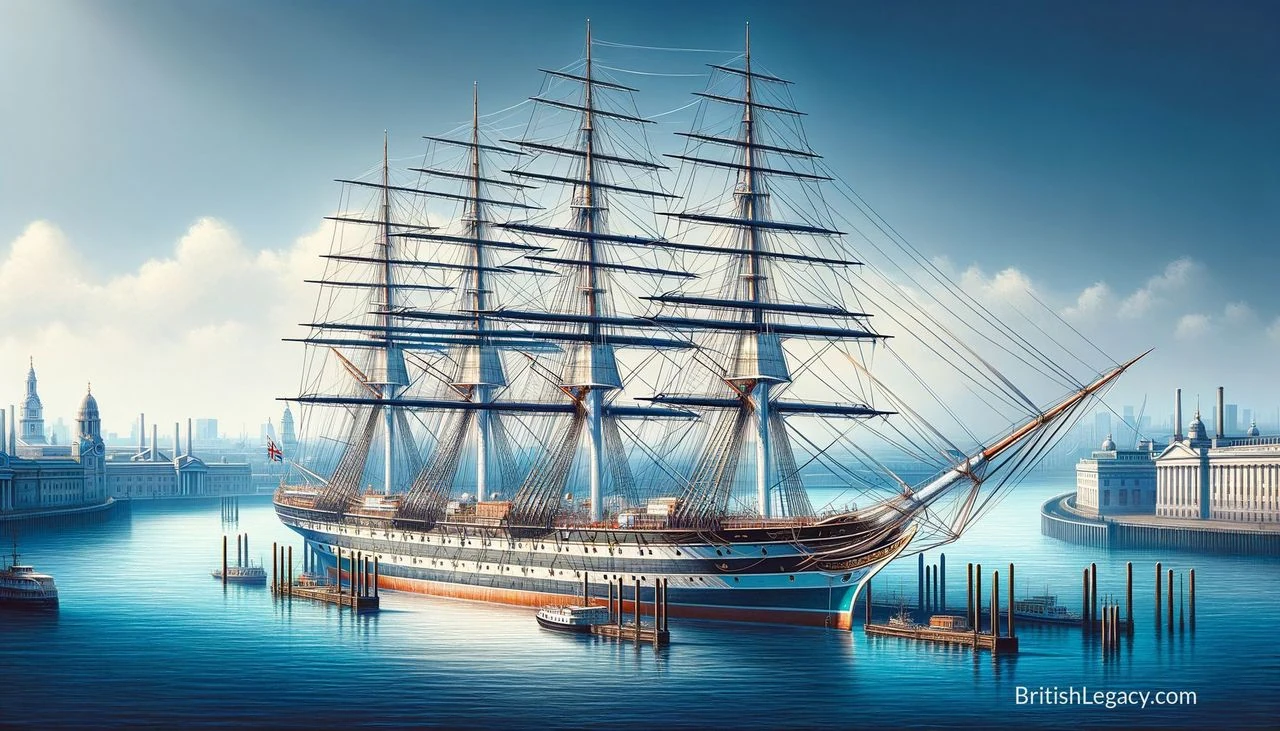
Cutty Sark was built to carry valuable cargo quickly, at a moment when steamships were beginning to change the routes for which sailing clippers had been designed. She did not win every race: in 1872, after losing her rudder in a gale, she reached London a week after her rival Thermopylae. But her speed, long working life and survival as a historic ship made her much more than a failed contender in the tea trade. From Dumbarton to Australia, Portugal and finally Greenwich, her history traces the changing fortunes of sail and the effort to preserve a working vessel as a national landmark.
A ship built for the tea trade
Ship-owner John Willis ordered Cutty Sark from the newly formed firm of Scott & Linton, whose yard stood on the River Leven at Dumbarton. The contract was signed on 1 February 1869. Willis wanted a fast ship to compete for high-value tea cargoes from China, where speed could help secure better freight rates. The design was by Hercules Linton. Construction was interrupted when Scott & Linton ran out of money; William Denny and Brothers took over the contract and completed the vessel. She was launched on 22 November 1869.
The ship’s name comes from Robert Burns’s poem Tam o’ Shanter, first published in 1791. Its witch Nannie Dee wears a cutty-sark: a short shift or chemise in Scots. In the poem, Tam cries “Weel done, Cutty-sark” as she dances. The name linked the witch’s speed with the ambition for the ship. Her figurehead represented Nannie Dee holding the tail of Tam’s horse, while a motto on the stern played on the name of her owner: “Where there’s a will is a way”.
Cutty Sark entered service on 16 February 1870, sailing from London to Shanghai under Captain George Moodie. She returned with more than 1.3 million pounds of tea. She made eight tea-season voyages, but the commercial conditions were already shifting. The Suez Canal opened to shipping in 1869, offering steamships a shorter route to Europe, and improvements to steam engines made them more efficient. Sailing ships still had to round the Cape of Good Hope, and their passage times were less predictable. Cutty Sark was one of the last tea clippers built, arriving as the trade that had justified her design was changing.
Speed, storms and the wool runs
Her best-known contest came in 1872, when she left Shanghai alongside Thermopylae. Cutty Sark had built a lead, but a gale after the Sunda Strait carried away her rudder. Captain Moodie rejected a call to stop at Cape Town for repairs. Ship’s carpenter Henry Henderson made a replacement from spare timber and iron, a task that took six days in difficult weather. Cutty Sark reached London on 18 October, seven days after Thermopylae. Henderson received a £50 bonus for his work. The episode demonstrated the crew’s resourcefulness, but it also contradicts the claim that Cutty Sark never lost a race.
The tea seasons ended as steamships took more of the trade. Cutty Sark carried other cargoes, including coal, jute and castor oil, before beginning a more successful phase as a wool carrier. In December 1883 she sailed from Newcastle, New South Wales, with 4,289 bales of wool and 12 casks of tallow, reaching London in about 83 days. The passage was 25 days faster than her nearest rival that year. In 1885 Captain Richard Woodget took command. He made use of the strong winds of the Roaring Forties on a southerly route, despite its hazards, and the ship became the fastest vessel in the wool trade for a decade. Her recorded maximum speed was 17.5 knots.
There were dangers as well as records. In November 1877, while anchored off Deal with dozens of other vessels during a storm, Cutty Sark’s anchor failed. She was blown among nearby ships, damaging two, and grounded on a mud bank before a tug pulled her clear. In 1880, a seaman was killed by the first mate, who was allowed to leave the ship; the crew then stopped work in protest. The captain later died at sea, and a subsequent master’s mismanagement left the crew short of provisions. An inquiry in New York in 1882 led to the captain and mate being suspended. These incidents belong to the ship’s working history as surely as its celebrated fast passages do.
Under Portuguese colours and back in Britain
Steamships eventually came to dominate the wool trade too. In 1895 Willis sold Cutty Sark to the Portuguese firm Joaquim Antunes Ferreira & Co. for £1,250, and she was renamed Ferreira. She continued as a cargo ship on routes connecting Portugal with places including Brazil, New Orleans, Mozambique, Angola and Britain. In 1916, after being dismasted in bad weather off the Cape of Good Hope, she was re-rigged as a barquentine because suitable replacement materials were difficult to obtain during the First World War.
In 1922 retired merchant navy captain Wilfred Dowman bought the vessel and brought her back to Britain. Restored to an approximation of her earlier rig, she served as a training ship at Falmouth. After Dowman’s death, his widow, Catharine, gave the ship and money for its maintenance to the Thames Nautical Training College. Cutty Sark moved to Greenhithe in 1938, where she was used as an auxiliary cadet training ship alongside HMS Worcester. By 1950 she was surplus to requirements. Following a temporary move connected with the Festival of Britain, she was transferred to the Cutty Sark Preservation Society in 1953.
Preservation in Greenwich
In 1954 Cutty Sark was moved into a purpose-built dry dock at Greenwich for permanent public display. The work prepared the ship for exhibition, and the vessel became a museum ship. She is now part of the National Historic Fleet and is listed as a Grade I monument. Her location near the National Maritime Museum and Greenwich Park makes her a prominent part of the area’s maritime landscape.
Preserving the ship has required difficult choices about how to support and display an ageing structure. By the early 2000s, corrosion affected the internal iron framework, while the hull was distorting under the way its weight was supported. A conservation project was planned to strengthen the structure and treat the framework. On 21 May 2007, a fire broke out while the ship was closed and partly dismantled for this work. Much of the timber had already been removed, limiting the loss of original fabric. An investigation concluded that the fire was accidental and most likely began when an industrial vacuum cleaner failed while left running. The ship was restored and reopened to the public on 25 April 2012.
A further fire broke out on 19 October 2014, damaging part of the deck and hull timbers. The fire was contained and the ship reopened shortly afterwards. Conservation also changed how visitors experience the vessel: the restoration included new supports and visitor spaces, including a gallery beneath the hull. The work prompted disagreement about how far modern access and display should alter a historic ship. That tension is central to Cutty Sark’s present life: the task is not simply to keep a famous outline visible, but to care for its structure while helping visitors understand the vessel that worked at sea.
Why Cutty Sark deserves a place in British Legacy
Cutty Sark deserves a place in British Legacy because her history makes the transformation of British maritime trade tangible. Built in Scotland for a London shipping line, she was designed for the China tea trade just as steam technology and the Suez Canal were undermining the commercial advantage of sail. Her later speed in the Australian wool trade shows how a sailing ship could adapt to new work, while the lost race against Thermopylae and the dangers of her working life keep the story grounded in fact rather than legend. Her career also crossed national boundaries: sold to Portugal, renamed Ferreira and used on international cargo routes, she was later brought back to Britain as a training ship.
Her preservation in Greenwich extends that history beyond the vessel’s working years. The dry dock, museum and continuing conservation work give the public a way to encounter the scale and construction of a nineteenth-century clipper rather than treating maritime history as an abstraction. The fires of 2007 and 2014, followed by restoration, show how vulnerable historic structures can be and how preservation can involve difficult decisions about original material, engineering and public access. Cutty Sark’s British significance therefore rests on more than speed or national symbolism: it lies in the ship’s documented working life, its survival through changing uses, and the ongoing effort to preserve a substantial piece of maritime history for future visitors.
Sources
Cutty Sark (revision 1377611841)
Adapted in part from Cutty Sark by Wikipedia contributors, under CC BY-SA 4.0. Text has been edited and combined with the existing article; this adapted text is shared under the same licence. Contributor history.