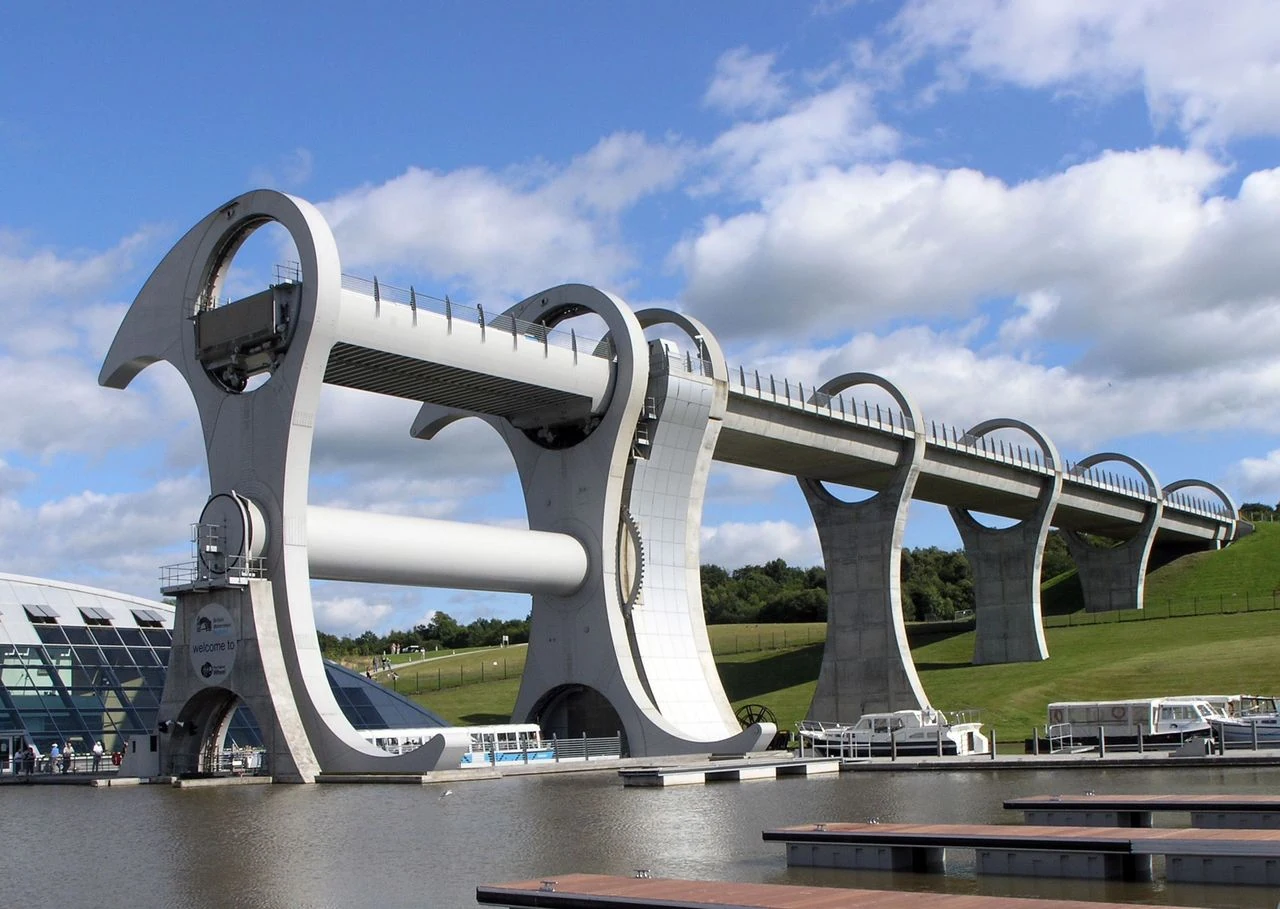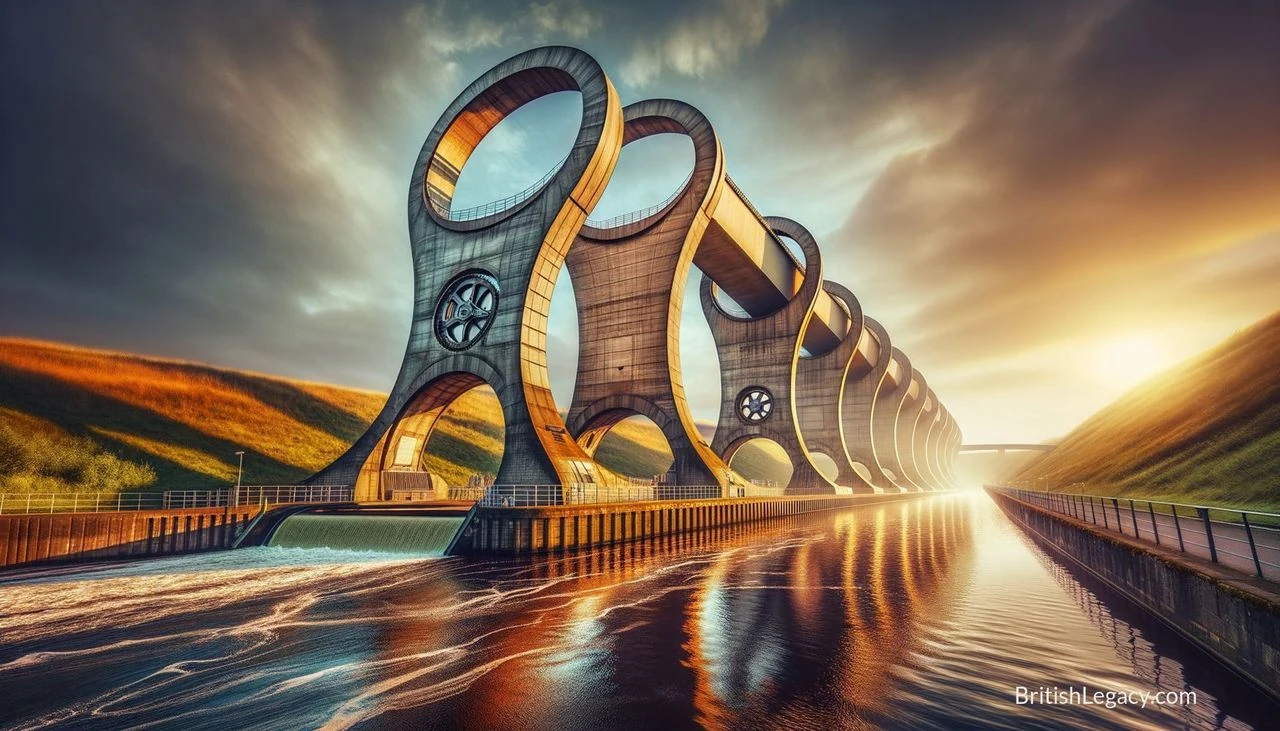
At Falkirk, a boat can rise 24 metres in a turning structure whose two water-filled caissons remain level as the wheel rotates. The Falkirk Wheel links the Forth and Clyde Canal with the Union Canal, restoring a navigable connection between Scotland’s east and west. Opened by Queen Elizabeth II in 2002, it combines a practical transport function with a distinctive piece of modern engineering.
A canal link lost and restored
The two canals were once joined by a flight of 11 locks. The 35-metre change in height made the passage slow and demanding: a journey through the locks took most of a day and required 3,500 tonnes of water per run. By the 1930s the locks had fallen into disuse and were dismantled in 1933. The Forth and Clyde Canal later closed, while the Union Canal was obstructed and, in places, filled in or carried through culverts and pipes.
Restoring the link meant more than constructing a lift. The Millennium Link project set out to reopen the canals to navigation and reconnect Glasgow and Edinburgh by water. British Waterways led the plan with support from local authorities and other partners. In 1997, the Millennium Commission committed £32 million towards a project then budgeted at £78 million; other contributions included funding from British Waterways, seven local councils, Scottish Enterprise, private donors and the European Regional Development Fund.
Rather than rebuild the original lock flight, the project chose a new landmark structure. The decision gave the restored waterway a working connection that also made the engineering itself visible. The Wheel was one part of a wider programme of canal works, including aqueducts, locks, bridges and tunnels.
Designing a wheel to carry boats
The final design emerged from a joint effort by British Waterways, architects RMJM, engineering consultants Arup and Butterley Engineering. An initial proposal, submitted by the Morrison–Bachy Soletanche Joint Venture Team in 1999, used four gondolas in a Ferris-wheel arrangement. It was considered functional but not the striking centrepiece the project sought. British Waterways assembled a team of architects and engineers, led by RMJM architect Tony Kettle, to develop a new concept. The final design took shape in a concentrated three-week period in the summer of 1999.
The Wheel’s silhouette has been associated with a double-headed Celtic axe, a ship’s propeller and a whale’s ribcage. Its overall diameter is 35 metres. Two opposing sets of arms extend from a central axle and carry a pair of water-filled caissons, each 21.3 metres long and able to hold up to four canal boats. The structure was designed for a working life of at least 120 years.
Construction began in March 1999. The wheel was assembled at Butterley Engineering’s plant in Ripley, Derbyshire, then dismantled and transported to Falkirk in 35 lorry loads. There it was reassembled in five sections and lifted into place. More than 1,000 people were employed in its construction. The wider project involved substantial excavation, a canal tunnel, aqueducts, three sets of locks and bridges.
How the lift works
Each caisson holds water, and their combined load is balanced. When a boat floats into one, it displaces water equal to its own weight. The water displaced by the boat therefore keeps the caisson’s total weight effectively unchanged, whether the boat is present or not. This application of Archimedes’ principle means that the Wheel does not need to lift one side against a heavier load.
Ten hydraulic motors turn the axle, using 22.5 kilowatts of power. A turn through half a revolution consumes about 1.5 kilowatt-hours. Gears keep the caissons level as the arms move: a system of interlocking gears makes each gondola turn in the opposite direction to the arms’ rotation. The lift itself raises or lowers a boat by 24 metres. The Union Canal lies another 11 metres above the aqueduct, so boats travelling between the canals also pass through two locks.
Moving boats between the Wheel and the waterways requires more than rotation. Watertight doors and locking mechanisms secure the caissons when the wheel is stationary. At the upper connection, a seal closes the gap between the caisson and aqueduct; water is brought to the same level before the doors open for passage. At the lower end, a dry docking pit allows boats to enter and leave without flooding the space beneath the wheel. These arrangements help make the sculptural outline a functioning piece of canal infrastructure.
Opening, use and public interest
Queen Elizabeth II opened the Wheel on 24 May 2002 during her Golden Jubilee celebrations. The ceremony had been delayed by a month after vandals opened the gates and flooded the structure in April. The incident damaged electrical and hydraulic equipment and cost £350,000 to repair.
The Wheel’s visitor centre stands beside the lower basin, where boat trips depart at roughly hourly intervals. Figures reported for the site record around 5.5 million visitors since it opened, including 1.3 million people who took a boat trip; annual visits were estimated at about 400,000. Those totals point to the attraction’s public reach, while the canal connection remains its central purpose.
The design has also entered Scotland’s wider visual record. Models and renderings appeared in a 2012 exhibition at the Victoria and Albert Museum in London. Since 2007, the Wheel has featured on the obverse of a Bank of Scotland £50 note series depicting Scottish engineering achievements. Its presence on the notes places a contemporary transport project alongside other works associated with the country’s engineering history.
Why the Falkirk Wheel deserves a place in British Legacy
The Falkirk Wheel deserves a place in British Legacy because it joins a specific public purpose to an inventive engineering solution. Its construction restored a canal link lost after the old lock flight fell into disuse, reconnecting waterways between the east and west of Scotland. Instead of reproducing the slow passage of 11 locks, the project created a lift that raises boats 24 metres in a half-turn. Its balanced caissons, gearing and hydraulic drive make that movement possible without treating the wheel as a static monument: it is infrastructure that carries boats.
Its story also reflects the scale of collaboration behind public works. British Waterways led a project supported by public bodies and other funders; architects, engineering consultants and manufacturers shaped the design and built it. The wheel itself was assembled in Derbyshire before being transported to Falkirk, while the larger canal restoration required tunnels, aqueducts, locks and bridges. Visitors and the Wheel’s appearance on Scottish banknotes show how the project has become visible beyond its immediate function. Its legacy is not a generic claim about national ingenuity, but an identifiable achievement: restoring a waterway connection through a working structure whose mechanism remains part of the experience.
Sources
Falkirk Wheel — Wikipedia, revision 1375258193
Adapted in part from Falkirk Wheel by Wikipedia contributors, under CC BY-SA 4.0. Text has been edited and combined with the existing article; this adapted text is shared under the same licence. Contributor history.