In Jez Butterworth’s The Ferryman, harvest day brings work, noise and a crowded household together on a farm in County Armagh. But the family’s routines cannot keep history outside. Set in 1981, the play follows a former IRA volunteer and his relatives as the discovery of the remains of a man who disappeared ten years earlier brings the past into the present. First staged at the Royal Court Theatre in London in 2017, the drama travelled to the West End and Broadway, where its production won major British and American theatre awards.
A household under pressure
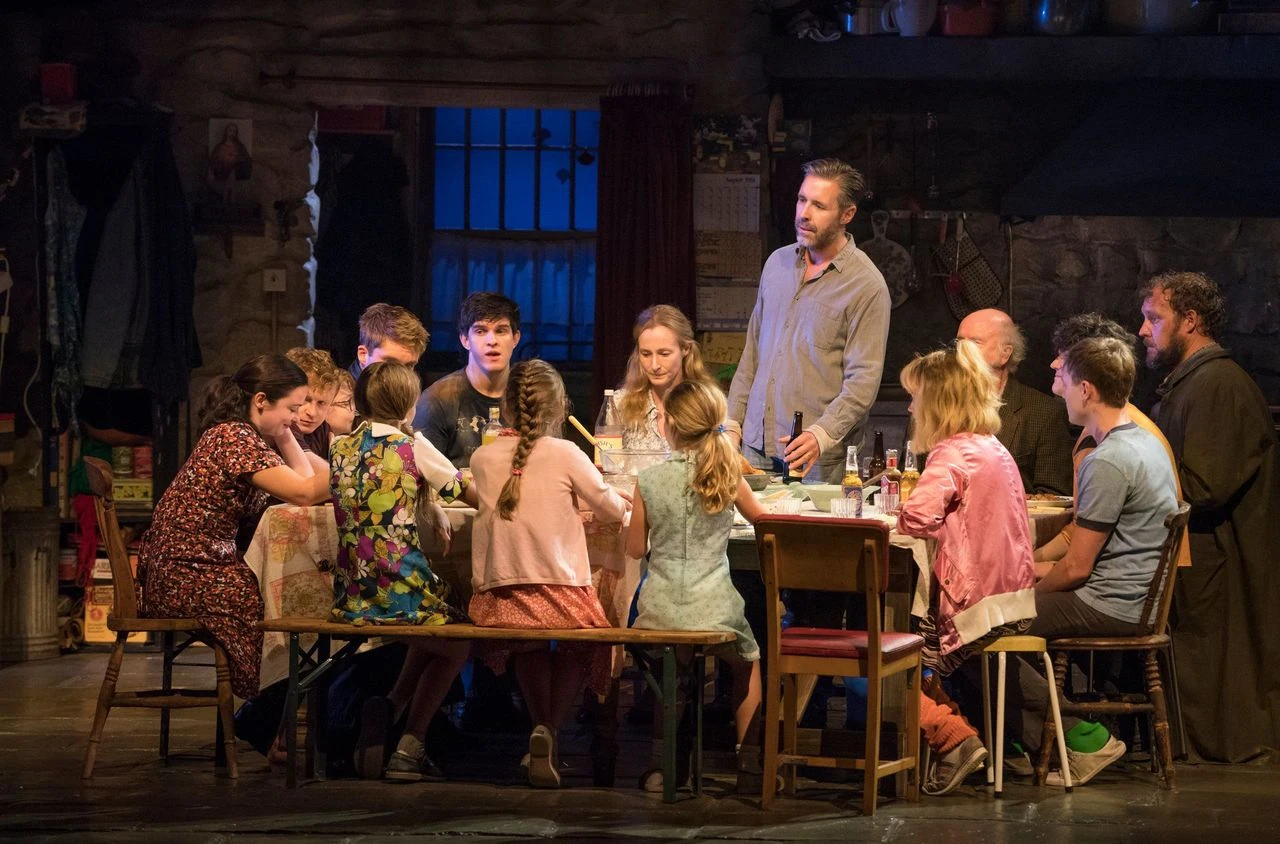
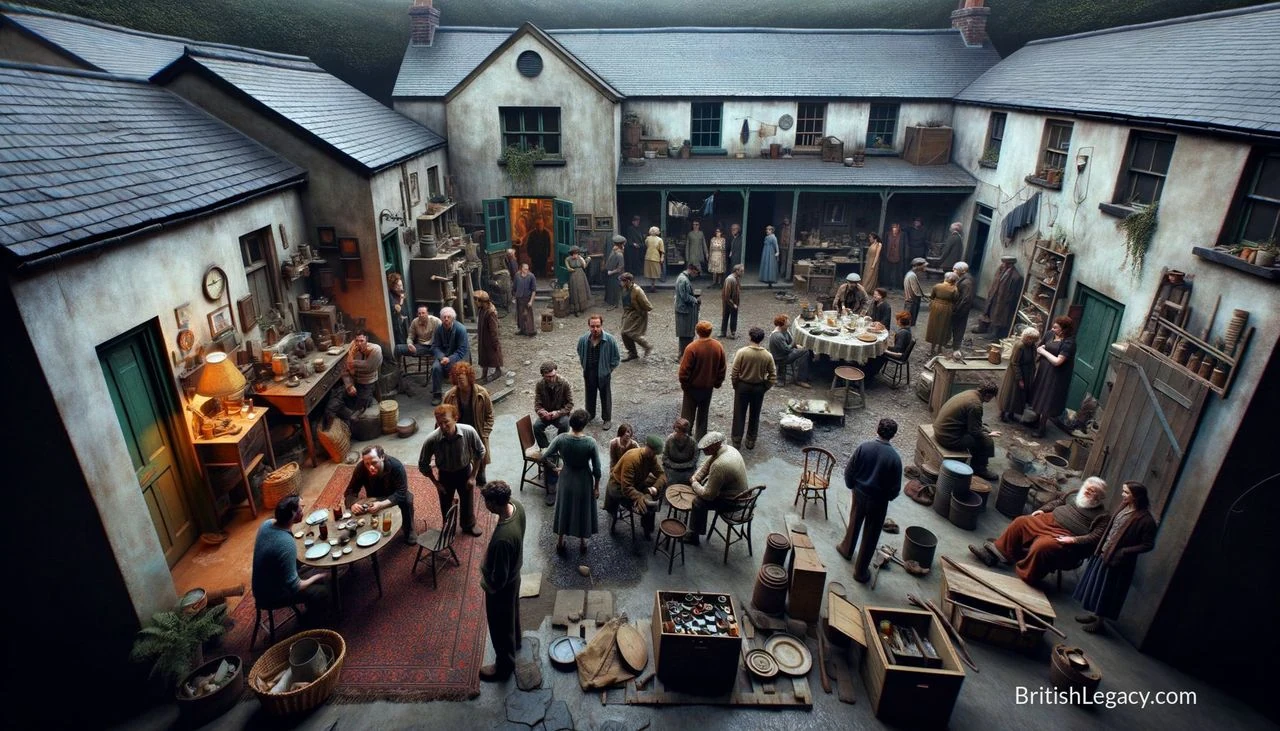
The play is set in a farmhouse in rural County Armagh during the Troubles. Its central family is multi-generational: Quinn and Mary Carney live with their seven children, alongside Uncle Pat, Aunt Mary, Aunt Pat, Quinn’s sister-in-law Caitlin and her son Oisin. The harvest gives the household a shared task and a framework for the day. It also places many generations and competing needs under one roof.
Caitlin’s husband disappeared in 1971. A decade later, his remains have been uncovered at a politically sensitive moment for the Republican Movement. That discovery alters the meaning of an ordinary working day. The family must reckon not only with private loss, but with the political circumstances surrounding the disappearance and its aftermath.
Quinn’s past as an IRA volunteer makes the family’s predicament part of a wider conflict, while the play keeps its focus on domestic life. Its tensions emerge among relatives who share a home, a farm and a history, rather than in an abstract account of political events. Family loyalty, secrecy and the consequences of choices made years earlier meet in the same confined space.
From the Royal Court to the West End
The Ferryman had its world premiere at the Royal Court Theatre on 24 April 2017, in a production directed by Sam Mendes. It ran there until 20 May and became the fastest-selling play in the theatre’s history. The original cast included Paddy Considine as Quinn, Laura Donnelly as Caitlin and Genevieve O’Reilly as Mary, alongside Bríd Brennan, Fra Fee, John Hodgkinson and Stuart Graham.
The production transferred to the Gielgud Theatre, opening on 29 June 2017 after previews began on 20 June. It remained in the West End until 19 May 2018. The cast changed during that run: among the performers who took on leading roles were William Houston and Owen McDonnell as Quinn, and Sarah Greene and Rosalie Craig as Caitlin. Those changes were part of a substantial London run, not a single fixed cast performance.
The play’s awards recognised work across the production. In 2017 it won Evening Standard Theatre Awards for Best Play and Best Director, and a Critics’ Circle Theatre Award for Best New Play. At the 2018 Laurence Olivier Awards it won Best New Play, Best Actress for Donnelly and Best Director for Mendes. The production also received WhatsOnStage awards, including Best New Play and Best Director.
Broadway and a widening audience
In 2018, the production crossed the Atlantic to the Bernard B. Jacobs Theatre in New York, where previews began on 2 October. It closed on 7 July 2019. The Broadway run brought further recognition: the play won the 2019 Tony Award for Best Play, while Mendes won for direction and Rob Howell for scenic design. The production also received awards from the Drama Desk, Drama League, New York Drama Critics’ Circle and Outer Critics Circle.
The journey from the Royal Court to Broadway shows how a drama rooted in one rural setting could reach theatre audiences on both sides of the Atlantic without leaving that setting behind. The farmhouse remains the play’s central world: harvest, family relationships and the consequences of a disappearance frame its account of political history. Its international success belongs to the production’s documented story, but the scale of its subject remains intimate.
Private loss and public history
The play’s starting point has a connection to Donnelly’s family. The disappearance of her uncle, Eugene Simons, during the Troubles inspired Butterworth’s plot. That relationship between a real family experience and a fictional drama helps explain why the disappearance is not merely background. The absence shapes the living family’s present, and the discovery of remains carries emotional as well as political weight.
The Ferryman does not present the Troubles as a distant backdrop to a self-contained family story. Instead, the conflict bears on the family’s everyday life and on the meaning of what has happened to Caitlin’s husband. By placing its characters within an ordinary working day, the play brings public events into close contact with relationships, responsibilities and loss.
Why The Ferryman deserves a place in British Legacy
The Ferryman merits a place in British Legacy because its history is tied to a significant British theatrical production and because its subject gives that achievement substance. The play opened at London’s Royal Court in 2017, became the theatre’s fastest-selling play, transferred to the West End and then reached Broadway. Its awards included the Laurence Olivier Award for Best New Play and the Tony Award for Best Play. Those milestones document the reach of the work and the recognition it received, while its cast and creative team show how much of that achievement was shared across performance and design.
Its value is not simply that it travelled successfully. Butterworth makes a family home the place where the Troubles’ political pressures and private consequences meet. The inspiration in Donnelly’s family history connects the drama to the experience of disappearance, while the harvest-day setting keeps attention on the people who must live with its aftermath. The result offers audiences a way to encounter contested history through relationships and daily obligations, rather than through general statements alone. In that combination of British stagecraft, a specific historical setting and close attention to family life, The Ferryman has a clear and lasting place in the story of contemporary British theatre.
Sources
The Ferryman (play), revision 1364307466
Adapted in part from The Ferryman (play) by Wikipedia contributors, under CC BY-SA 4.0. Text has been edited and combined with the existing article; this adapted text is shared under the same licence. Contributor history.