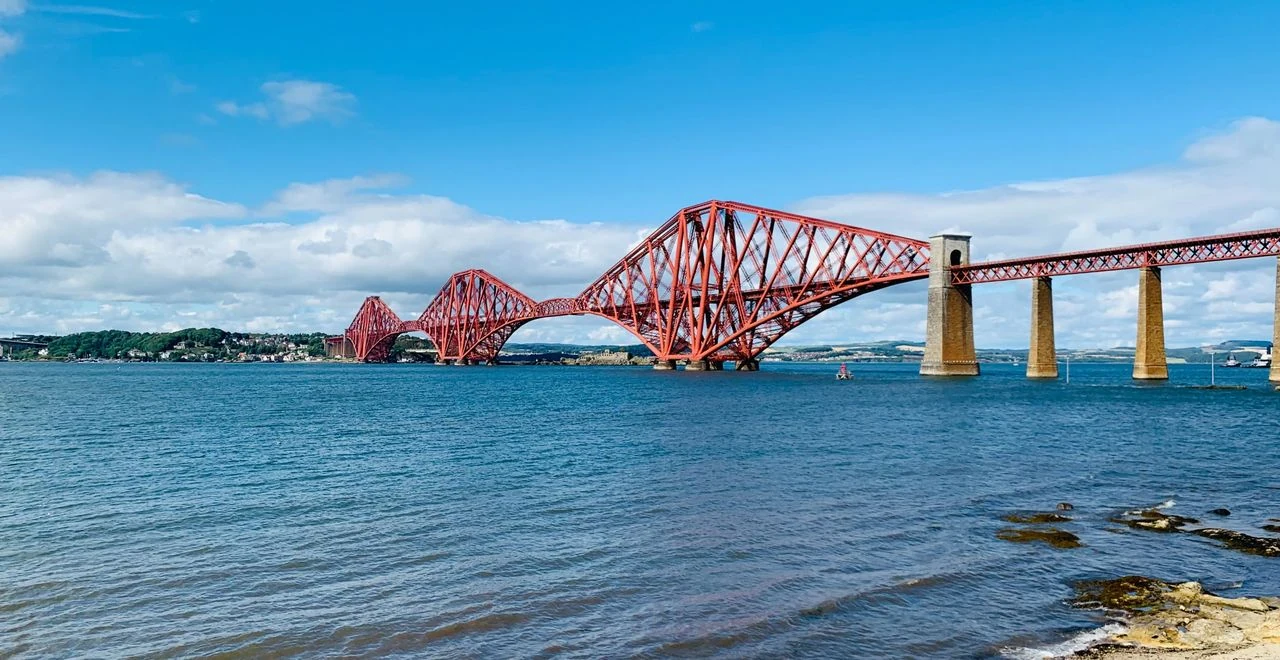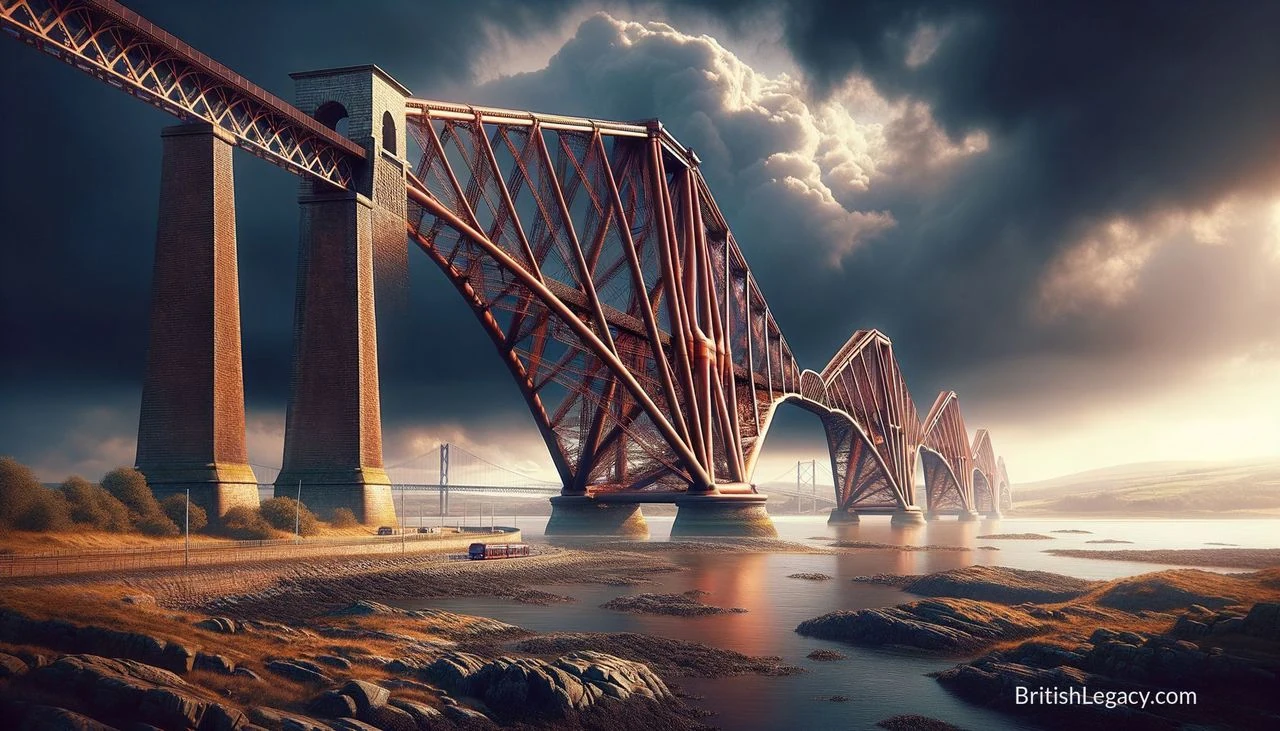
Across the Firth of Forth, the bridge’s three great cantilever structures turn a difficult railway crossing into a striking piece of engineering. The Forth Bridge links South Queensferry and North Queensferry, carrying rail traffic between Edinburgh and Fife. Opened in 1890, it was built in steel at a time when confidence in bridge design had been shaken by disaster. Its size and visible structure made it a landmark; its continuing railway use and careful maintenance have kept it part of everyday infrastructure as well as Scotland’s industrial heritage.
A crossing shaped by earlier failures
Before the bridge, travellers crossed the Forth by ferry. Railway companies wanted a direct route between Edinburgh and Fife, avoiding a lengthy journey west or the ferry connection at Queensferry. Several schemes were considered. Engineer Thomas Bouch proposed a bridge, and work on an earlier project began in 1878. That plan was abandoned after the Tay Bridge collapsed in 1879. The public inquiry found serious failings in the Tay Bridge’s design, construction and maintenance, and identified Bouch as mainly responsible for defects in its construction and maintenance and entirely responsible for its design. The disaster also brought stricter expectations for the wind loads bridges had to withstand.
Bouch’s Forth design was formally abandoned in January 1881. Sir John Fowler and Sir Benjamin Baker were invited to develop a replacement. Their design used the cantilever principle: projecting arms carry a lighter central girder, with forces managed through tension and compression. The bridge’s three principal structures, each formed by four towers, gave the crossing its distinctive outline. It was not simply a bold shape; it was a response to the structural demands of a railway bridge over a wide, tidal estuary.
Steel and a new scale of construction
Construction began in 1882, and the bridge was completed in December 1889. It opened on 4 March 1890. At 2,467 metres long, it crosses the Firth between South Queensferry and North Queensferry, with its double railway track raised above the water at high tide. Its two main spans are each about 518 metres long. When it opened, it had the world’s longest single cantilever span; the Quebec Bridge surpassed it in 1919. The Forth Bridge remains notable for its two cantilever spans of about 521 metres.
It was the first major structure in Britain built of steel. Steel production had made large quantities of the material available, and the bridge brought that development into a project on a scale that made its use unmistakable. Steel came from works in Wales and Scotland, including Siemens’ works at Landore, the Steel Company of Scotland near Glasgow and Dalzell’s Iron and Steel Works in Motherwell. The construction also used granite and extensive masonry. More than six million rivets joined the steelwork, while the completed superstructure weighed over 50,000 long tons.
The work demanded engineering on and around the water as well as high above it. The three cantilever structures rest on granite piers, with foundations made using caissons and cofferdams to deal with differing riverbed conditions. Some caissons were sunk using compressed air so that workers could excavate in dry conditions below the waterline. Approach viaducts were built in sections and raised as the masonry supports advanced. Steel parts were prepared on shore, then moved into position for assembly and riveting. The bridge’s achievement lay not only in its final profile but in solving a sequence of practical problems at several locations across the estuary.
Opening the railway route
Before the first public crossing, the completed bridge underwent a substantial load test. On 21 January 1890, two trains, each made up of three heavy locomotives and 50 coal wagons, were driven towards the middle of the north cantilever. Together they weighed 1,880 tons, more than twice the bridge’s design load. Engineers measured the deflection as the trains moved, and the recorded response was as expected. The first complete crossing followed on 24 February, when a train carrying railway company chairmen made several journeys over the bridge.
At the official opening on 4 March, the Duke of Rothesay, later Edward VII, drove home the final rivet, which was gold-plated and inscribed. The bridge created a direct rail link across the Forth and formed part of the Edinburgh–Aberdeen route. Its opening helped change the geography of railway travel between the east of Scotland and the south. New connections were needed to make full use of the crossing, and the complete express service did not begin until June 1890.
The project had a human cost. About 4,600 people worked on the bridge at its peak. A figure of 57 deaths was recorded in 1890, while later research identified 73 deaths connected with construction and its immediate aftermath. The accounts explain that totals differed according to whether deaths on the approaches and those occurring after the contractors’ Sick and Accident Club ended were included. That club provided medical treatment and financial assistance to injured workers and support for some bereaved families. The bridge’s scale should not obscure the conditions and risks faced by the people who built it.
Maintaining a working landmark
The Forth Bridge has continued to carry trains, rather than surviving only as a monument to Victorian ambition. Its track and structure have required sustained work. A major programme begun in 2002 removed old paint, repaired exposed steel and applied a new protective coating. The project used an enclosure around the bridge to control conditions while the work was carried out. The familiar saying “painting the Forth Bridge” suggests an endless job, but the bridge was not historically repainted continuously from end to end: weathered areas received attention, and the maintenance regime changed over time.
Network Rail owns the bridge and its associated railway infrastructure. In 2015, UNESCO inscribed it as a World Heritage Site, recognising its place in the history of bridge design and construction during the growth of railway travel. It is also a Category A listed building in Scotland. The bridge’s public presence extends beyond railway engineering: it has appeared in films and television, in Scottish banknotes and in other depictions of the country’s built heritage. These associations draw on the structure’s recognisable form, but its continuing function remains central to its significance.
Why The Forth Bridge deserves a place in British Legacy
The Forth Bridge deserves a place in British Legacy because it shows how engineering responded to a specific national need: creating a reliable railway crossing over the Firth of Forth. Its cantilever design, steel construction and substantial foundations combined to make that crossing possible. The bridge was built after the failure of an earlier scheme and amid new scrutiny of wind loading and structural safety. Its story therefore includes not just technical ambition but the practical consequences of learning from a disaster and designing to meet demanding conditions.
Its legacy is also material and continuing. The bridge remains part of Scotland’s railway network, linking communities and carrying trains across the estuary more than a century after its opening. Its construction drew on steelmaking and engineering in Scotland, Wales and elsewhere in Britain, while its maintenance has required later generations to protect and adapt a working structure. UNESCO recognition acknowledges its wider importance, but the bridge’s clearest value is visible in the combination of use and achievement: a landmark that still performs the task for which it was built. That connection between engineering, public infrastructure and everyday travel makes the Forth Bridge a specific and enduring part of Britain’s industrial history.
Sources
Forth Bridge — Wikipedia, revision 1376175709
Adapted in part from Forth Bridge by Wikipedia contributors, under CC BY-SA 4.0. Text has been edited and combined with the existing article; this adapted text is shared under the same licence. Contributor history.