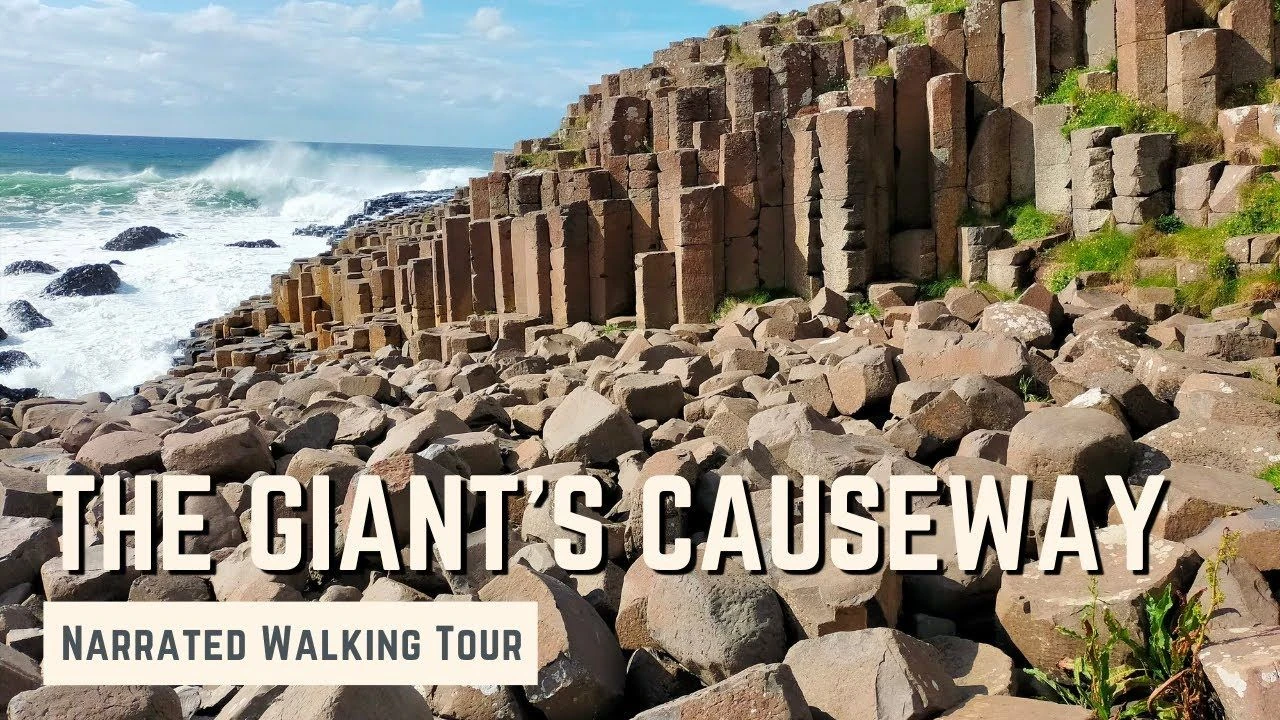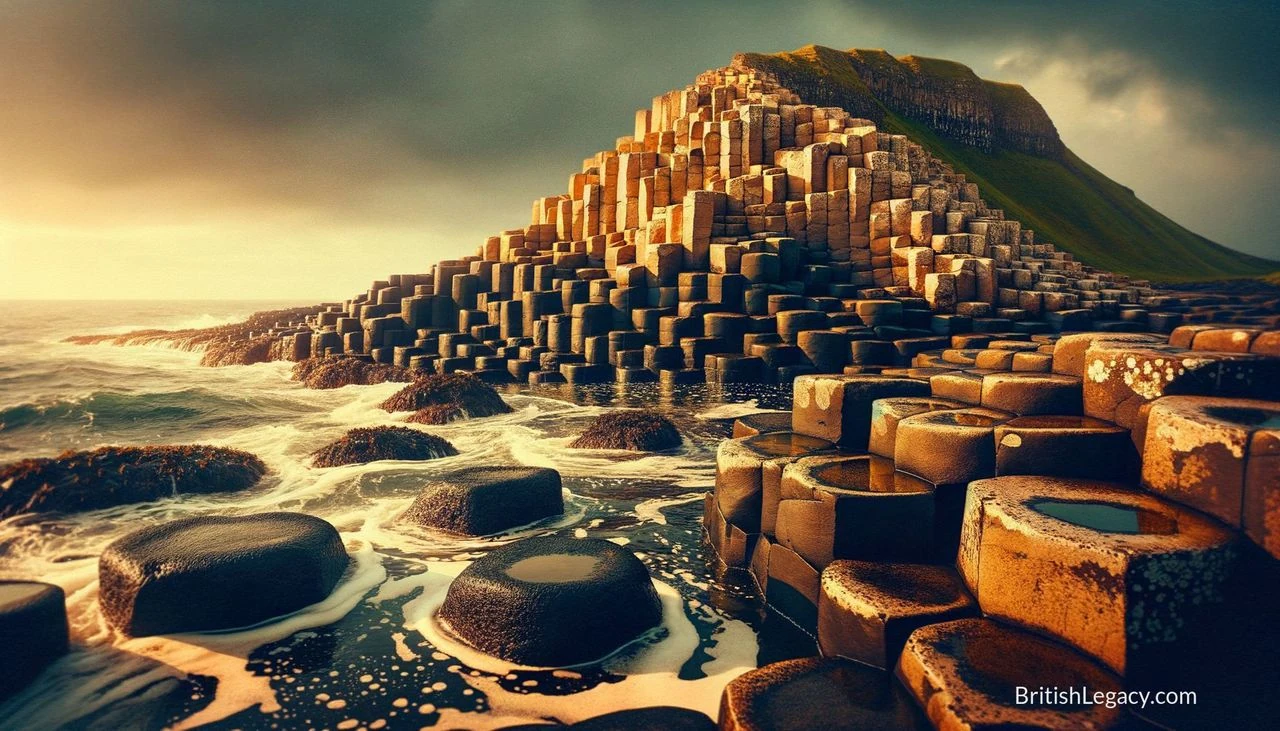
Along the coast of Northern Ireland, the Giant’s Causeway is a striking meeting of geological form and human storytelling. Around 40,000 interlocking basalt columns descend towards the sea, most with six sides, though some have four, five or seven. Their regular shapes can look almost designed; their origin lies in volcanic activity and the cooling and contraction of molten rock.
Columns shaped by volcanic activity
The Causeway’s columns formed around 60 million years ago, during a period of intense volcanic activity. As molten basalt moved through chalk beds and cooled, it contracted into polygonal forms. The resulting rock creates a close-set pattern across the shore: columns stand together in tiers, while others lie beneath the waves. The tallest formations reach about 12 metres.
The arrangement makes the site an unusually accessible place to encounter columnar rock and consider the processes that shape it. Its formations offer insight into volcanic activity and geology, and the Causeway is described in the existing account as a point of comparison for similar geological features elsewhere. Its appeal is not confined to specialists: the columns’ repeated shapes make geological processes visible in the landscape itself.
Finn McCool and the crossing to Scotland
Geology is only one way the Causeway has been understood. Local folklore gives the columns a human-scale origin story, attributing them to the giant Finn McCool. In the tale, Finn builds a bridge across the sea to confront Benandonner, a giant from Scotland.
When Finn sees that Benandonner is much larger than he expected, he retreats. Finn’s wife disguises him as a baby; when Benandonner sees the child, he supposes that its father must be enormous. He flees back to Scotland, destroying the bridge as he goes. The story offers a memorable explanation for a landscape shaped by natural forces, and links the Irish coast to a legendary encounter across the sea.
Recognition, care and public interest
The Giant’s Causeway was designated a UNESCO World Heritage Site in 1986. Its recognition reflects its geological importance, while the place is also associated with Northern Ireland’s folklore and cultural life. The existing account describes the site as attracting hundreds of thousands of visitors annually and contributing to the region’s tourism industry. It also says the columns have inspired works of art, music and literature, though it does not name particular examples.
The National Trust manages the site, with the stated aim of preserving it for future generations while accommodating visitors. That responsibility matters at a landscape whose distinctive features are also its attraction: public access and the protection of the natural formation have to be considered together. The Causeway’s columns also provide a setting for education about earth sciences, bringing geological processes into view for visitors and students.
Why the Giant’s Causeway deserves a place in British Legacy
The Giant’s Causeway deserves a place in British Legacy because its importance is rooted in a specific landscape in Northern Ireland and in features that can be seen directly: thousands of basalt columns formed through volcanic activity, with polygonal sides and heights reaching about 12 metres. Its 1986 designation as a UNESCO World Heritage Site recognises the site’s geological significance. The formation also makes the processes that create columnar rock accessible to a broad public, connecting a dramatic coastal setting with learning about the natural world.
Its legacy also lies in the way geology and folklore meet at the site. The story of Finn McCool and Benandonner gives the crossing between Ireland and Scotland a place in local storytelling, while the Causeway’s management by the National Trust reflects the need to care for a much-visited natural landscape. Together, those elements make the site more than a collection of unusual rocks: it is a recognised geological landmark, a focus for public interest and a place where cultural memory attaches to the physical landscape. That combination gives the Giant’s Causeway a clear and enduring place in the heritage of Northern Ireland and the wider British Isles.